Introducing TensoraAi ($TENSOR)
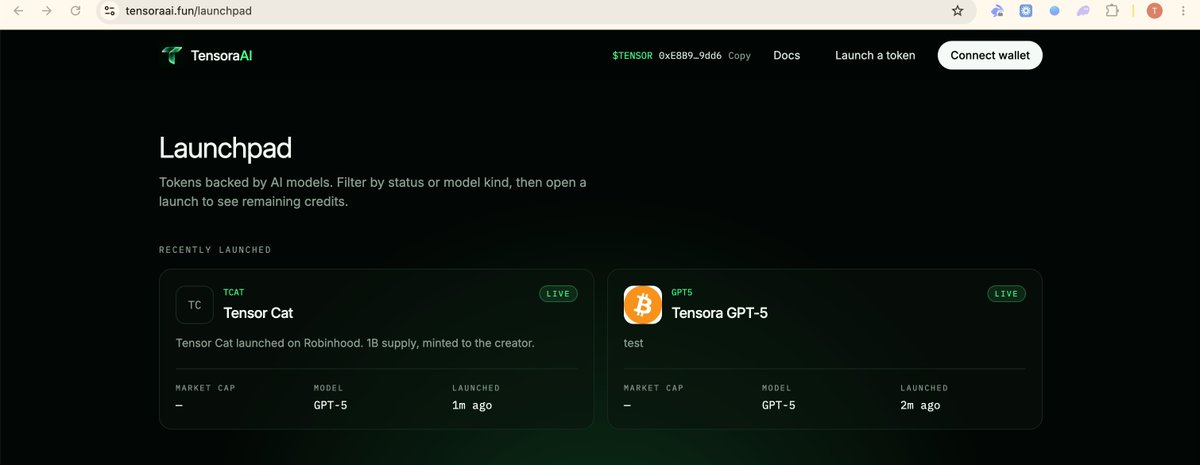
https://t.co/LQc6BRyuAj is a launchpad for tokens backed by AI models, live on Robinhood Chain.
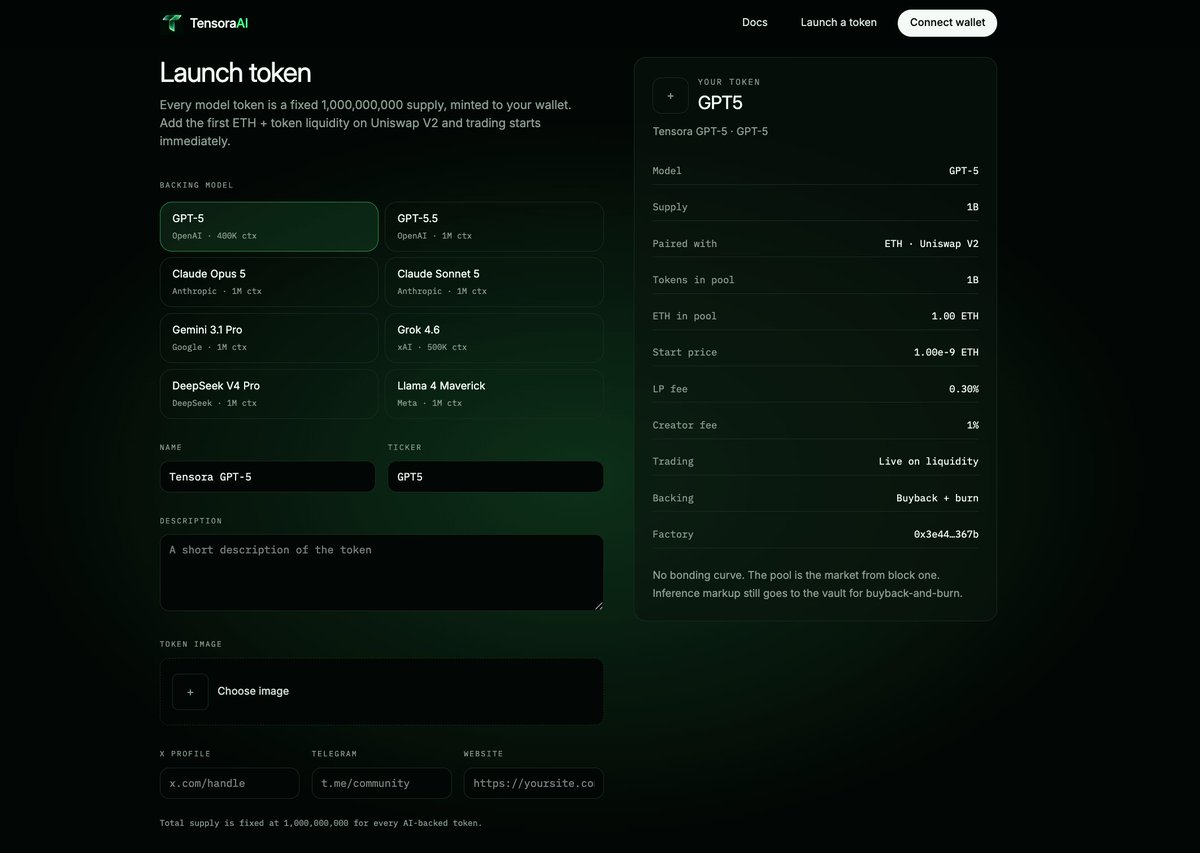
Each launch is one model, one token. You pick an AI model, name it, and the factory deploys a 1 billion supply ERC-20 to your wallet plus a revenue vault. No bonding curve. No graduation. If someone seeds a Uniswap V2 ETH pool, it trades immediately.
The token is a claim on usage, not a company. People run the model. Inference goes through OpenRouter. Cost plus a 20% markup is paid in ETH and lands in that token’s vault. A keeper can buy the token on the open book and burn it. More inference, less supply.
Platform fees - launches, later swaps, protocol share of inference are designed to buy $TENSOR and burn it. Holders are not promised yield. They watch supply shrink when the product is used.
Launch a model. Trade it. Run it. That’s the loop.
0xE8B926607156c3f736256b9f6e30b9AA605a9dd6
Tensora AI launchpad has now crossed $1M in volume across tokens deployed on the launchpad
Launch tokens backed by an AI Model. Each Tensora token is a claim on a living model - its weights, its runs, its revenue. Live on @RobinhoodCrypto Chain.
Tensora AI launchpad has now crossed $1M in volume across tokens deployed on the launchpad
Launch tokens backed by an AI Model. Each Tensora token is a claim on a living model - its weights, its runs, its revenue. Live on @RobinhoodCrypto Chain.
Inference → ETH → buyback
User prompt
→ Tensora infer API
→ OpenRouter (the token’s model id)
→ dollar cost from the provider
→ markup = cost × 2000 bps (20%)
→ markup converted to ETH
→ RevenueVault.deposit{value: markup}
That markup is the only revenue the token is designed to claim. A keeper (or the Pons buyback vault after graduation) spends that ETH on the token. Pre-graduation, Pons can lock bought-back supply into a five-year vest instead of an instant burn. Tensora’s product loop is still: usage raises ETH, ETH retires supply.
No staking. No snapshots. No points.
1. What you hold
A Tensora launch is a 1,000,000,000 supply ERC-20 bound to one OpenRouter model id (openai/gpt-5, anthropic/claude-opus-5, …).
On-chain metadata stores name, ticker, logo, socials, and a Model: line in the description. That id is how inference is routed. The token does not wrap GPU hours and does not entitle you to the model weights.
Cashflow is a single number: inference markup in ETH.
2. Price discovery
Phase 1 — bonding curve. Constant product with a phantom ETH reserve. Quote-leg fee (config 0 is 1%). Optional creator tax on top. Buys and sells hit the curve. Market cap on the launchpad is spot × 1B.
Phase 2 — graduation. After enough real ETH is taken in, anyone can graduate. The curve drains into a full-range Uniswap V4 ETH pool. The position NFT is locked with no withdraw path. A shared hook keeps the same fee split after the pool exists.
There is no oracle. The curve and the later pool both price in ETH.
The tech is fixed.
You can now deploy your own tokens directly on Tensora AI.
Infrastructure is stable, deployment is live, and the launch layer is ready to scale.
Build. Deploy. Launch.
The tech is fixed.
You can now deploy your own tokens directly on Tensora AI.
Infrastructure is stable, deployment is live, and the launch layer is ready to scale.
Build. Deploy. Launch.
We are currently connecting the AI launch server to Pons Launchpad and working on robusting the liquidity pool directly through Pons to ensure everything is properly set up and secure.
Using uniswap v2 hook
Tokens backed by AI models