3/ i want to understand how a team thinks about the things that can go wrong. Looking forward to the next article already, solid work on this @annanay. Maybe challenges on how to keep wallet balances, positions and open orders in sync when updates arrive late or out of order? 🙃
1/ this is the kind of detail that makes me bullish on @QFEX .
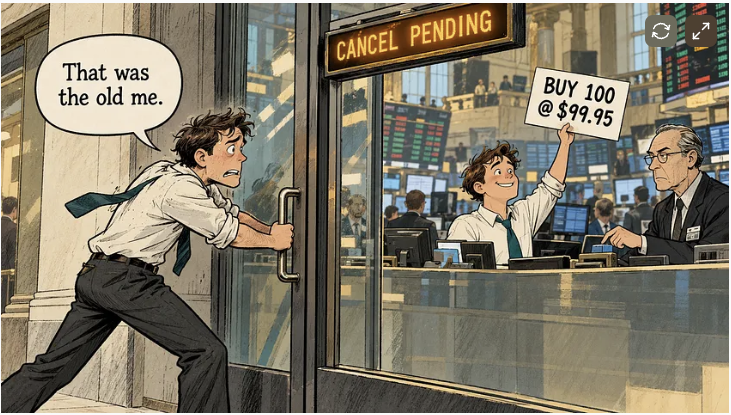
its latest research gets into what a trading engine must remember when orders are waiting for confirmation, cancellations are unresolved, or fills arrive before the expected response.
worth reading 👇 the core idea:
Desired Orders Are Not Live Orders
In the next part of my series on building an HFT system, I talk about order tracking and some of the hidden race conditions that can bring an automated system to its knees. A must read!
https://t.co/hVYVOO4PFc
2/ if an order could still execute, it still counts towards your risk.
get that wrong and a system can place duplicate orders or exceed its limits while thinking everything is fine.
publishing this level of engineering detail is a signal i pay attention to.
My bull case for $YUBICO is: imagine every $TSLA robot having a butt plug. That would be cool. Come trade with me on @QFEX . Use my ref link please: https://t.co/KrvR3KLwL6
4 data leaks reported today:
1. Coinbase's vendor Amplitude exposed some users’ contact data (funds unaffected).
2. Bithumb (Korea) had user data leaks.
In TradFi, two securities firms in Korea leaked data:
3. Mirae Asset
4. Daishin Securities
You can't prevent a leak, but you can protect yourself.
Leaked exchange data (names, emails, phone numbers, addresses, ID documents, transaction history) is mostly used for phishing, SIM swapping, and social engineering.
Reduce info you share
- Use a unique email alias for each exchange (SimpleLogin, Apple Hide My Email, etc). A leak then can't be linked to your other accounts, and you can spot which service leaked.
- Share only what's required. Don't add optional profile details.
- Use a dedicated phone number (a VoIP or secondary SIM) for exchange accounts if you can, since leaked numbers are the main route to SIM swaps.
Lock down the account
- Use a unique, long password from a password manager.
- Turn on hardware security keys (YubiKey) or passkeys, or at least an authenticator app.
- Avoid SMS 2FA.
- Enable withdrawal address whitelisting and a withdrawal time lock if the exchange offers them.
- Set up an anti-phishing code, which puts a code you choose in every legitimate email from the exchange.
- Review active sessions and API keys regularly. Delete any API keys you don't use.
- Restrict API keys to withdraw-disabled and IP-whitelisted.
Defend against
- SIM swapping: Ask your carrier to add a port-out PIN or number lock.
- Phishing and impersonation: Assume anyone who contacts you about your account, "security issues," or "refund recovery" is a scammer, even if they know your name, balance, or recent trades.
- Exchange support staff don't ask for your password, 2FA codes, or seed phrase.
- Never click links in emails or texts. Go to the site yourself.
- "Wrench attacks": Leaked addresses plus holdings data have led to real-world extortion and robberies. Don't publicize your holdings, and keep large balances out of anything tied to your home address if you can.
If a breach is announced
1. Change the exchange password and any other account that reused it.
2. Check https://t.co/qtIGFkbaPO for your email address.
3. Revoke API keys and active sessions.
4. Review recent withdrawals and security settings.
5. Watch for phishing emails and texts that reference the breach, because scammers move fast after one.
Stay SAFU! 🙏
Software is no longer a moat, the team running @QFEX is the moat. Relationships built along the way and every execution is vital. And so far I have faith in the team. I believe they are going to be big. With the loss refund program going on, pls @annanay grant me my refund 😆
My goal is to put @QFEX on the top 3, there's no stopping me from bull posting this platform. When something reaches enough critical mass the jeers become cheers.
"so how do i hedge against the $2 fee?” you might ponder.
easy. refer another person to trade on @QFEX to earn referral rebates or you could just rename “losses” to “airdrop farming costs” in your spreadsheet.
new to crypto? two opposite trades can still lose money.
simple example:
→ one trade makes $10
→ the other loses $10
→ you pay $2 in total fees
result: you're down $2.
cancelling out the price move doesn't cancel out the costs.
1/ The internet is made up of many nodes, the question is what is the shortest path to get to the node that actually matters. Weigh and assign a score to those nodes to the problem you are solving. So let's say you have a question on "what is the weather in SF?" The model
2/ could look like a corpus of X accounts (nodes) that consistently post about the weather. Sample a sub-graph of high-authority nodes (accounts) and run an RRF algorithm to rank their recent outputs. By scoring based on proximity, historical accuracy, and current engagement,