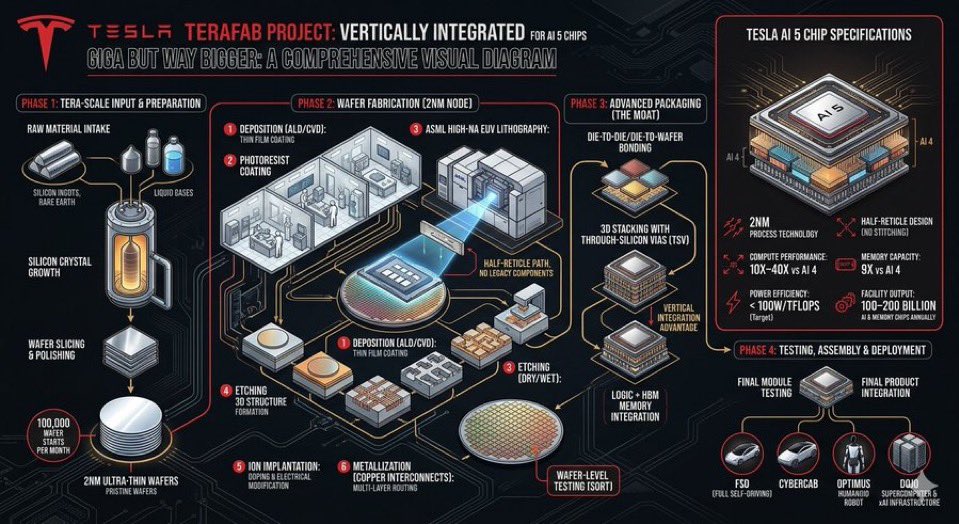
Tesla's Terafab Project is a massive in-house semiconductor fab designed to produce AI chips at unprecedented scale, addressing chronic supply shortages.
Formal announcement of the TERAFAB project, which will be done jointly by @SpaceX and @Tesla, tonight around 8pm CT. Livestream on 𝕏.
The goal is to produce over a TERAWATT of compute per year (logic, memory & packaging) with ~80% for space and ~20% for the ground.
Tesla’s TeraFab officially begins TODAY 🏭 This is make or break for possibly the whole AI industry
Elon’s trying to build a 2nm chip fab from scratch. The most advanced process node on Earth.
Only 3 companies can do this. TSMC spent $165 billion on their Arizona cluster alone. It took decades of institutional knowledge.
Tesla has manufactured zero semiconductors. Ever.
But they don’t really have a choice choice:
Even in the best-case scenario where TSMC, Samsung, and Micron all max out production for Tesla, it’s still not enough chips for the Optimus and Cybercab roadmap…let alone the rest of the industry
The AI5 chip this fab is designed to produce has 50x the compute of AI4. They need 100-200 billion of them per year. No foundry on the planet can commit to that volume on Tesla’s timeline.
If it works, Tesla becomes one of maybe 4 entities on Earth that can produce frontier AI silicon in-house, and the only one that also builds the robots and cars. It would be game over
This microscopic piece of silicon is an essential part of our technology, allowing computers to carry out complex calculations on a scale that would be unimaginable even 30 years ago.
TERAFAB is going to become the worlds largest producer of these microchips. The future is Tera.
Terafab math
For “big” chips like Tesla’s AI5 (a half-reticle design, roughly 300–450 mm²), producing 100 million chips per year would require on the order of ~100k wafer starts per month, roughly the output of a single high-volume leading-edge fab.
At current industry efficiency, that translates to about 1–2 million sq ft of cleanroom space. Since cleanroom typically makes up 20–35% of total facility area, the initial Terafab phase would likely span ~4 to 10 million sq ft.
That puts the starting factory right in the same ballpark as Gigafactory Texas (~10 million sq ft).
Elon’s long-term target is a vastly higher combined volume of AI compute/memory chips for inference, far beyond the initial 100 million example.
However, the point of Terafab’s redesign is to break conventional fab assumptions, compressing more output into less space so that extreme production volumes become achievable.