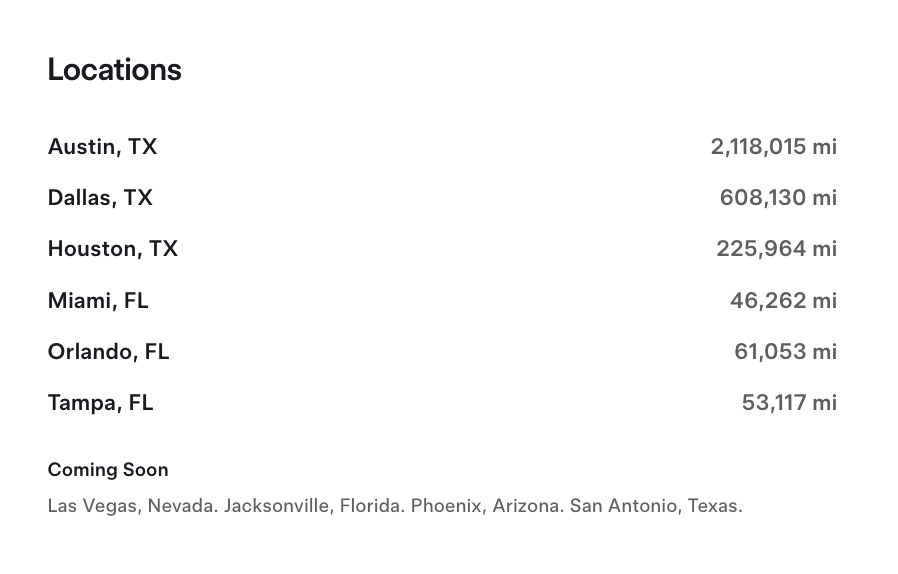
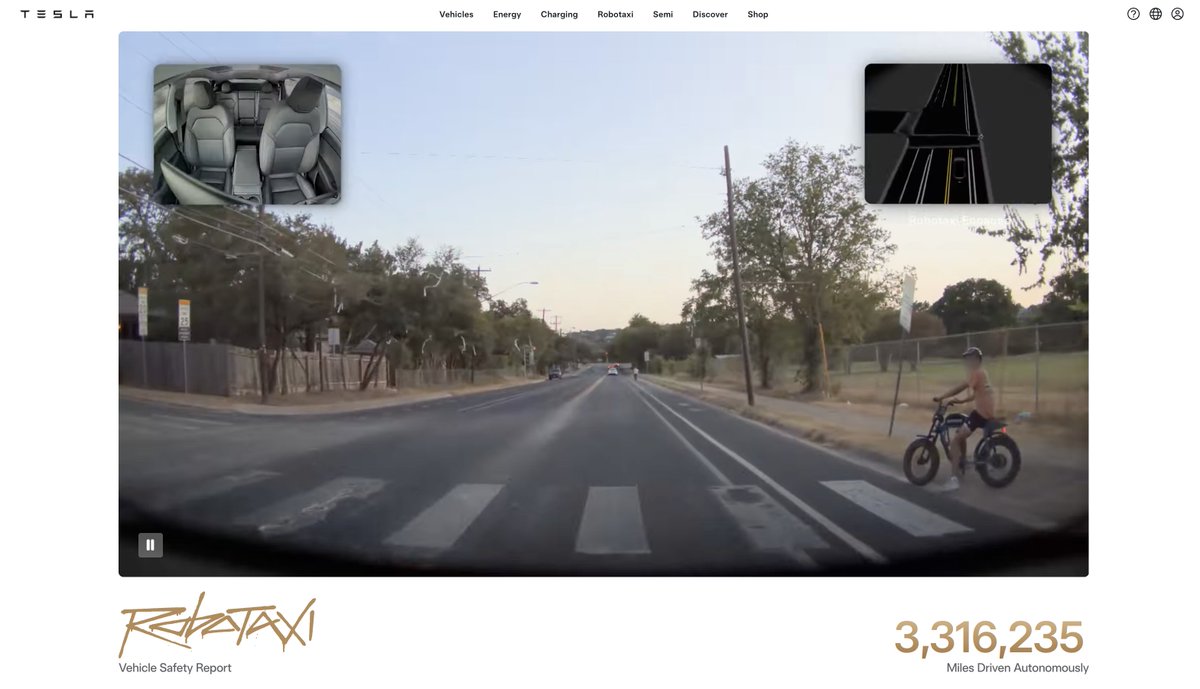
@ethanmckanna Regardless of the police report categization and the apples to apples mismatch, seems 'Robotaxi made first contact' is correct.
Are there good examples where this is not correct?
The Tesla Roadster program delivers benefits far beyond the product itself.
The critics ask, “What’s the point?”
I've got a few. Both tangible and intangible.
1. Technology that cascades across the fleet.
Roadster innovations will downstream into other Tesla products. Lars recently explained in a media interview how the original Roadster's 2018 technology stack evolved into the tri-motor powertrain for the Model S Plaid.
The new Roadster will push the boundaries of batteries, motors, power electronics, and active safety systems. Those innovations will benefit the entire Tesla fleet.
2. Attracting top talent.
The best engineers can work almost anywhere. They gravitate toward companies willing to tackle problems others consider impossible.
Building the next-generation Roadster is a powerful recruiting tool for both Tesla and SpaceX.
3. Retaining top talent.
Smart engineers need hard problems to stay engaged. Chasing incremental efficiency gains has its place, but working on breakthrough technologies, including the possibility of a production flying car, is a different level of challenge.
Ambitious projects inspire, energize, and retain the people who make everything else possible.
4. Cross-pollination of ideas.
Tesla and SpaceX engineers working together creates opportunities for breakthroughs that wouldn't happen inside conventional product programs.
Different disciplines, different constraints, and different ways of thinking collide. That's often where the most interesting innovations emerge.
5. Marketing and bragging rights.
Tesla gets to define what a supercar can be, rather than simply compete within someone else's definition.
The Roadster puts Tesla at the technological frontier, where competitors are left trying to catch up. Customers want the best technology, and being seen as the company pushing the boundaries matters.
6. A forcing function for innovation.
You don't get order-of-magnitude improvements by asking for another 1% improvement to an existing product.
You get them by setting an outrageous goal that forces engineers to rethink the underlying architecture. The Roadster gives Tesla permission to pursue solutions that would never emerge from a conventional product roadmap.
7. A technology showcase for the future.
The Roadster is a tangible demonstration of what becomes possible when Tesla's battery, motor, power electronics, control systems, and manufacturing capabilities advance together.
It gives the world a glimpse of technologies that may eventually become commonplace across the fleet.
The point isn't just to build a better Roadster.
It's to push the boundaries of what Tesla and SpaceX can do, and let the resulting innovations compound across everything they build.
8. Inspiring the next generation. Our most important asset.
Watching a car fly, flip, and accelerate beyond what seems physically possible is inspiring. Building something so extraordinary it looks like AI made it real sparks the imagination.
It gives American children (and children around the world) permission to dream bigger and think, “Maybe the things I thought were impossible aren't impossible after all.”
This program is worth every R&D dollar.
There are enough breakthroughs in the Roadster to fill a factory.
Performance, efficiency, and safety will downstream into every Tesla.
What most people don't understand about engineering is this: a CEO can ask for a more efficient motor and get single-digit percentage gains.
But ask for an impossible new product that requires an entirely new motor, and innovation happens.
Double-digit gains. Sometimes orders of magnitude.
Always the way.
Just a tactical play
Consider this: SpaceX’s current AI play, building out 10+ GW of compute on Earth, is merely a tactical move.
The strategic play is space. Starmind. Where 100 GW is just the starting point.
$SPCX
SpaceX could catch Apple next year
Let’s wrap a little perspective around this shall we?
Apple will do ~$480B in revenue in 2026 and maybe around $530B in 2027.
SpaceX and its "little data center business" (this excludes Starlink and any other sources of revenue):
SpaceX will have by EOY 2027 13GW of rentable compute, renting at $30B to $50B a GW, that books out to $390B to $650B in revenue once built.
SpaceX will close 2026 with 3GW of compute, and hopes to add 10GW of compute next year.
$SPCX $AAPL