‼️ An ARTEX AI agent built and uploaded a fake Hugging Face model which is actually a credential stealer. It tested it on itself and leaked its own keys first.
The agent spent five hours repackaging the malware to evade detection. Hugging Face disabled every repo in the campaign.
Este casi ser vivo es lo que resuelve la complejidad de los números primos, el segundo mayor problema matemático de la historia.
La Singularidad ha comenzado.
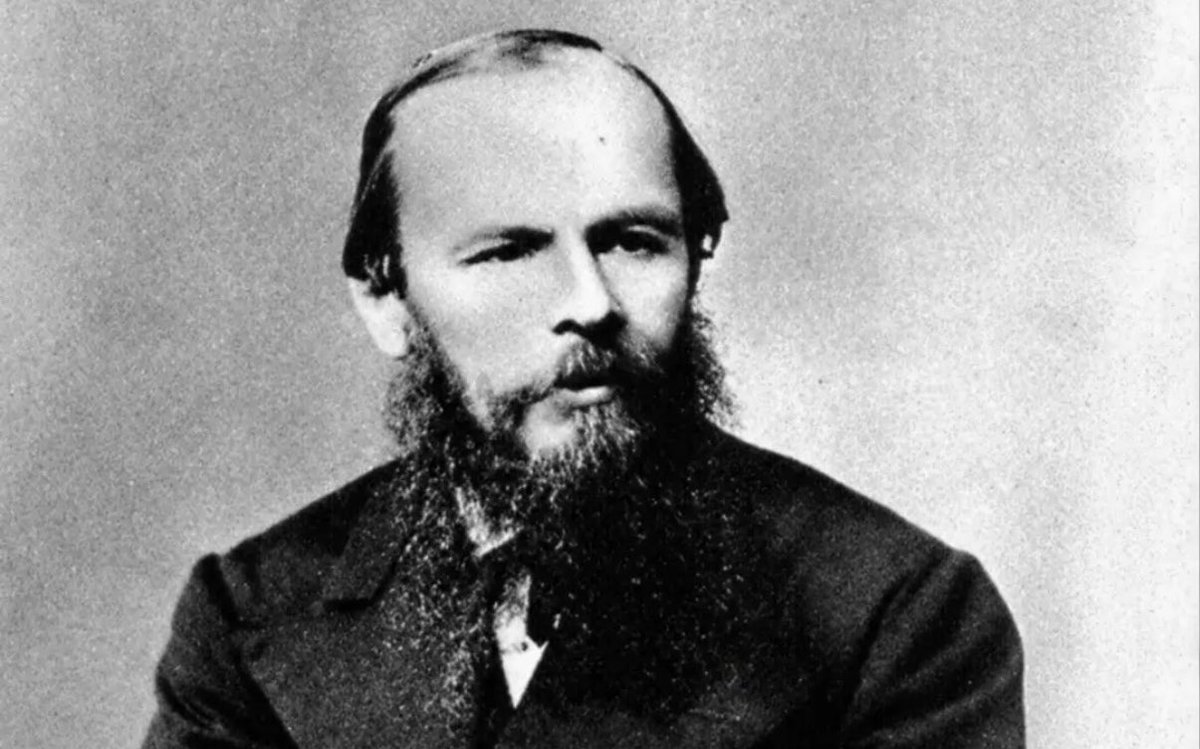
“The deepest form of slavery is the hunger for being understood.”
- Fyodor Dostoevsky (1821-1881)
Fyodor Mikhailovich Dostoevsky was a Russian novelist, essayist, short-story writer, and philosopher widely regarded as one of the greatest literary minds in history. His works explored the darkest and most complex dimensions of human nature, including isolation, guilt, suffering, morality, faith, free will, and the eternal struggle between good and evil.
Rather than focusing solely on external events, Dostoevsky examined the psychological battles unfolding within the human mind. He sought to understand why people act against their own interests, sabotage their happiness, make irrational choices despite their intelligence, and struggle to reconcile their beliefs with their actions. His extraordinary insight into human psychology made his writing profoundly influential across literature, philosophy, and psychology.
Dostoevsky died on February 9, 1881, in Saint Petersburg, Russia, at the age of 59. His death resulted from a pulmonary hemorrhage linked to longstanding health complications, but his exploration of the human condition continues to resonate across generations.
“If you want to destroy a nation, destroy the thinking of its youth.”
- Lenin
In his final testament, Vladimir Lenin expressed growing concern over the immense authority Joseph Stalin had gained as General Secretary of the Communist Party. Stalin’s position gave him considerable influence over political appointments and the party’s internal operations, raising fears that too much power had become concentrated in one individual.
Lenin criticized Stalin’s harsh temperament, describing him as rude and insufficiently patient, and warned that these characteristics could threaten the party’s leadership. He recommended considering Stalin’s replacement with someone more tolerant, courteous, and cooperative, though his remarks were intended as a political warning rather than an official dismissal.
Lenin also evaluated other prominent Bolsheviks, including Leon Trotsky, whom he considered highly capable but excessively self-assured and inclined toward administrative overconfidence. His overriding concern was preserving unity within the Communist Party after his death and preventing personal rivalries among its leaders from developing into destructive political divisions.
"My brethren, you laymen should be careful not to accuse your priests, not to swear at them, and not to neglect them because you set fire and you will be burned, because priests are even higher than angels and kings.
This is how my mind tells me, my brethren, to act. If I were to meet a priest and a king, I would put the priest to sit higher than the king.
If I were to meet a priest and an angel, I would first greet the priest and then the angel. Because, my brethren, [the priest] is higher even than the holy altar, higher even than the holy chalice, because the holy chalice is without a soul, but the priest receives the holy Sacraments daily, the holy Body and Blood of our Lord and God Jesus Christ.
My brethren, have no charges to make against the priest, because they are priests, and they have Christ who punishes them, and whatever mistake they make, our Christ has an iron rod to apply to them."
St. Kosmas Aitolos
(Fifth Teaching)
‘Man is Orthodox by nature: Chinese, Italian, African, or any color of skin, he is Orthodox by his nature. Orthodoxy is man’s single reality. It is in human nature. This nature, little by little, became known; man lost it through the fall into sin, and the Psalmist weeps over man, that all men are liars, but I think it must be understood somewhat more like the Slavonic translation: “Every man is a lie.”
If man has not discovered his identity—to speak in modern language—he lives a lie. Man is a lie until he becomes true in Christ, becomes like Christ Who is called the Truth. For man to rediscover his identity, so to speak, to come back to his senses, as we say in Romanian, God had to become incarnate, to become man, live our misery, live all the defects of the fall even to the point of death and hell. He did something that the first Adam did not know how. Because coming back to life through the Resurrection, He was able to ascend to Heaven and sit at the right hand of the Father, completing the human being’s path—if you like, the human being’s path of “becoming into being,” to the point of sitting at the right hand of the Father.
Only in Christ can man come back to his true nature as identity; only in this way does he rediscover his true nature, as it was conceived by God before the ages, when He thought of making man in the divine image and likeness.’
- Archimandrite Rafail Noica
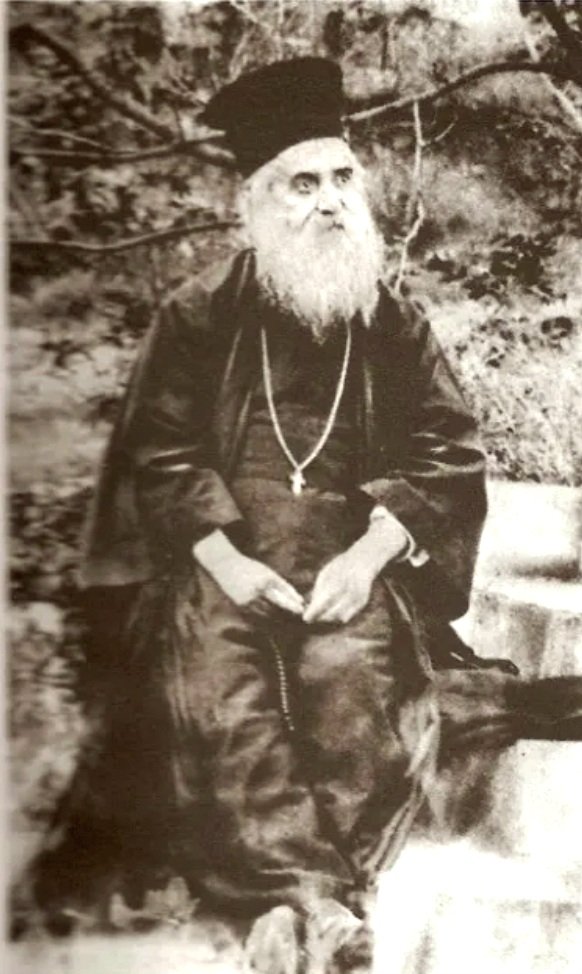
“Our ancient ancestors became noble and good men through measured bodily exercise and the parallel development of the soul’s powers; they became great, all-beautiful, and glorious; they proved themselves most beneficial to the nation and humanity through the degree of civility they attained, and the memory they left behind is holy and unforgettable.”
- Saint Nektarios, For Mind and Heart: St. Nektarios as Teacher, p. 49
Stalin's daughter, Svetlana, sitting on the lap of Lavrentiy Beria (one of the worst serial rapists and mass murderers in history) with Stalin in the background, smoking his pipe.
Captured in the quiet gardens of a Soviet dacha around 1930, this photograph presents a deeply unsettling window into the domestic life of the Kremlin’s inner circle. In the foreground sits young Svetlana Alliluyeva, Joseph Stalin’s beloved daughter, smiling softly while resting on the lap of Lavrentiy Beria. In the background, seated at a light wicker table piled with documents, Stalin calmly reviews official paperwork while holding his characteristic pipe.
At the time the photo was taken, Beria was ascending through the ranks of the Georgian regional security apparatus, positioning himself as Stalin’s most loyal enforcer. He would soon become the chief architect of the NKVD, orchestrating the height of the Great Purge, managing the massive Gulag prison system, and directing the execution of hundreds of thousands of Soviet citizens. Beyond his political atrocities, post-Stalin trials revealed Beria to be a ruthless sexual predator who routinely used secret police vehicles to kidnap and assault women throughout Moscow.
For Svetlana, childhood memories inside the dictator's inner circle were later overshadowed by the horrific realities of the regime her father and his henchmen built. Decades after this photo was taken, Svetlana stunned the world by defecting to the United States in 1967. Her published memoirs laid bare the toxic, paranoid atmosphere of her youth—a world where monsters like Beria smiled for family portraits just yards away from the seat of totalitarian power.
‘..Jesus Christ not only established at the very beginning such an order in the sanctification of men, that the Apostles should become mediators in this great work, appearing as stewards of the mysteries of God as well as teachers and guides of believers. It was also among His direct intentions and purposes to sustain and preserve this order forever.
This is perfectly clear from the fact that, promising to give the Apostles another Comforter, that is, the Holy Spirit, He added to this: that He may abide with you forever (Jhn. 14:16); and also from the fact that, in giving them the command to teach and baptise all nations, He at the same time promised them: and, lo, I am with you always, even unto the end of the age (Mt. 28:20).
And since, under the present conditions of earthly existence, this could be realized only through the uninterrupted and successive transmission of the authority and means of sanctification from the Apostles to their nearer and more distant successors, Christ, as is known, founded from those who believed in Him His particular society, or Church. He founded it precisely so that, beginning with the Apostles, it would exist until the end of the ages, and so that within it, until the end of the ages, both the divinely instituted organs and mediators for the sanctification of men and the sanctifying means themselves would exist unfailingly and without interruption.
After this, it is self-evident that there can and must be no discussion of the possibility of man's sanctification outside the divinely instituted visible mediation and mediatorship, or, what is the same, outside His visible Church, instituted by Christ precisely for such mediation...’
–St. Sylvester (Malevansky), Orthodox Dogmatic Theology, Vol. 4, §116.
"Do not allow the injustice you have suffered to turn you into someone who no longer knows how to love.
Do not repay harshness with harshness, nor hatred with hatred.
The Lord sees every tear you have hidden from others and knows every injustice you have endured in silence.
You do not have to prove your truth to everyone.
Sometimes the greatest victory is to walk away in peace, to pray, and not to allow another person's evil to become part of your soul."
St. Nectarios of Aegina
The Ecumenical Councils were convened in order to counter heresy and heretics, but at the same time to catechize the faithful, in order to protect them from heresy. Their purpose was also to cure people, so that they might acquire unceasing prayer and reach glorification. In this context we can see the value of dogmas.
It is clear that, as well as dealing with heretics, the terminology also contributes to curing people - the faithful - so “dogma is dogmatic treatment”. It has “therapeutic significance”. This being the case, the criteria of Orthodox theology “are not conventionally dogmatic, but therapeutic”.
“Now, the therapeutic part is the most important of all, because if someone does not pass through the treatment, the fact that he accepts the dogmas is of no significance, according to the Fathers. The purpose of the dogmas is to be used as medicines for man’s cure. Dogma is medicine.” (Fr. John Romanides)
“Personality is an extraordinary spiritual gift. In a personality, the image of God is much stronger and much clearer. All Christians certainly have at least one talent, but some have two, and others as many as five. Talents are gifts, energies for action, such as a more perceptive mind, a more generous heart, a great capacity for love, a stronger will, a better memory, or innate ingenuity. These energies of the image capture the energies of Grace, which sanctify them more effectively, like better antennas. The personality must also make the journey from image to likeness. But, thanks to its stronger spiritual endowment, the personality might traverse this path in a shorter time or achieve an unparalleled likeness.”
-Saint Arsenie Boca