Most security systems ask you to replace everything.
Terracrypt takes a different approach.
Our mission is to make any security system quantum-ready.
Any infrastructure. Any application. Any industry.
The goal isn't to compete with existing security.
The goal is to strengthen it.
We're not stopping until Terracrypt becomes the benchmark for next generation encryption.
V3 is cooking.
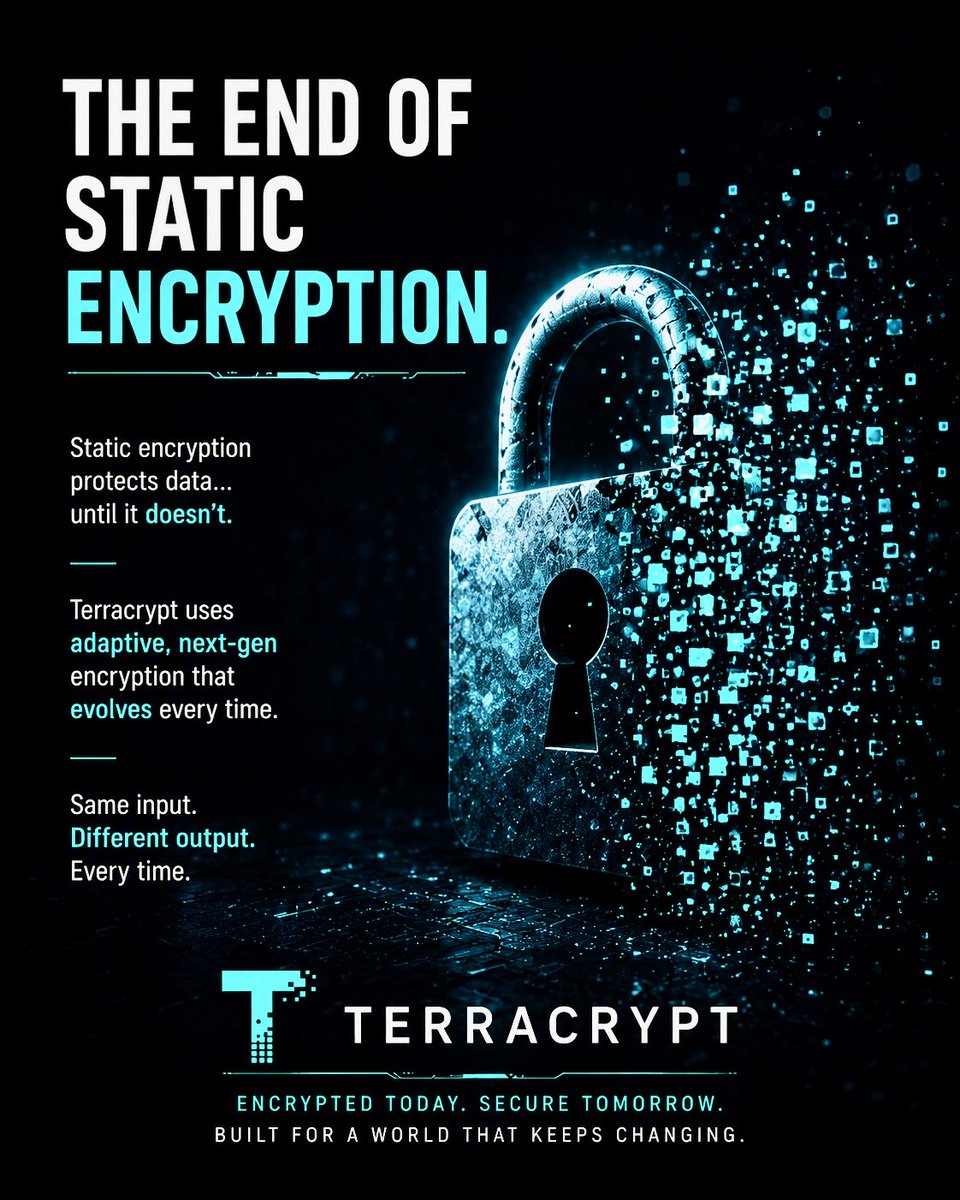
𝗧𝗛𝗘 𝗘𝗡𝗗 𝗢𝗙 𝗦𝗧𝗔𝗧𝗜𝗖 𝗘𝗡𝗖𝗥𝗬𝗣𝗧𝗜𝗢𝗡
The biggest weakness in security is assuming tomorrow will look like today.
Threats evolve.
Attack methods evolve.
Computing power evolves.
Security must evolve too.
Experts are evaluating that 2029 may mark the end of today’s encryption era.
The question is not whether security will change.
The question is whether you’re prepared before it does.
Terracrypt is built around a different principle:
Same input.
Different output.
Every time.
Because predictable systems create patterns.
And patterns become targets.
𝗣𝗥𝗜𝗩𝗔𝗖𝗬 𝗦𝗛𝗢𝗨𝗟𝗗 𝗕𝗘 𝗗𝗘𝗙𝗔𝗨𝗟𝗧
Privacy should not be a premium feature.
It should be the default.
Most platforms are built around collecting, analyzing, and storing user data.
Terracrypt is built around a different idea:
• Your messages belong to you
• Your files belong to you
• Your information should not become platform intelligence
Security is important.
But ownership of your data matters too.
𝗤𝘂𝗮𝗻𝘁𝘂𝗺 𝗶𝘀 𝗰𝗼𝗺𝗶𝗻𝗴. 𝗪𝗲 𝗮𝗿𝗲 𝗿𝗲𝗮𝗱𝘆.
Quantum computing is no longer theoretical.
The transition has already started.
The real question is not if current encryption models will be challenged but when.
Terracrypt is being built for a future where security must survive beyond traditional assumptions.
• Non-deterministic encryption
• Zero-trust architecture
• Quantum-resistant direction
• Same input. Different output. Every time.
Preparing after the shift is already too late.
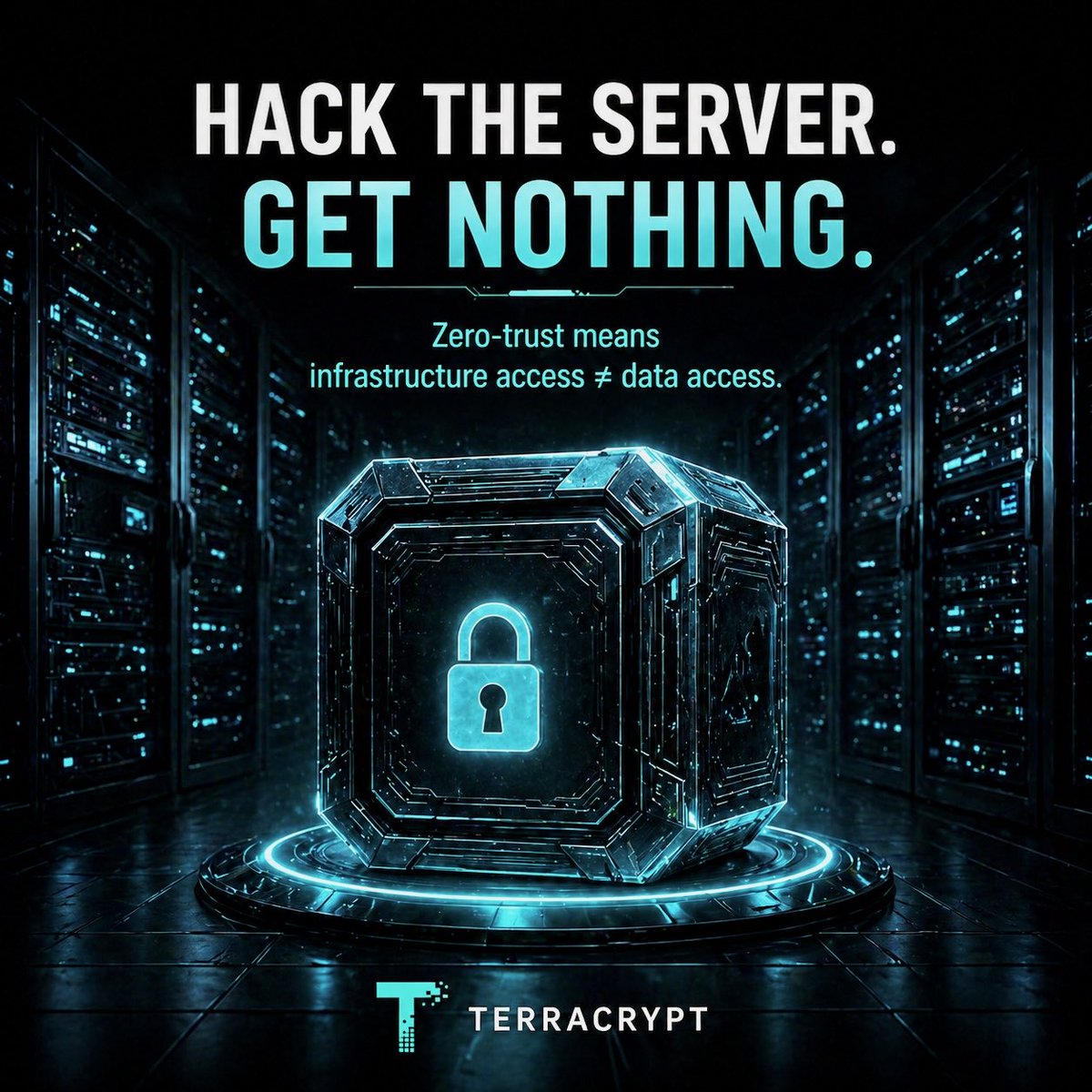
𝗛𝗮𝗰𝗸 𝘁𝗵𝗲 𝘀𝗲𝗿𝘃𝗲𝗿. 𝗚𝗲𝘁 𝗻𝗼𝘁𝗵𝗶𝗻𝗴.
Most systems still assume that breaching infrastructure means breaching data.
That’s the old model.
Terracrypt is built on a zero-trust architecture where infrastructure access does not equal readable information.
Even if systems are targeted, meaningful data remains protected.
Security should not depend on perimeter walls.
It should depend on whether usable data exists at all.
𝗪𝗵𝗮𝘁 𝗶𝘀 𝘇𝗲𝗿𝗼 𝘁𝗿𝘂𝘀𝘁
Zero-trust isn’t a buzzword. It’s a security model built on one principle:
Trust no one by default.
In practice, that means:
No passwords stored anywhere.
No hidden access for service providers.
No intermediaries who can read or manipulate your data.
No internal system that automatically gets privileged access.
Only the sender and the receiver can ever access the content.
Even if infrastructure is compromised, the data remains unreadable.
Why it matters:
Most breaches happen because someone inside the trust chain gets access.
Zero-trust removes the trust chain.
The conclusion is simple:
Security should not depend on who promises to protect your data.
It should depend on who can never access it.
That is the Terracrypt model.
𝗛𝗼𝘄 𝗻𝗼𝗻-𝗱𝗲𝘁𝗲𝗿𝗺𝗶𝗻𝗶𝘀𝘁𝗶𝗰 𝗼𝘂𝘁𝗽𝘂𝘁 𝘄𝗼𝗿𝗸𝘀
In traditional encryption, the same input always leads to the same output. Terracrypt changes this. Every encryption process generates a different ciphertext, even if the plaintext stays identical. This eliminates patterns, making brute-force attempts useless.
Why quantum-resistance matters:
The quantum era is not a distant future. Advances in quantum computing are steadily progressing, and once large-scale systems emerge, RSA and ECC will no longer be secure. Terracrypt is one of the few systems designed to survive that shift.
🔚 The conclusion is clear:
Terracrypt is encryption for the post-quantum world.
And at the center of it all is $TERRA, the token that powers the future of secure communication, payments, and enterprise solutions.
Everyone says: “We’ll upgrade.”
But what if users don’t move in time?
@cz_binance that’s the real risk.
Check out Terracrypt.
We’re building wallets that solve this problem at the root , no need for protocol
to change. Soon testnet available , after going live with quantum proof wallet
for Bitcoin and beyond.
Saw some people panicking or asking about quantum computing's impact on crypto.
At a high level, all crypto has to do is to upgrade to Quantum-Resistant (Post-Quantum) Algorithms. So, no need to panic. 😂
In practice, there are some execution considerations. It's hard to organize upgrades in a decentralized world. There will likely be many debates on which algorithm(s) to use, resulting in some forks.
And some dead project may not upgrade at all. Might be a good to cleanse out those projects anyway.
New code may introduce other bugs or security issues in the short term.
People who self custody will have to migrate their coins to new wallets.
This brings to the question of Satoshi's bitcoins. If those coins move, then it means he/she is still around, which is interesting to know. If they don't move (in a certain period of time), it might be better to lock (or effectively burn) those addresses so that they don't go to the first hacker who cracks it. There is also the difficulty of identifying all his addresses, and not confuse with some old hodlers. Anyway, it's a different topic for later.
Fundamentally:
It's always easier to encrypt than decrypt.
More computing power is always good.
Crypto will stay, post quantum.
𝗪𝗛𝗬 𝗧𝗘𝗥𝗥𝗔𝗖𝗥𝗬𝗣𝗧 𝗜𝗦 𝗥𝗘𝗗𝗘𝗙𝗜𝗡𝗜𝗡𝗚 𝗘𝗡𝗖𝗥𝗬𝗣𝗧𝗜𝗢𝗡 𝗙𝗢𝗥 𝗧𝗛𝗘 𝗤𝗨𝗔𝗡𝗧𝗨𝗠 𝗘𝗥𝗔
Why it’s different from AES & ECC:
Today’s standards, including AES and ECC, were designed for a pre-quantum world. Quantum computing has already proven it can dismantle these systems in hours, not centuries. Terracrypt doesn’t rely on outdated assumptions, it is designed from the ground up to resist quantum attacks.
What “zero-trust” really means:
Zero-trust isn’t just a buzzword. In practice, it means:
- No passwords stored anywhere.
- No hidden access for service providers.
- No intermediaries who can read or manipulate your data.
Only the sender and the receiver can ever access the content.
Everyone talks about post-quantum security.
No one talks about speed.
We solved both.
Tested over 20 iterations:
~20ms per MB ⚡
Sub-ms messages
Zero perceptible delay
Security you can’t break.
Performance you can’t feel.
Built for the world after quantum and fast enough for today.
Terracrypt.
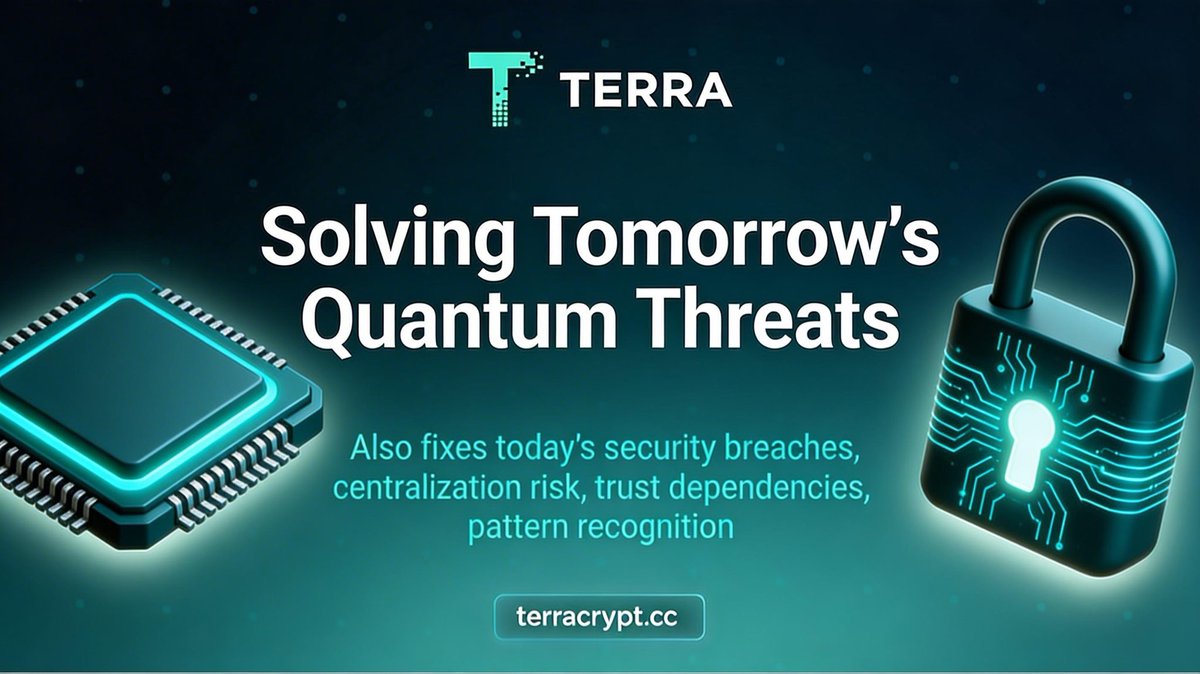
While preparing for the quantum era, we solved three of today’s biggest hacking problems:
• Centralization risk
• Trust dependencies
• Pattern recognition
Quantum computers will break traditional encryption.
But most breaches today don’t even require that.
They happen because infrastructure gets compromised.
Terracrypt solves both.
The first audio and video calls fully protected with post-quantum encryption are now working.
Real-time communication where captured data today cannot be decrypted tomorrow.
No retroactive exposure.
No stored secrets waiting for quantum computers.
Just private communication built for the next era.
We cant wait to see everyone testing it.
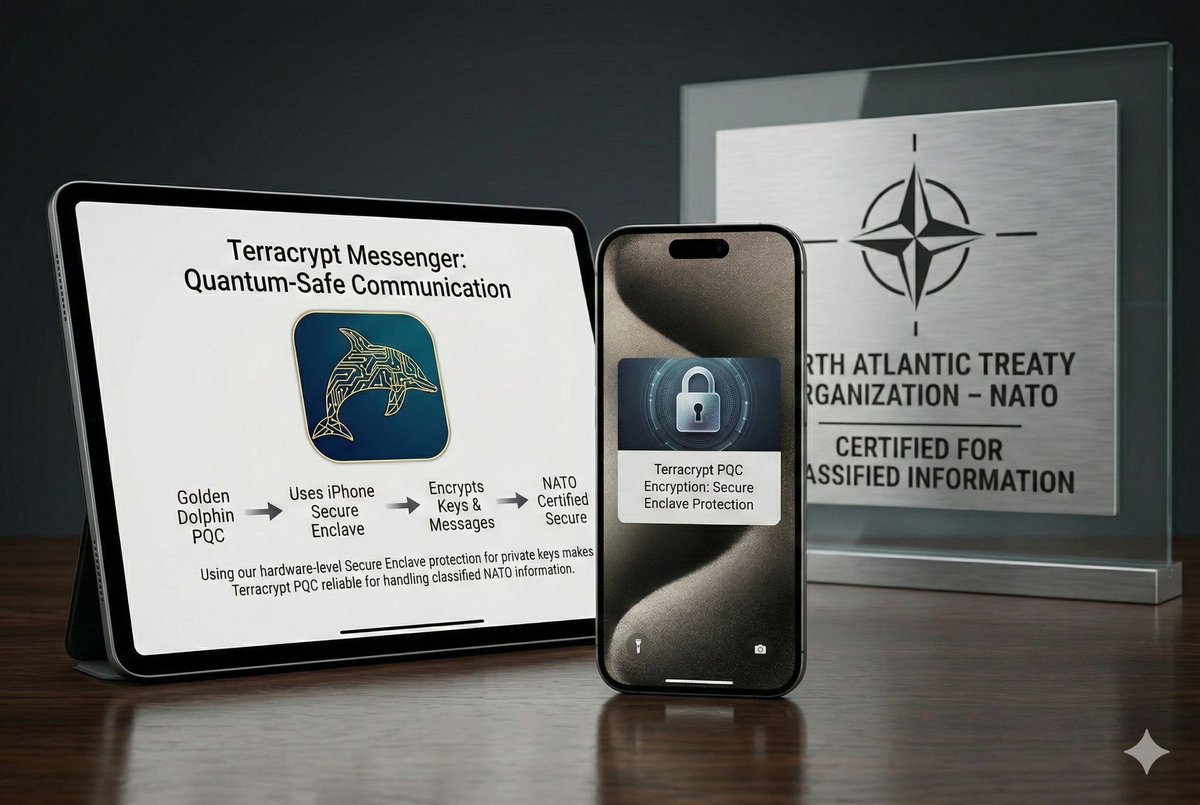
Apple just announced that iPhone and iPad are now approved to handle classified NATO information.
For TerraCrypt, this is huge.
We built our security stack from the ground up the only external component we rely on is Apple’s Secure Enclave for storing private keys on-device.
Now we have official confirmation that the environment where TerraCrypt keys live meets NATO-level security standards.
Zero-trust architecture + a NATO-approved hardware enclave = unmatched protection for our users.
The future of secure communication is here. 🚀🔐
@VitalikButerin We have a proof of concept , building the solution right now , will be done in about a month @VitalikButerin if you are interested to hear we can show you .
𝗧𝗵𝗲 𝗖𝗵𝗮𝗻𝗴𝗲 𝗛𝗲𝗮𝗹𝘁𝗵𝗰𝗮𝗿𝗲 𝗕𝗿𝗲𝗮𝗰𝗵 – 𝗪𝗵𝗲𝗻 𝗔𝗰𝗰𝗲𝘀𝘀 𝗕𝗲𝗰𝗼𝗺𝗲𝘀 𝗘𝘅𝗽𝗼𝘀𝘂𝗿𝗲 🔐
In early 2024, Change Healthcare, part of UnitedHealth Group, suffered one of the largest healthcare cyberattacks in U.S. history.
Millions of patients were affected.
Medical records, billing data, and personal identifiers were compromised.
Healthcare payments across the country were disrupted.
When internal systems connect insurers, hospitals, pharmacies, and payment processors through a single trust layer, compromise doesn’t stay contained.
Access becomes visibility.
Visibility becomes exposure.
Terracrypt is built on a different model.
Access never equals readable data.
Infrastructure compromise does not reveal user intelligence.
Sensitive information does not exist in usable form inside shared environments.
Security shouldn’t depend on perimeter defense.
It should depend on whether meaningful data exists to steal at all.
𝗧𝗵𝗲 𝗠𝗼𝗺𝗲𝗻𝘁 𝗦𝗲𝗰𝘂𝗿𝗶𝘁𝘆 𝗦𝘁𝗼𝗽𝘀 𝗕𝗲𝗶𝗻𝗴 𝗥𝗲𝘃𝗲𝗿𝘀𝗶𝗯𝗹𝗲
Most security systems are built with one hidden assumption:
that if something goes wrong, it can be fixed later.
Keys can be rotated, algorithms can be upgraded, systems can migrate.
Quantum computing breaks that assumption.
Once encrypted data is captured today, it doesn’t need to be broken today.
It only needs to be stored.
When quantum capabilities mature, past communications become readable retroactively.
There is no patch for yesterday’s exposure.
This is where most systems fail quietly.
They focus on protecting access in the present,
while ignoring that long-term confidentiality depends on how data is encrypted before it’s ever intercepted.
Terracrypt is built with this reality in mind.
Encryption that never produces reusable output.
No exposed cryptographic identities to harvest.
No stable patterns worth storing for later decryption.
Quantum security is about making stored data useless forever.
That’s the difference between delaying risk and removing it.
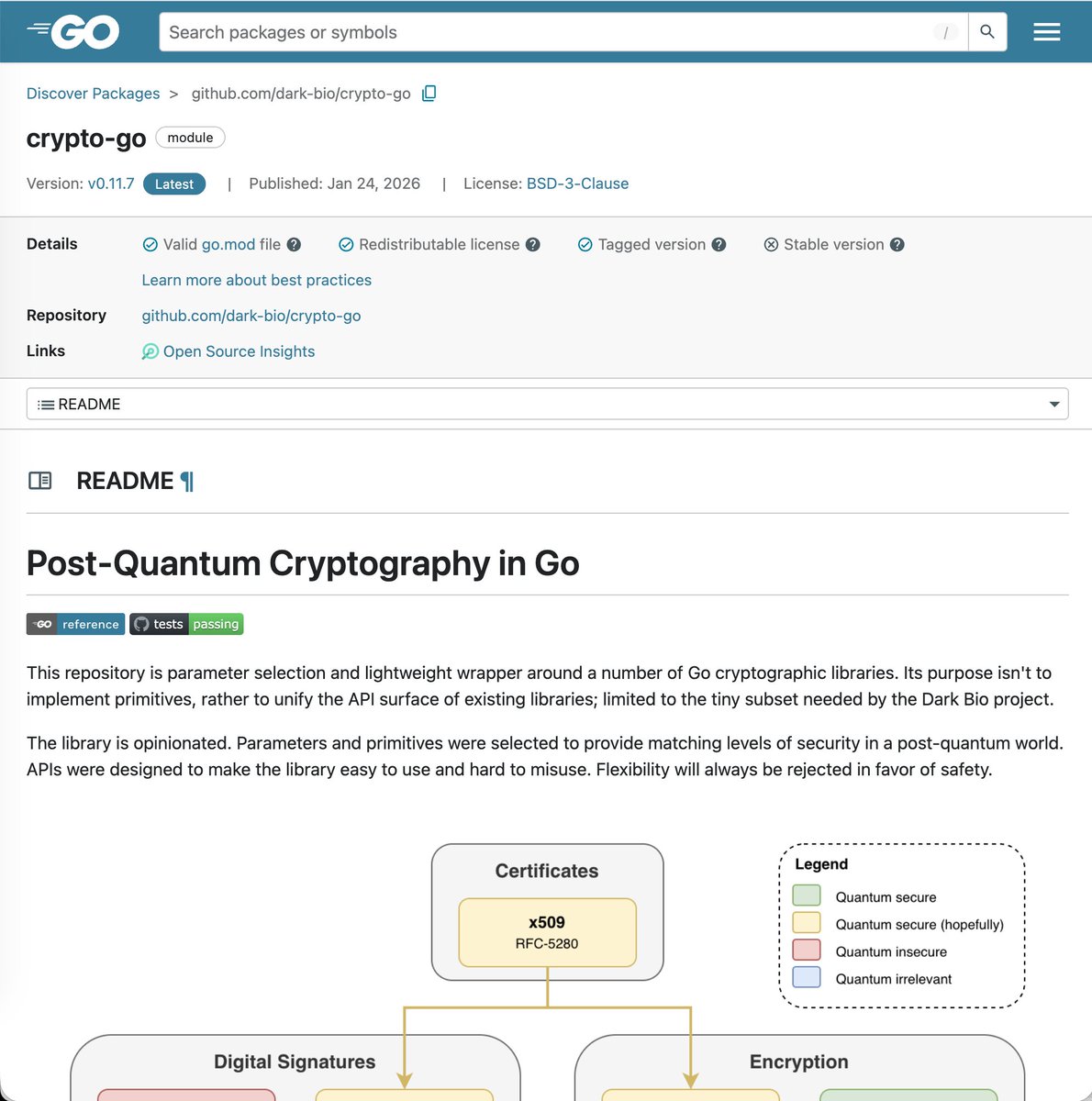
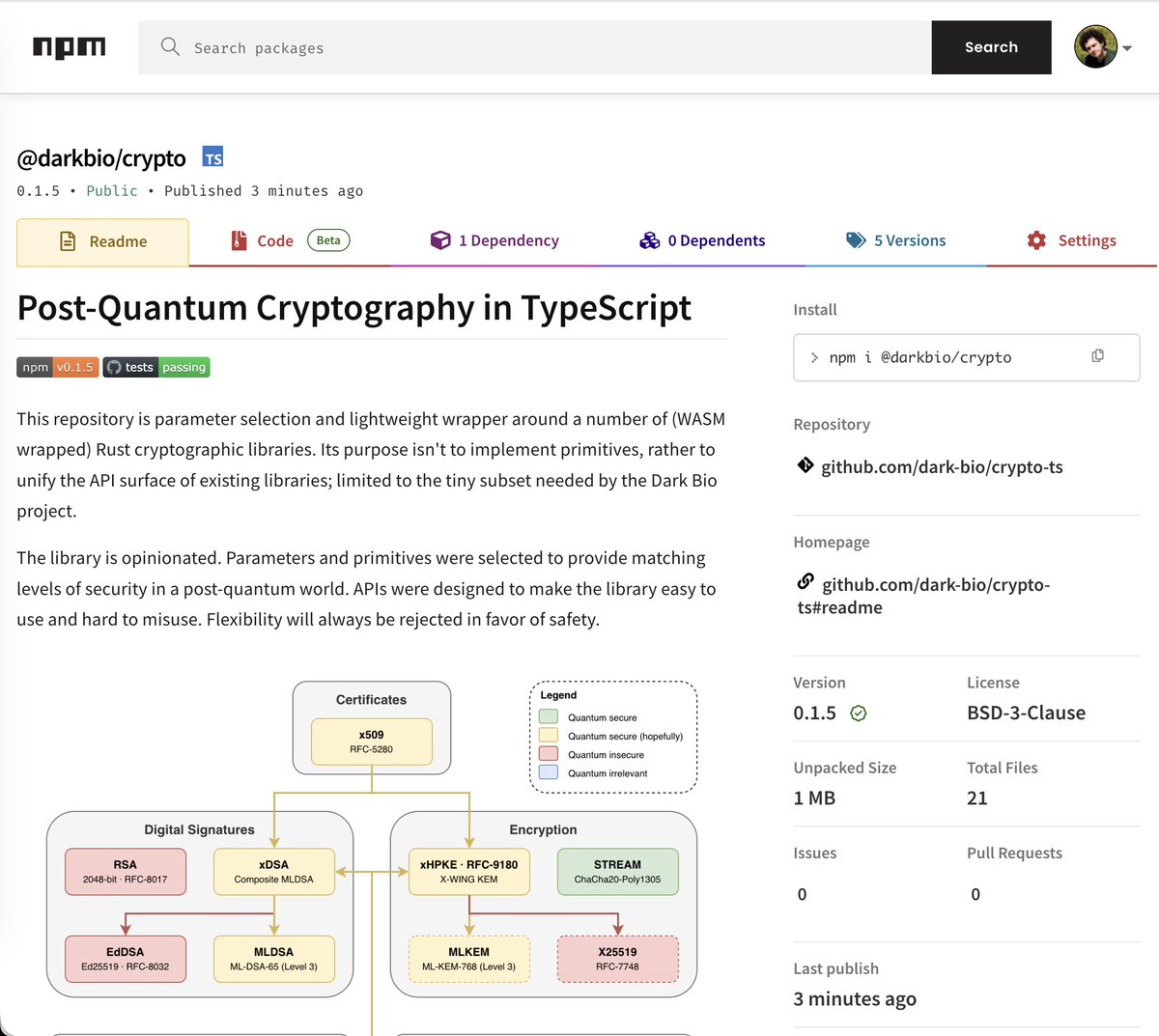
You have no excuse any more for not using post-quantum cryptography. I have you covered on desktop, cloud, mobile and web. 🤓 #rust#golang#flutter#typescript
𝗪𝗵𝗲𝗻 𝗣𝗿𝗶𝘃𝗮𝗰𝘆 𝗗𝗲𝗽𝗲𝗻𝗱𝘀 𝗼𝗻 𝗣𝗿𝗼𝗰𝗲𝘀𝘀🔐
Proton Mail didn’t expose messages.
They exposed something else:
Recovery emails.
IP addresses.
Timestamps.
All available once logging is legally required.
That’s a consequence of a model where privacy depends on policy, jurisdiction, and when logging starts.
Terracrypt is built on a different assumption.
If metadata can’t be meaningfully logged,
if identities don’t exist as readable records,
if systems never see the full picture,
then compliance doesn’t translate into exposure.
Security shouldn’t rely on how carefully data is handled.
It should rely on whether usable data exists at all.
𝗧𝗵𝗲 𝗥𝗲𝗮𝗹 𝗤𝘂𝗮𝗻𝘁𝘂𝗺 𝗧𝗵𝗿𝗲𝗮𝘁 𝗜𝘀𝗻’𝘁 𝗦𝗽𝗲𝗲𝗱
Most people think quantum computing is dangerous because it’s faster.
That’s not the real problem.
The real threat is that quantum computing changes the rules of security entirely.
Today’s systems assume three things:
• that encryption is predictable
• that keys can be exposed safely
• that breaking security takes time
Quantum computing breaks all three.
It doesn’t try every possibility faster.
It changes the math so guessing is no longer necessary.
That’s why systems built on deterministic behaviour fail.
Once a pattern exists, quantum machines exploit it.
Terracrypt removes patterns by design.
Every encryption output is unique.
Keys are never exposed during communication.
No system in the flow ever has enough information to reconstruct anything.
Quantum computing doesn’t “attack” Terracrypt.
It has nothing stable to target.
Post-quantum security isn’t about racing faster machines.
It’s about building systems that give those machines nothing to work with.