TerraDart is featured in What's new in Flutter 3.50 🎉
Highlighted in the package ecosystem section as a standout community package for defining cloud infrastructure in pure Dart.
Thank you to the Flutter team, to @AbdallahSh07 for always supporting TerraDart, and to everyone who has tried and shared it 💙
https://t.co/hbFzXY0S3J
Built for the @dart_lang and @FlutterDev community.
#Dart #Flutter
TerraDart 0.37.0 is out 🚀
Install the CLI with:
dart install terradart_cli
`dart install` builds an AOT-compiled native executable, so terradart starts faster than the old `dart pub global activate` setup, which ran on the Dart JIT VM.
Also in this release:
- Dart 3.12 is the new minimum
- `terradart --version`
- Provider updates: Google Cloud 8.12.0, AWS 6.73.0, Azure 5.14.0, Cloudflare 5.29.0, Appwrite 2.7.0
Built for the @dart_lang and @FlutterDev community.
Already using Terraform? terradart migrate converts .tf files into Dart stacks, keeps anything not yet converted as regular Terraform, and pins engine: terraform when your state came from Terraform.
Full CLI docs (environments, state migrate, migrate):
https://t.co/uO3E3F0moK
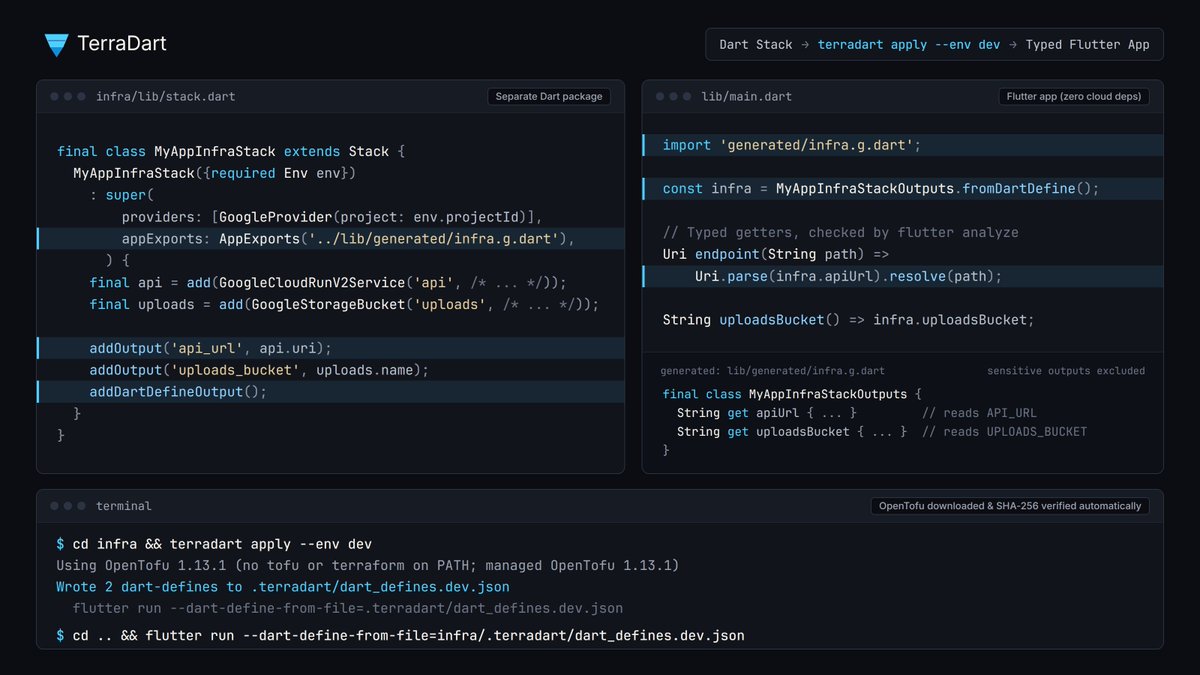
Write your cloud stack in Dart, run terradart apply --env dev, and read cloud outputs (API URLs, bucket names, and more) in Flutter with full type safety.
In a Flutter repo, terradart init creates a separate infra/ package writing lib/generated/infra.g.dart. Zero cloud deps.
After apply, terradart writes infra/.terradart/dart_defines.dev.json and prints the exact flutter run --dart-define-from-file command to boot with those values.
In Flutter:
const infra = MyAppInfraStackOutputs.fromDartDefine();
infra.apiUrl
infra.uploadsBucket
What you no longer wire by hand:
- No separate Terraform install: terradart fetches a pinned, SHA-256 verified OpenTofu binary on first use when tofu or terraform is not on PATH.
- No string-key drift: rename an output in Dart, run terradart synth, and flutter analyze flags every stale use in the app.
- Secrets stay out of the client binary: sensitive outputs are excluded from the define file by design.
- No infra write access in app CI: terradart outputs --env prd reads applied state and writes the define file with no plan and no apply.
Install: dart pub global activate terradart_cli
Walkthrough: https://t.co/gGDCYMcwZR
#FlutterDev #DartLang
TerraDart is featured in What's new in Flutter 3.50 🎉
Highlighted in the package ecosystem section as a standout community package for defining cloud infrastructure in pure Dart.
Thank you to the Flutter team, to @AbdallahSh07 for always supporting TerraDart, and to everyone who has tried and shared it 💙
https://t.co/hbFzXY0S3J
Built for the @dart_lang and @FlutterDev community.
#Dart #Flutter
The closest to your setup is this full-stack example: a Flutter app plus a Dart server on Cloud Run and Cloud SQL, with all the infra written in Dart.
https://t.co/70CyFoLIf1
To try it yourself, start here: https://t.co/kRMHLKqr2v
And you're right, it's still early. Would love to hear how it goes for you 🙌
@TObikansi35734@AbdallahSh07 Thanks for asking! Yes, same idea: infrastructure as code. The difference is you write it in Dart, and your Flutter app reads the deployed values (like your API URL) as typed Dart, so a mismatch shows up at compile time.
Right, anything in a dart-define can be extracted from the app.
In TerraDart, you mark secret outputs as sensitive. The define file only carries the rest: sensitive outputs are left out by default, and synth flags it if you try to include one.
Secrets stay server-side, read at runtime from a store like Google Cloud Secret Manager or AWS Secrets Manager.
https://t.co/NaS62ikizf
TerraDart tip:
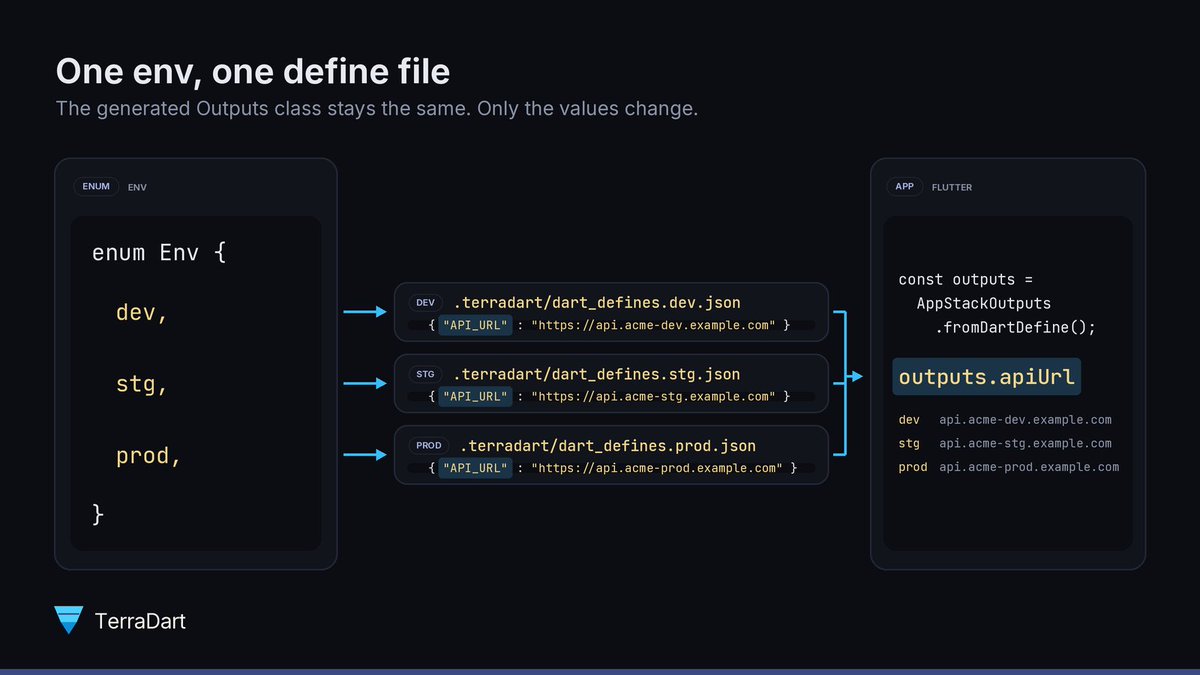
dev, stg, and prod can be a Dart enum.
Each member gets its own state, and apply writes its own define file:
terradart apply --env prod
flutter run --dart-define-from-file=.terradart/dart_defines.prod.json
The generated Outputs class stays the same. Only the values change.
@turkelitopcusu Thanks, ALAZ! Both already hold: sensitive outputs are excluded from the generated reader by default, and addDartDefineOutput(only:) naming a sensitive output fails at synth.
A dedicated regression test for the public-to-sensitive flip is a good idea, thanks for the nudge.
TerraDart v0.36.0 adds Azure 🚀
Google Cloud, AWS, and now Azure: all three major clouds, in type-safe Dart.
https://t.co/n9s0tcrB0A
Your infrastructure outputs reach your Flutter app as a typed class.
Built for the @dart_lang and @FlutterDev community.
#Dart#Flutter#Azure
@Mohamedour7@dart_lang@FlutterDev Thanks, Mohamed! TerraDart shares typed infra values, not data models. Your Stack's outputs and constants become a generated Dart class the Flutter app reads, e.g. outputs.apiUrl.
For DTOs, a shared Dart package both sides depend on works well.
https://t.co/HtUEnIX190
@ZeePalmLabs Thanks, Ethan. Yes. Each env in your Dart enum gets its own state and its own define file: terradart apply --env prod writes .terradart/dart_defines.prod.json.
Pair it with a flavor via --dart-define-from-file. Same typed Outputs class, different values.
https://t.co/JLj1FPSngy
API URLs in .env files, config.json, hardcoded strings. Your app keeps its own copy of your infra.
Make the Stack the only source.
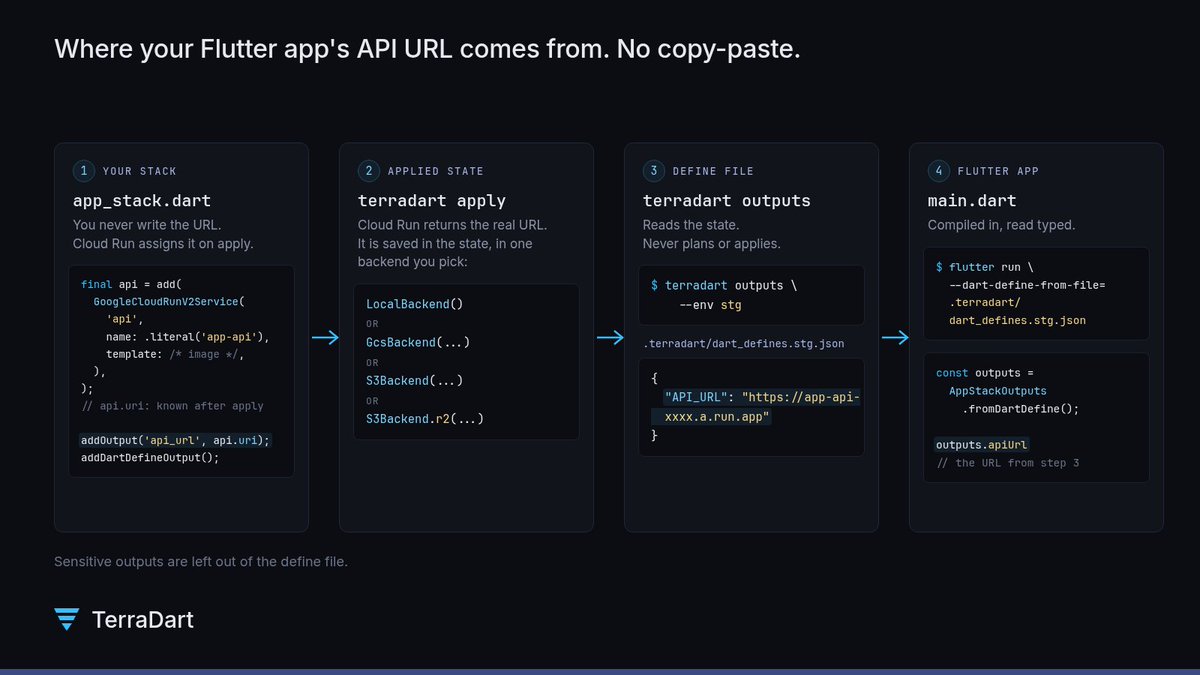
addOutput('api_url', api.uri), terradart apply, then outputs.apiUrl in Flutter. Typed, and a typo is a dart analyze error.
TerraDart tip:
Your Flutter app needs the API URL your infra just created.
No copy-paste. terradart outputs reads it from the applied state and writes a define file:
terradart outputs --env stg
flutter run --dart-define-from-file=.terradart/dart_defines.stg.json
TerraDart just reached 50 stars on GitHub.
Thank you to everyone who starred it, tried it, opened issues, or shared it.
Azure is next, targeting the end of 2026.
https://t.co/vqNgifNPM6