Managing Director of ent! Marketing Former CEO of Averi Infusions. Former Chair/CEO of Hill St BevCo, TSXV:BEER, prior CMO of MDC Partners. Views my own.
It Was Supposed to Be History
I'm a Polish filmmaker living in London.
I wasn't raised to care about antisemitism. Quite the opposite.
Like many Poles of my generation, I grew up with a version of history that focused heavily on Polish suffering during the Second World War. I visited Auschwitz as a teenager, yet somehow left without truly understanding the scale of what had happened to Europe's Jews.
That changed when I was 19 and worked on Schindler's List.
For the first time, I was confronted with parts of history that had been missing from my education. Later, living in Paris and spending time in New York, I met Jewish people whose understanding of Poland, Europe and history was very different from my own. Some conversations were uncomfortable. A few were life-changing.
The more I learned, the more I realised that antisemitism didn't disappear after the Holocaust. It adapted.
Today it often arrives dressed as political activism, conspiracy theories, selective outrage, historical revisionism, or simply a double standard applied to the world's only Jewish state.
I am not Jewish. I have no family connection to Israel.
What I do have is a deep distrust of propaganda, mob thinking, and people who demand that history be simplified into slogans.
My work on antisemitism began with a simple realisation: if I could be misled about history, so could millions of others.
That is why I make films, conduct interviews, and challenge narratives.
Not because I have all the answers.
Because I spent too many years believing things that weren't true.
Je reçois de plus en plus de messages privés de personnes très proches des élites parisiennes.
Le constat est simple :
Je suis devenu radioactif.
Pourquoi ?
Parce que je défends des idées devenues presque interdites dans certains cercles :
La liberté d’expression.
La liberté individuelle.
Le droit d’entreprendre.
La responsabilité personnelle.
La réduction du poids de l’État.
La simplification radicale de la bureaucratie.
L’idée qu’un individu libre crée plus de valeur qu’un comité.
L’idée qu’aucun bureaucrate à Bruxelles, Paris ou ailleurs ne sait mieux que des millions de citoyens ce qui est bon pour eux.
Je pense que les entrepreneurs créent davantage de prospérité que les administrations.
Je pense que l’innovation résout plus de problèmes que la réglementation.
Je pense que la technologie est le plus puissant moteur de progrès que l’humanité ait jamais connu.
Et oui, j’admire Elon Musk.
Pas parce qu’il est parfait.
Mais parce qu’avec une fraction des moyens des États, il a :
Révolutionné le spatial.
Accéléré la transition vers les véhicules électriques.
Déployé un réseau Internet mondial.
Fait avancer les interfaces cerveau-machine.
Contribué à démocratiser l’IA.
Pendant que des armées de bureaucrates produisent des milliers de pages de régulations, certains bâtissent.
Et je préfère les bâtisseurs.
Comme disait Victor Hugo :
« Vous avez des ennemis ? Tant mieux. Cela signifie que vous avez défendu quelque chose dans votre vie. »
Et pour être honnête, c’est même pire que ça.
À partir du moment où défendre ces idées crée des ennemis, j’ai tendance à redoubler d’efforts.
L’opposition n’est pas un signal d’arrêt.
C’est souvent un signal que l’on touche à quelque chose d’important.
Alors à ceux qui veulent entrer en conflit avec moi sur ces sujets : allez-y.
Le débat, la confrontation des idées et le combat intellectuel sont un carburant.
Je ne cherche pas les ennemis.
Mais je ne les crains certainement pas.
Les bâtisseurs n’ont jamais obtenu la permission de construire le futur.
Despite the reputation, I don't think everyone needs to be carnivore. You don't have to bin the vegetables, torch the fruit bowl, and swear a blood oath to ribeye.
My position is calmer than the internet would have you believe. It comes down to three things.
One. Fatty animal foods belong at the centre of the human diet, as the keystone, the place the evolutionary record keeps quietly pointing to while we keep politely looking away. The guidelines shoved them into the corner of the plate, and that was the mistake.
Two. Plants are not automatically virtuous. Some are wonderful, some are fine, and some carry oxalates, lectins, and a long list of caveats nobody reads out while calling them clean. "Plant" was never a synonym for "harmless."
Three. Carnivore is a viable diet in its own right, short term and long term, for health and for the way you feel walking around inside your own body.
That's the whole manifesto. No commandments. No congregation. Animal fat restored to its rightful seat, plants judged honestly rather than worshipped, and one very good option put back on the table for whoever wants it.
Eat your veg if it suits you. I'd just like the steak to stop being treated like the problem.
A British biologist looked at 200,000 years of human history and found that the entire reason humans broke out of poverty was not intelligence, not language, not even agriculture, but one mechanism so simple a 6-year-old could explain it.
His name is Matt Ridley.
He is a zoologist by training, an evolutionary biologist by career, and in 2010 he wrote a book called The Rational Optimist that quietly argued the most important fact about human progress had been hiding in plain sight for the entire history of economics.
Naval Ravikant has been telling people to read everything Ridley has ever written for the last 15 years. The reason is the argument inside this one book.
For 200,000 years, anatomically modern humans walked around with the same brain you have right now. Same skull size. Same neural architecture. Same raw capacity for language, planning, and abstract thought.
For roughly 190,000 of those years, almost nothing happened. Generation after generation lived and died inside the same Stone Age toolkit their great-great-grandparents had used. Then somewhere around 50,000 years ago, the line on the chart of human progress started to tick upward. Then it bent. Then it exploded.
The question Ridley spent years on was the only question that mattered. What changed.
It was not the brain. The brain had been the same for 190,000 years. It was not language, which had existed long before the takeoff. It was not even agriculture, which arrived only 10,000 years ago and was actually preceded by the upward bend, not the cause of it.
What changed was that humans started trading with strangers.
This sounds too small to be the answer. Ridley argues that it is the answer to almost everything. The moment one human exchanged a useful object with another human from a different group, something happened that no other species on earth had ever done.
Two ideas that had developed in isolation came into contact. The flint knapper learned what the spear maker had figured out. The fisherman from the coast learned what the hunter from the forest had figured out. The two pieces of knowledge fused into something neither side could have produced alone.
Ridley calls this ideas having sex. The phrase sounds frivolous and it is meant to. The point is that ideas, like genes, get better when they combine with other ideas from different lineages.
An idea sitting inside one head, no matter how brilliant the head, eventually hits a ceiling. The same idea exposed to ten thousand other ideas does something genes do under sexual reproduction. It mixes. It recombines. It produces offspring nobody planned.
The cleanest proof of this argument is the most uncomfortable case study in the book. Tasmania.
Around 10,000 years ago, rising sea levels cut Tasmania off from mainland Australia. A population of roughly 4,000 humans was now isolated on an island, with no possibility of contact with the rest of humanity. They had the same brains. The same language. The same starting toolkit as their cousins 150 kilometers north. The natural experiment was now running.
What happened next is something no economist or geneticist had ever predicted.
The mainland Australians kept inventing. Boomerangs. Spear-throwers. Fishing nets. Bone needles for sewing fitted clothes. Watercraft with paddles. Their technology compounded slowly across the centuries.
The Tasmanians went the other way. They did not just fail to invent the new tools their cousins were developing. They started losing the tools they already had. Fishing was abandoned within a few thousand years. Bone tools disappeared. Fitted clothing disappeared. They forgot how to make fire from scratch and started carrying lit firebrands from camp to camp instead, relighting their fires from a neighbor's whenever their own went out.
By the time European explorers arrived in the 17th century, the Tasmanians had the simplest toolkit of any human society ever recorded. Their material culture had gone backward for 8,000 years.
The archaeologist Rhys Jones called it a slow strangulation of the mind.
Joseph Henrich at Harvard later proved with formal mathematical models that there was nothing wrong with Tasmanian brains. There was something wrong with their network. A toolkit requires a critical mass of people exchanging skills to maintain itself.
The act of teaching a skill is imperfect. Every generation loses a small percentage of what the last generation knew. If your population is large enough and trading widely enough, those losses get caught and corrected by someone else who still remembers.
If your population shrinks below a certain threshold and stops mixing with outsiders, the small losses compound until entire technologies disappear.
This is the part that should haunt anyone reading this in 2026.
Intelligence is not a property of the individual brain. Intelligence is a property of the network the brain is connected to. A genius in isolation will produce less than a mediocre thinker inside a dense exchange of other mediocre thinkers.
The thing your ancestors needed in order to break out of 190,000 years of stagnation was not better brains. It was better connections between brains they already had.
The implication for any individual is direct and uncomfortable. If you are smart and isolated, you will be outproduced by people half as smart who are connected.
The most successful people in any field are almost never the smartest people in it. They are the ones positioned at the intersection of the most idea flows. They are reading more authors than their competitors. They are talking to more people from more disciplines. They are in the rooms where ideas from different lineages bump into each other.
Ridley ends the book on the line that sounds optimistic but is actually a warning its this "The future will be invented by people who connect ideas, not by people who guard them."
The pig is the most democratic animal that has ever lived.
Everything that follows is built on that. A pig needs no pasture, no hillside, no shepherd, no barn full of winter feed. It eats what you cannot. Acorns, windfall apples, kitchen scraps, the peelings and the whey and the spoiled milk headed for the midden. You feed it nothing and it gives you everything: a year of fat, lard, protein and crackling from an animal that turns household waste into the richest meat a poor family will ever taste.
One sow. A back garden. No land, no lord, no permission.
That is the problem with the pig. Not hygiene. Not parasites. Not the desert heat, though you will have been told all three by someone confident and wrong. The problem with the pig is that it made the poor man independent, and independence is the one thing the powerful have never been able to abide in people they mean to keep.
Walk it back. In Bronze Age Mesopotamia and Egypt, pork was everywhere, thriving in the muck and crowded backstreets of the cities, above all the meat of the urban poor. Protein from almost nothing. And, crucially, protein the tax collector could not see. A field of barley is visible. A herd of cattle is visible. A pig in the yard, fattening quietly on scraps, is wealth that appears in no ledger.
So the herders who chased status moved to cattle and sheep. Cattle you could drive, count, tax, lend and inherit. The pig was wealth you could hide, and a ruling class has never had any use for wealth it cannot count.
The taboo did not fall from the sky. It crept in. In the southern Levant, pork consumption had been eroding since around 3000 BC, long before a word was written against it. By the early Iron Age the pig was a flag: the Philistines, migrants from the Aegean, ate it; the Israelites, native to the hills, largely did not. You could tell whose a settlement was from the bones in the midden.
Then comes the part we can date. When the Biblical texts were codified, the priestly elite of Judah took a custom that already existed and carved it into law, hardening a soft regional habit into a line of identity you would die rather than cross.
And men did. By the time of the Maccabees, under Greek rule, it was no longer about cuisine. Hellenistic officials forced Judeans to eat pork precisely because they knew what refusing it now meant. To refuse was to declare who you were. Men chose death over a single mouthful. The animal had become a border drawn through the human body.
The Greeks ate pork happily. The Romans ate it by the wagonload. So refusing it became a way of being Not Them, and the taboo grew in power because it was useful: every time an empire pressed down, the pig was a way to stay yourself. Centuries later Islam inherited the line and hardened it again, and now some two billion people will not touch the most efficient protein a poor household can keep.
Notice what is absent from all of it. Nutrition. Health. The body. The pig was banned not for being dangerous to eat but for being dangerous to own: an animal that let the landless feed themselves without asking, invisible to the men with the ledgers.
Power has never minded what you put in your mouth, only what you can do without it.
The pig let people do without.
That was the sin. It always was. It quietly still is.
A note on what the cow actually does.
She walks, on her own legs, to grass that grew, on land that has been grazed for the same purpose, by similar animals, for ten thousand years. She eats the grass. She converts it, in her four-chambered digestive system, into milk, fat, and muscle. The grass she does not convert passes out as dung, fertilising the soil that grew the grass that grew the cow.
The cycle does not require oil. It does not require synthetic fertiliser. It does not require irrigation. It does not require a logistics company in Hertfordshire. It does not require a single line of computer code.
She does this on land, in much of Britain, that grows nothing else. The acid hillsides of Wales. The peat of the Lake District. The high pasture of the Brecon Beacons. The chalk downs of the south. None of it is arable. None of it would produce, without industrial inputs, a single edible crop.
It does, however, grow grass. The grass grows the cow. The cow grows the food.
This is the entire system, end to end. Refined by ten thousand years of practical experience. Produces some of the most nutrient-dense food known to medicine. Closes its own loop. Builds its own soil. Pays its own way.
She is, on every measure of efficiency that matters, a small miracle of evolved engineering.
She is being blamed, by men in cities who have never seen a hillside, who fly to four conferences a year, who eat almonds shipped 6,000 miles from a draining Californian aquifer, for the climate.
The cow is, presumably, expected to apologise.
She has not.
“Free Palestine.”
I grew up on those words.
In Lebanon, most people around me wanted a free Palestine for a very practical reason — to send the Palestinian refugees back. The civil war that tore my country apart was ignited in no small part by the Palestinian armed factions who turned Lebanon into their launching pad. “Free Palestine” meant: free us from them.
In Damascus, where my father’s family lived, the sentiment was different but equally self-serving. Palestine must be returned to the Arabs, its righteous owners. No one asked follow-up questions. No one was expected to.
Palestine was central to Islam, most Arabs are Muslim, therefore supporting the Palestinian cause was reflexive. A non-brainer in the most literal sense — no brain engaged at all.
Nobody stopped to point out that Palestine is not an Arabic word. Nobody found it strange that Jerusalem, the supposedly third holiest city in Islam, is not mentioned once in the Quran. Not once. Nor is Palestine. The entire theological and political architecture of this cause rests on a foundation that their own scripture doesn’t bother to acknowledge.
What was actually happening was indoctrination. A systematic, generational rejection of Jewish sovereignty — and frankly, of any minority sovereignty. Jews, Christians, Druze, Kurds, Assyrians, Yazidis — the Arab world has been remarkably consistent in how it treats people who are different. We just don’t talk about that.
Instead, in the West, we talk about Palestine.
In the West, a civilization that has elevated human rights to its highest moral currency, the Palestinian cause has become the one exception to every rule. In the queue of human suffering, Palestinians cut the line every time. Homosexuals executed in Gaza and hanged from cranes in Iran? Palestine first. Women imprisoned in Saudi Arabia for campaigning for the right to drive — a right they were denied until 2018 — girls sold into marriage in Afghanistan, women erased from public life entirely under the Taliban? After Palestine. Political dissidents ground into dust in Syrian and Egyptian prisons, journalists disappeared in Libya, children starving in Yemen while their rulers wage proxy wars, entire populations hollowed out by hunger in Sudan? All of it waits. Christians ethnically cleansed from Iraq and Syria, the Arab world methodically emptied of every Jewish community it once held — a demographic erasure carried out across a century with surgical patience and near-total Western silence?
Palestine is still first.
So let’s end where we started. Free Palestine. Which Palestine, exactly? The Roman invention? The British administrative line? The British Mandate covered the entire territory of what is today Israel, the West Bank, Gaza and Jordan. In 1921, 78% of that mandate was handed to the Hashemite family — a dynasty imported from Hijaz in present-day Saudi Arabia — and became the Kingdom of Jordan, which it remains to this day. A foreign royal family, on the majority of historic Palestine, ruling it as a monarchy. Nobody protests that. No flags, no chants, no encampments. The remaining 22% was designated for the Jews, became Israel, and is the only part that any pro-Palestinian activist has ever had a problem with.
So when you say Free Palestine, you mean that 22%. You mean the Jews.
And free it from whom? From a people with a three-thousand-year-old documented presence in that land, to restore the glory of a name coined by Roman colonizers, a name lifted from the Torah, a name that has no roots in Arabic, no mention in the Quran, and no history as a sovereign state?
You are not chanting for liberation. You are chanting for colonialism — the Roman kind, repackaged for social media.
Free Palestine is not a cause. It is a colonial term, coined by invaders, recycled by the indoctrinated. The least you can do is have the intelligence to understand it and the decency to reflect on your position.
📍#Israel
@MelanieBennet_ the way word clouds work is that the more popular the phrase, the bigger it gets. the words, Jew Free, could not possibly have been posted by one person, or it would be the smallest font on the screen. It is larger than other words or phrases, demonstrating its popularity.
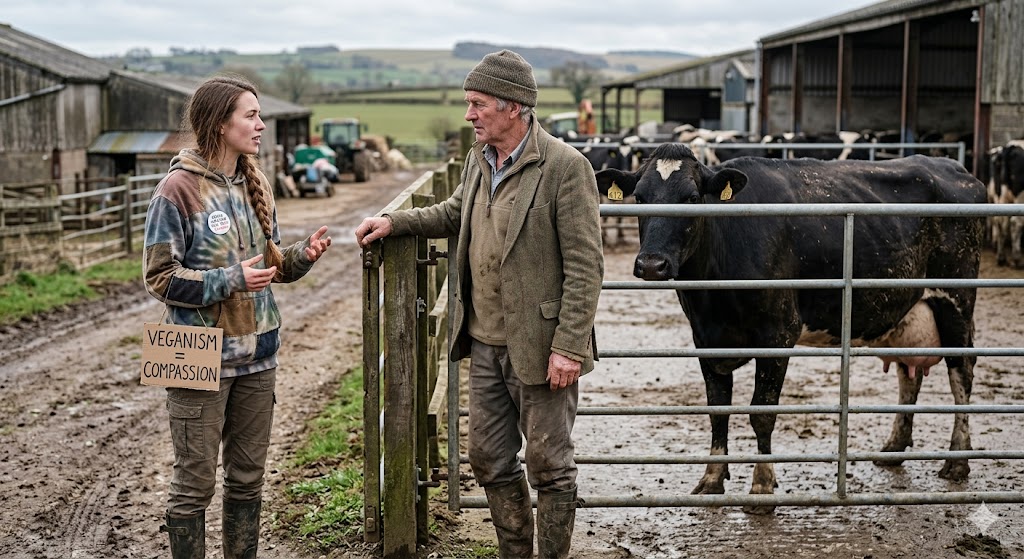
Activist: "Dairy is the cruellest industry."
Farmer: "She's stood at the gate waiting to be milked. Came in on her own."
Activist: "Yes, but you separated her from her calf."
Farmer: "After a day. She gives forty litres. The calf needs six. He'd be the size of a sofa by lunchtime."
Activist: "Only because she's bred to overproduce."
Farmer: "Bred over ten thousand years to feed three calves through a Pleistocene winter. We are the spare calves she was prepared for."
Activist: "Doesn't excuse forced impregnation."
Farmer: "She's bellowing across three fields and standing on her friend. The cow files the request. I do the paperwork."
Activist: "And the milking machines hurt her."
Farmer: "She walks in herself. The door's open the other way. She has never used it."
Activist: "Her body will break down at five."
Farmer: "My oldest girl is twelve and currently bullying the heifers off the trough. Tell her she's broken down. I'll wait."
Activist: "..."
Farmer: "She is laughing. You just don't speak cow."
100% there is no genocide in Gaza. No eradication project. People confused about what the word means is culturally appalling and dangerous for the future of western society. The confusion has indeed been engineered by people know what they are doing. No genocide does not mean simply too much death and destruction in war. It is about intent and action to destroy a national, ethnic, racial, or religious group, in whole or in part. Sam Harris @MakingSenseHQ is spot on.
Farmer: "Gentlemen. I'd like to present the ultimate plant-based protein technology."
Investor 1: "We're listening."
Farmer: "It converts inedible plant matter into complete protein. Grass, cornstalks, brewery waste, vegetable peelings. Anything cellulose-rich that humans can't digest."
Investor 2: "Energy requirements."
Farmer: "Sunlight."
Investor 2: "For the plant matter, you mean."
Farmer: "And for the conversion. Same sunlight. Reused."
Investor 3: "Heating costs for the bioreactor."
Farmer: "None. The unit holds 38.5 degrees year-round on its own."
Investor 1: "Failure rate."
Farmer: "Self-repairing. The unit also replicates once a year at no additional cost."
Investor 3: "Replicates."
Farmer: "Produces a smaller version of itself. Which becomes a full unit."
Investor 2: "Net carbon."
Farmer: "Neutral. The carbon in goes back to the air the grass pulled it from. Round and round, same atoms, no new ones added."
Investor 1: "And the waste output."
Farmer: "Twenty tonnes of soil enrichment per unit per year. The waste is also a product."
Investor 2: "This would obliterate Beyond Meat."
Farmer: "It already has. They just don't know yet."
Investor 1: "Where can we see one."
Farmer: "There are about 1.5 billion currently deployed. Have been for ten thousand years."
[silence]
Investor 3: "It's a cow, isn't it."
Farmer: "It's a cow."
Investor 2: "We were promised plant-based."
Farmer: "The plant goes in one end. I don't know what else you wanted."


![SamaHoole's tweet photo. Farmer: "Gentlemen. I'd like to present the ultimate plant-based protein technology."
Investor 1: "We're listening."
Farmer: "It converts inedible plant matter into complete protein. Grass, cornstalks, brewery waste, vegetable peelings. Anything cellulose-rich that humans can't digest."
Investor 2: "Energy requirements."
Farmer: "Sunlight."
Investor 2: "For the plant matter, you mean."
Farmer: "And for the conversion. Same sunlight. Reused."
Investor 3: "Heating costs for the bioreactor."
Farmer: "None. The unit holds 38.5 degrees year-round on its own."
Investor 1: "Failure rate."
Farmer: "Self-repairing. The unit also replicates once a year at no additional cost."
Investor 3: "Replicates."
Farmer: "Produces a smaller version of itself. Which becomes a full unit."
Investor 2: "Net carbon."
Farmer: "Neutral. The carbon in goes back to the air the grass pulled it from. Round and round, same atoms, no new ones added."
Investor 1: "And the waste output."
Farmer: "Twenty tonnes of soil enrichment per unit per year. The waste is also a product."
Investor 2: "This would obliterate Beyond Meat."
Farmer: "It already has. They just don't know yet."
Investor 1: "Where can we see one."
Farmer: "There are about 1.5 billion currently deployed. Have been for ten thousand years."
[silence]
Investor 3: "It's a cow, isn't it."
Farmer: "It's a cow."
Investor 2: "We were promised plant-based."
Farmer: "The plant goes in one end. I don't know what else you wanted."](https://pbs.twimg.com/media/HI1_ZQsW8AAJAfB.jpg)


