I'm so excited this is out!! We wrote a review about how the nature of statistical learning may change with development. Feeling very lucky to have had the dream team of mentors to think (and write) about these issues with ⭐️ @amysuefinn@megschlichting@duncanlabUofT
'Changes in statistical learning across development', a new Review by @tessforest, @megschlichting, Katherine D. Duncan & @amysuefinn
Web: https://t.co/YVQomsrrVh
ReadCube: https://t.co/eCBCZdUV9C
Thrilled to share our new preprint validating personalized fMRI state segmentation during event processing. Thanks to our amazing collaborators @amysuefinn Huiqin Chen @whartonshumthin, intrepid project lead @robyn_e_wilford and Linda Geerligs for developing the GSBS algorithm.
Early Caregiver Predictability Shapes Neural Indices of Statistical Learning Later in Infancy! Out today in Dev. Science 🙂 A team effort (!) w/ coauthors incl. @dcnlabcolumbia@laurel_joy_gd@SarahMcCormick1 Nwabisa Mlandu, Michal Zieff and @KirstyDonald https://t.co/zabmioiWZZ
And, this was only true for entropy in the same modality as the learning task, maybe suggesting variability in sensory input early in life helps explain why SL performance doesn't always correlate across modalities, or why we see different dev. trajectories of auditory/visual SL
This helps us understand why past research shows a link between caregiver predictability and cognitive outcomes across species (hot topic @FluxSociety this week!): nuanced variation in early predictable experiences shapes the development of core learning processes early in life.
New paper out! We show how children really are little sponges, learning to the same extent regardless of whether we tell them to focus or not! And the fact that @MarlieTandoc managed to see this through from her lab-manager days will forever impress me!! https://t.co/aLtqs9BLUN
Job alert! Looking for a postdoc with experience and interest in EEG, sleep, memory consolidation, and/or aging for a recently funded 3-year project. Feel free to email me with any questions. Link below for job ad: https://t.co/200yJzqYox
This paper is now officially out in @JOCN_Journal! In it, we use intracranial recordings to explore how the brain rapidly extracts temporal structure across experiences!
https://t.co/xl8VVwFvf8
U of T researchers have shown that while children struggle to pay attention, they still take in information — even info they are instructed to ignore — and there may be many reasons why this is beneficial.
Read more about the study: https://t.co/rqHBuTGSnP
Looking for a postdoc! This position would focus on understanding shifts of covert attention that occur before eye movements using EEG and eye-tracking. There would be opportunities for research on capture as well. More info here:
https://t.co/0GtU3z4WQg
Maternal predictability differs based on environmental affordances! Come check out these @dcnlabcolumbia lab managers’ poster this morning at #aps2023 👏🏻👏🏻
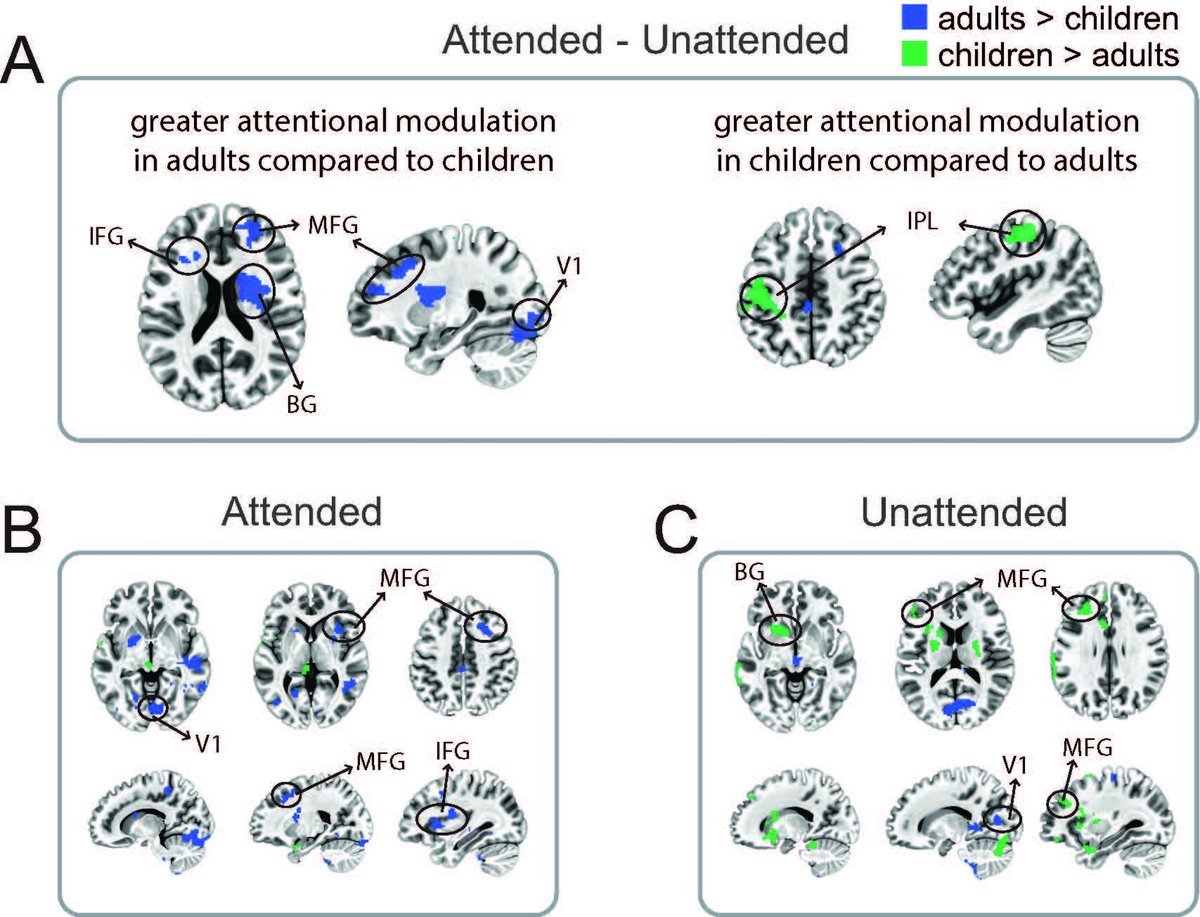
The first kid fMRI study I ever helped scan is out now! ⭐️A real joy to learn from @yaelanjung@amysuefinn and @DirkBWalther throughout this project (and the results are pretty cool, too!)
#JNeurosci: @yaelanjung, @tessforest, @DirkBWalther, and @amysuefinn@UofT show that attention works differently in children's brains compared to adults', likely allowing children to learn about facts that are not immediately relevant for a task.
https://t.co/zoUHeD5ERC