🚨🚨🚨 Out today in @IJBNPA!
2 x Laboratory RCTs on the effect of reducing meal portion size on total daily energy intake, considering the moderating role of socioeconomic position (SEP)
https://t.co/LnvT8DGguA
@eric_robinson_ @Katie_Clarke9 @LucileMarty1 & Andy Jones 🥳
🚨 funded PhD opportunity (UK)
Come and work with @J_P_Reynolds and a fabulous supervisory team at Aston!
Research focus = advancing theory on why people support/oppose policies ✅
Deadline 1st Apr
New @IJBNPA: Reducing meal portion sizes could be an effective way to reduce overall daily energy intake and—contrary to other suggestions—it may be a socioeconomically equitable approach to improving diet. 🇬🇧🇬🇧🇬🇧🇬🇧🇬🇧🇬🇧🇬🇧
https://t.co/xsBApJc5iu
🚨🚨🚨 Out today in @IJBNPA!
2 x Laboratory RCTs on the effect of reducing meal portion size on total daily energy intake, considering the moderating role of socioeconomic position (SEP)
https://t.co/LnvT8DGguA
@eric_robinson_ @Katie_Clarke9 @LucileMarty1 & Andy Jones 🥳
5/5 🍝⬇️ Reducing meal portion sizes could be an effective way to reduce overall daily energy intake beyond the initial meal, and contrary to other suggestions it may be a socioeconomically equitable approach to improving diet.
4/5 📊We found that smaller main meal portions led to ⬇️ -235 kcal per day (95% CI: 134, 336) in Study 1 and ⬇️-143 kcal per day (95% CI: 24, 263) in Study 2.
No evidence that SEP moderated these effects in any analyses - ie worked for both higher and lower SEP.
🥳Our new publication is out! https://t.co/L5JlfXwyfC
We found that increasing the availability of non-alcoholic drinks reduced selection and purchasing of alcohol in an online supermarket setting (full thread below) ⬇️
[5/5] No evidence that higher vs lower SEP individuals differ in their response to increased availability of healthier foods. Potentially effective/equitable intervention to promote healthier dietary choices - more research now required in real world environments measuring intake
🚨 New paper out in Obesity Reviews
A systematic review and meta-analysis examining socioeconomic equity of the effect of increasing availability of healthier foods on food choice and energy intake
https://t.co/iIICEkCMrr
@eric_robinson_ @LucileMarty1 Maisie Inns & Andy Jones!
[4/5] We also found that increased availability of healthier foods was associated with fewer kcal selected (-131kcal - higher SEP; -109kcal - lower SEP) - no moderation by SEP
Congratulations🙌 to EDIT collaborator @eric_robinson_ on their most recent systematic review and meta-analysis examining socioeconomic equity of the effect of increasing availability of healthier foods on food choice and energy intake.
https://t.co/Hd18MWbpJm
@WorldObesity
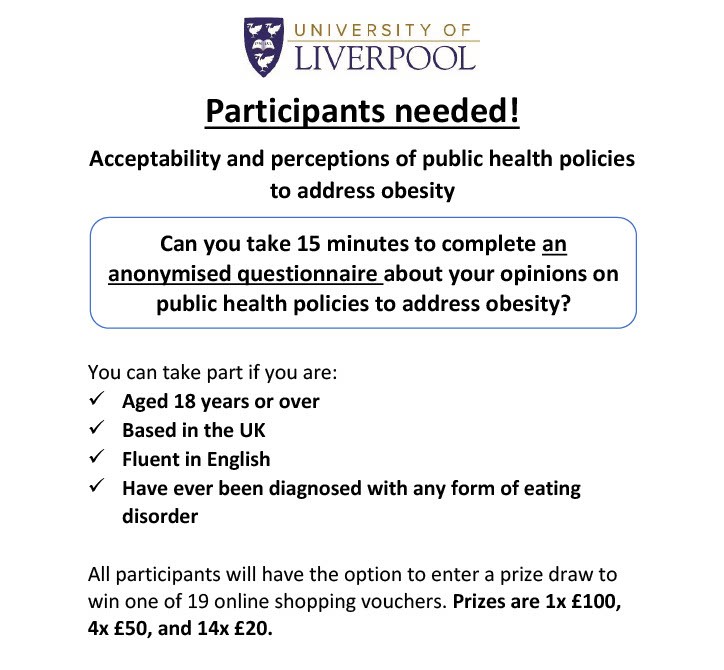
PARTICIPANTS NEEDED!
We're recruiting participants who have been diagnosed with eating disorder(s) to share their thoughts on public health policies to address obesity in the UK (~15min & prize draw). Check the eligibility criteria below. Please RT.
👉 https://t.co/NQS3EemhqS