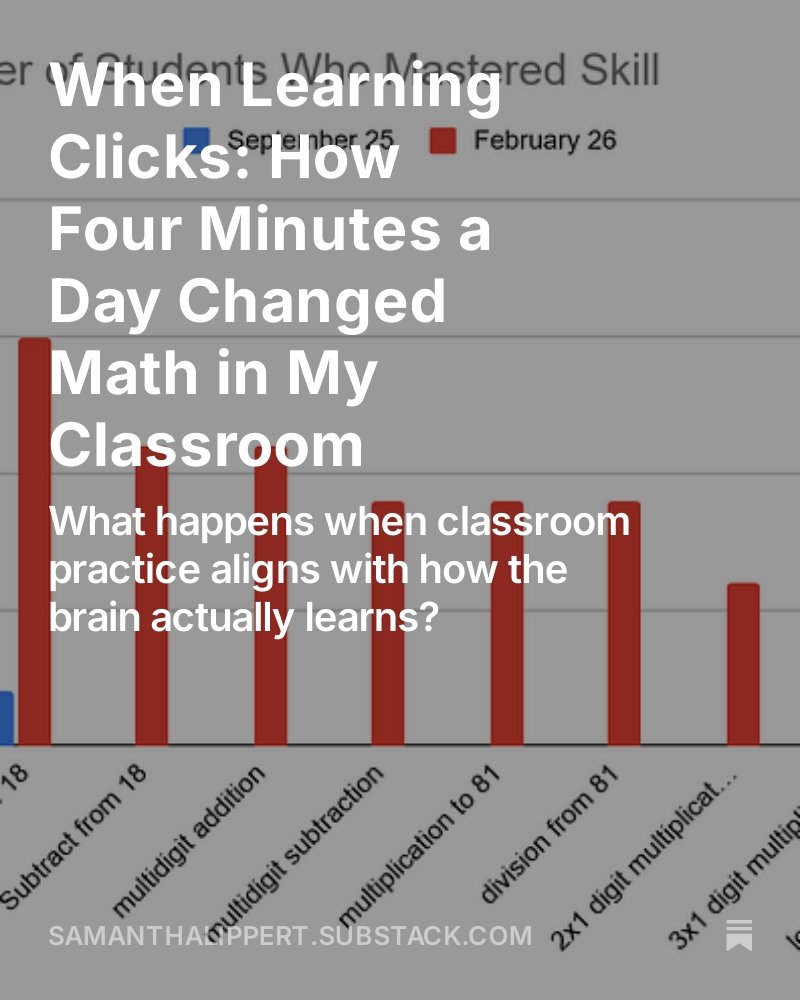
When instruction aligns with how the brain learns, success becomes predictable.
Automatically didn't replace thinking - it created space for it.
Check out my latest substack post!
https://t.co/9y14C9CtJY
There is no such thing as a "visual learner."
While students may have learning style *preferences* (e.g., visual vs. verbal), they do not actually learn better when receiving information via their preferred learning style.
This has been empirically tested over and over again. But despite having countless stakes driven through the heart, the myth continues to rise up from the grave like an unkillable zombie. It is the educational equivalent of astrology.
To get ahead of the a common follow-up confusion:
Q: "But math topic XYZ clicked for me when I saw an image/diagram!"
A: What you're thinking of is matching instructional design to the content, not matching teaching style to the learner.
Lots of math topics benefit from images/diagrams regardless of what the learner might claim is their learning style.
Yes, an image/diagram may help you learn a particular math topic. That doesn't mean you are a visual learner.
What it means is that the particular information being taught is effectively communicated through an image/diagram. For everybody, not just for you.
What you're experiencing is that you learn better when the instructional design is properly tailored to the information being taught.
From the bottom-left reference in the screenshot, "How Learning Happens" by @P_A_Kirschner and @C_Hendrick:
"How do you explain to a pupil in an auditory way how crimson red and brick red look? Or how do you kinaesthetically explain how a blackbird sings? In other words, it's actually the subject matter and the learning goal that should determine how one teaches and not a preference or a non-existent learning style."
Exit tickets are a popular method of closing a lesson. We have so many options when it comes to closing a session of learning. Reflect on mindset? Make relevant connections? Go back content? Examples from 'Hacking Questions' by C Hamilton
Neuroscience shapes how we understand reading. Do classrooms keep up?
The “From the Archives” article, “The ‘Reading Brain’ is Taught, Not Born,” shows how cognitive science challenges assumptions and reinforces the need for evidence-based instruction.
https://t.co/dzTvfLLNu1
Every time I hear someone say that ‘building relationships is how we get children to behave’ I’m amazed how often they then don’t define what
A) they mean by a relationship
B) how to actually build this mysterious thing.
This leads to multiple errors, eg trying to get kids to ‘like’ you and so on.
Part of the problem is that a lot of research into this appears to be dependent on correlation, not causation. Typically you see great behaviour and good relationships together, so people assume the latter causes the former.
But a good relationship is the outcome of good behaviour management, not the other way around. It’s a product, not a cause.
Why? Because a ‘relationship’ is simply a description of two things- How two or more people typically
1. Behave and
2. Value one another.
So if you want to ‘build a relationship’ you teach students how to act with one another, with you, with school peers, and so one. Simultaneously you teach them that they matter to you, and that their safety and success matters.
These things are far more important than ‘do you know what football team they support?’ You’re not their mate. The relationship you want- and they need- is adult to child, student to teacher. Demonstrated high regard AND standards.
Oh, one more major thing: boundaries. Students need to know there are limits of acceptable conduct, with penalties for crossing them. Any discussion about behaviour, or school behaviour system, that doesn’t have these, will eventually be pointless. No community survives without them, so why should classrooms and schools be different?
Yes.
Writing is not a second thing that happens after thinking. The act of writing is an act of thinking. Writing *is* thinking.
Students, academics, and anyone else who outsources their writing to LLMs will find their screens full of words and their minds emptied of thought.
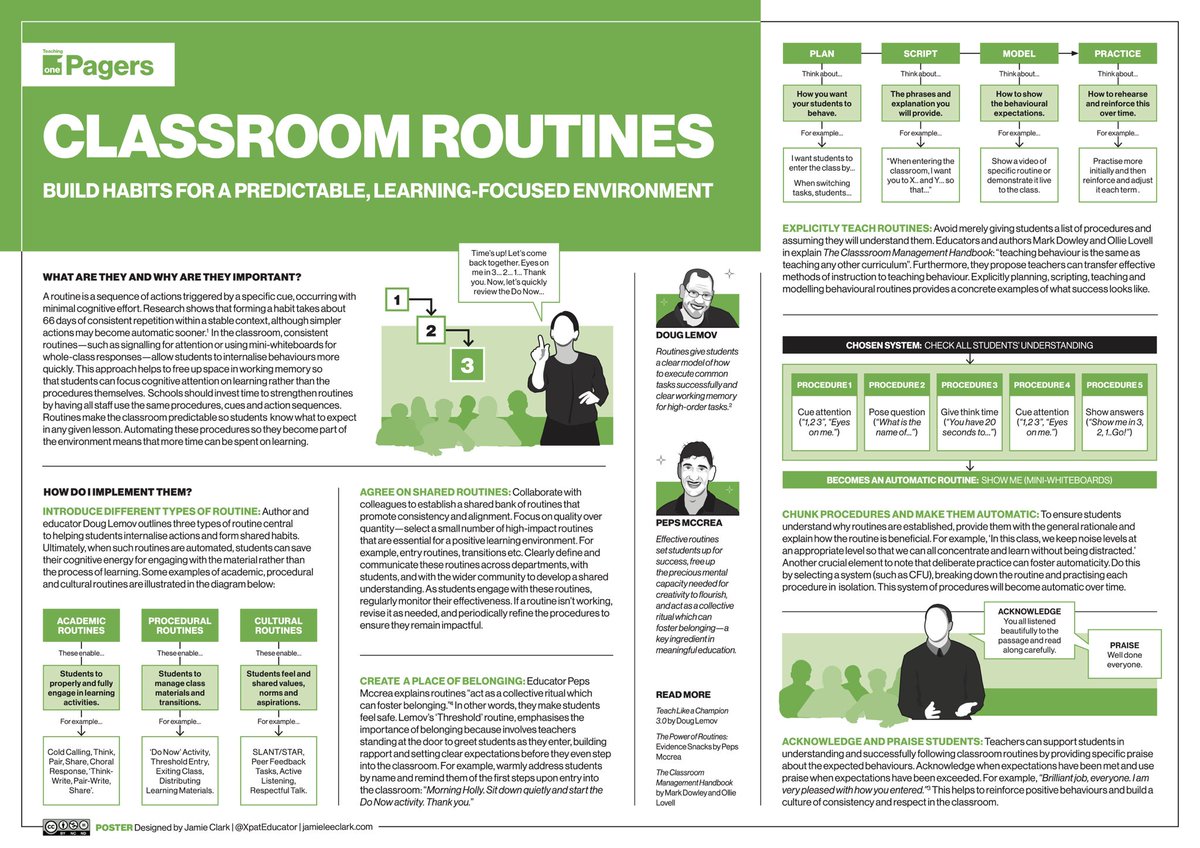
🔁 CLASSROOM ROUTINES! Routines free up time for what matters most—learning. This new poster summarises key strategies for establishing and automating effective routines to make classrooms predictable and run like clockwork. Inspired by the brilliant work of @PepsMccrea and @Doug_Lemov
🌱 Support my work by tapping REPOST and grab a FREE high-quality copy here: https://t.co/Xj2XpPGvnu
Students who lack foundational word recognition skills can struggle to comprehend what they read. Vocabulary must be taught explicitly, in a way that engages all of the parts of the brain associated with word recognition. One way to do this is through the POSSUM approach. Learn more about this approach in our past blog post: https://t.co/MLYDcBn9xl
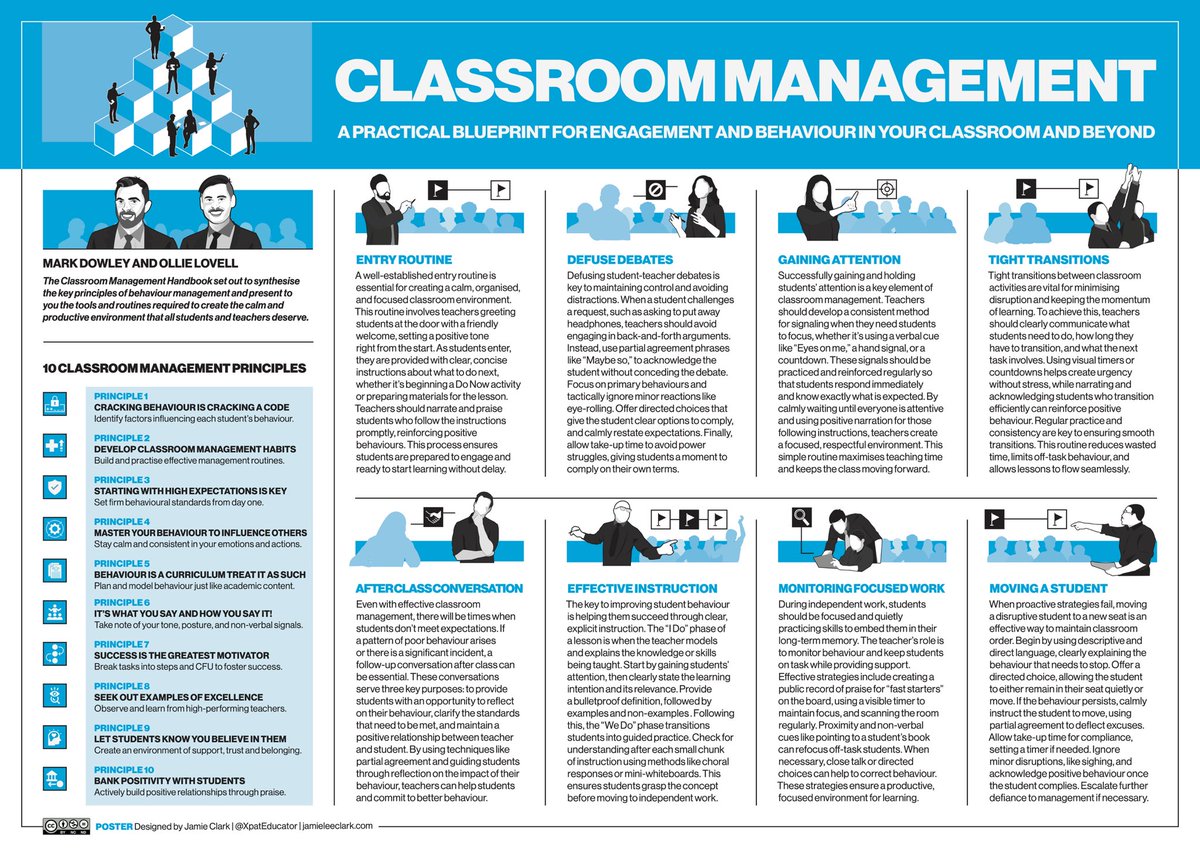
🛎️ CLASSROOM MANAGEMENT! This new A3 poster highlights the key principles and top routines from highly practical The Classroom Management Handbook by @coachdowley and @ollie_lovell. Grab your copy of the book via @JohnCattEd - these ideas have helped me personally create calmer, more focused classrooms!
☝️REPOST first and download a FREE HQ copy here: https://t.co/Xj2XpPGvnu
Fight against the SOR pendulum swinging too far ✊🏼
Students SHOULD decode words… AND they should look at the pictures/ask if what they read makes sense.
Metacognition is key—did what I thought the word said make sense in this context?
It’s NOT an either/or. It’s a first-then.
“Just because everyone gets Tier 1 doesn't mean they all get the same Tier 1.” AMEN @sstollar6 A blog for every literary teacher/leader to read. So many misconceptions about this. https://t.co/YKuBIoh3nX
In the absence of a Lesson Model, teachers & coaches who support them may be operating from entirely different mental models for how the lesson unfolds. The coach may be working from a model of higher clarity & precision.
Notes on our work with @HarmonyEdu
https://t.co/kHnMU6mIdo
Mic drop moment from @SusanBneuman talking with @measuredmom about literacy in preschool:
“I think the term ‘developmentally appropriate’ has been misused very often, and often as an excuse for not teaching.”
https://t.co/8TE7Cybv3U
"Only about 1/4 of the teachers who leave teacher prep programs across our nation enter classrooms prepared to teach kids to read... while the rest of the teachers who've invested lots of money & lots of time... enter classrooms unprepared." @NPR
https://t.co/ynotH7CH6z
🤩 Giveaway!
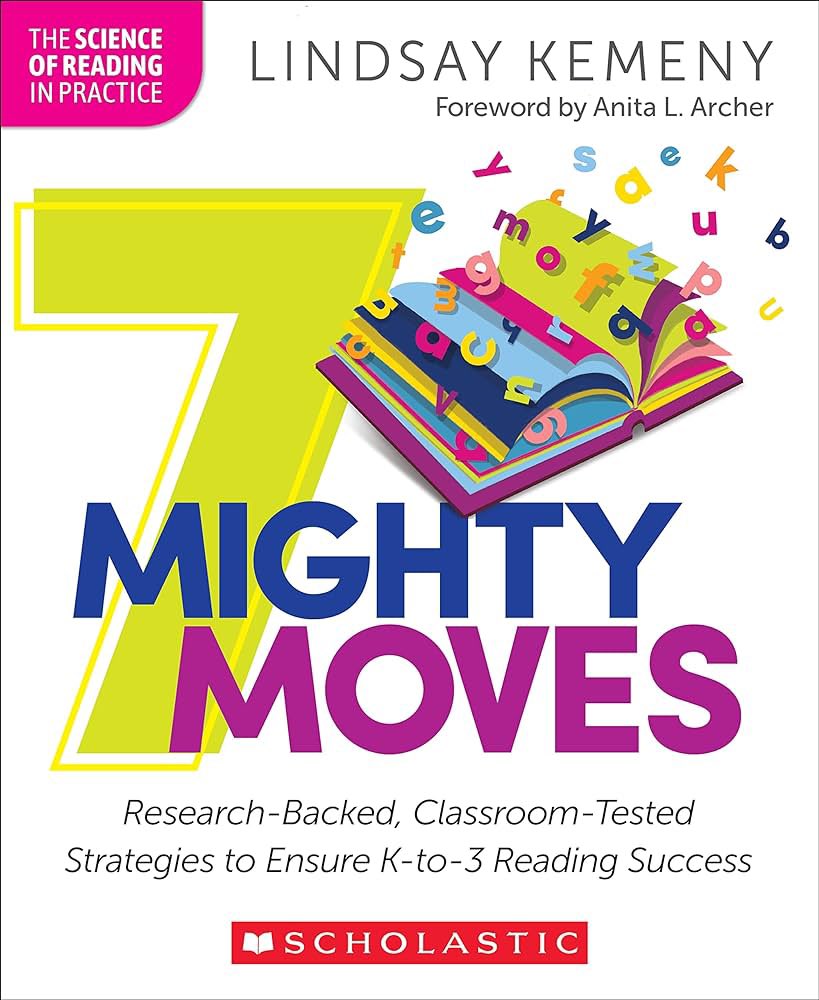
I’m ending 2023 by giving away a copy of the must-read 7 Mighty Moves by Lindsay Kemeny - one of my favourite books of the year!
🇨🇦 & 🇺🇸 only
To enter:
1. Retweet this tweet
2. Must be following me
Ends Thursday December 28th at 8 pm EST.
Good luck!
"You can have the best data in the world, but if you don't know how to integrate that into your instructional practice... your differentiation moves... then really the data is a dipstick divorced from your intentional actions in the classroom."
https://t.co/31DEIhdRXH @NWEA