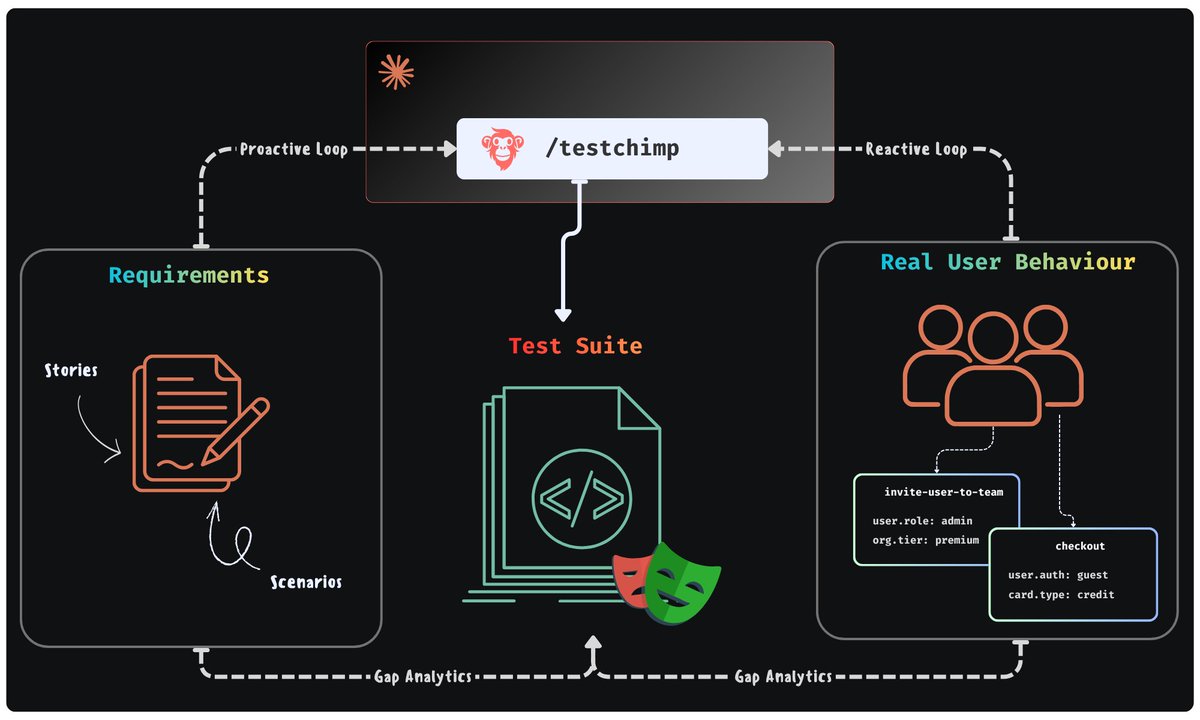
Introducing TestChimp: Autonomous QA for dev teams.
Automatically maintain your E2E test suite - aligned with requirements and real user behaviour insights.
Result: An AI SDET that writes the RIGHT tests that matter to your business. https://t.co/lGFNGGVpJi
#VibeTest#SDET
Once a release has the approvals you require, TestChimp can now call your CI/CD with a webhook: GitHub Actions, GitLab, Bitbucket, Azure DevOps, CircleCI, Jenkins or your own receiver.
So the go/no-go and the deploy become one step.
https://t.co/yNgHiiNcKt
#DevOps#QA
@nobrainer_tech nice, that's a cleaner guard than ours. one snag we'd expect: legit fixes that touch a shared fixture or page object under tests/ would trip it, so maybe scope the check to *.spec.ts files
Playwright CI uploads to TestChimp can now include a full video of the run. It opens from the execution viewer, and old videos clear out with your retention window.
Useful when a CI failure doesn't make sense from the trace alone.
https://t.co/yNgHiiNcKt
#Playwright#QA
Release sign-off usually lives in a Slack thread, and the deploy goes out either way.
TestChimp can now call your CI/CD deploy webhook (GitHub Actions, GitLab, Jenkins and more) once a release has the approvals you require.
https://t.co/yNgHiiNcKt
#QA#DevOps
A green CI badge is not release evidence.
TestChimp gives each release one picture: requirement coverage kept current by MeetBots and AgentWatch, what ran, and what changed since last time.
https://t.co/ha1X1eoiOr
#QA#DevOps#EngineeringLeadership
"Claude already writes our tests." Good, it should.
What it can't see alone: which scenarios have no tests, which tests nobody reviewed, and what to test next. TestChimp measures that, with MeetBots and AgentWatch keeping them current.
https://t.co/nrLcZKAvby
#QA#AgenticAI
@alexabelonix List on https://t.co/TnnF6UBW8L - unlike the gazillion "startup list" spams, the twist is - u can attach proof points like MRR, Webtraffic or even uptime to build user trust - and attract with a coupon offer.
Your agent fixed a failing test. Did it fix the test or loosen it?
In TestChimp a person marks a test verified after checking it, and a later agent patch flags it for another look. MeetBots and AgentWatch keep its scenarios current.
https://t.co/8IBXXdnB7k
#QA#AgenticAI
An hour ago you and your coding agent agreed that refunds over $500 need a second approval. Can your tests see that rule anywhere?
AgentWatch reads Cursor and Claude Code sessions and proposes story and scenario updates you approve.
https://t.co/kTBoCJ5Y0e
#AgenticAI#QA
Solo founders shipping with Lovable, Replit or Cursor: who does your QA?
Bonobi by TestChimp watches your pushes, test results and releases, keeps scenarios current with AgentWatch, and tells your coding agent what to test next.
https://t.co/tjNvXgC9r9
#Founders#QA#AgenticAI
Eng leads: which user flows did your tests skip this release?
TrueCoverage compares what real users do in production with what your tests touch, so the gaps become your agents' next tests. MeetBots and AgentWatch keep scenarios current.
https://t.co/IWCt62z6Xz
#QA#AgenticAI
@theo Limits and context side by side is useful. The failure we keep hitting past that is the decision from 3 threads back that never made it into the new one, so the agent "fixes" something that was intentional. Carrying those decisions forward matters more than the % used.
@swyx Curious what it pushes on. The gap we keep seeing between demo and real is the states nobody designs - empty list, failed save, slow network, expired session. Agents nail the happy path screen, then the first 500 shows a blank page.
@rauchg Agents filing structured feedback is the right loop. Same idea works inward too: when an agent gets confused in your own codebase, that's usually a missing requirement or a missing test. Most teams let it die in the chat log instead of writing it down.
@hwchase17 The save-steps-as-a-Playwright-file part is the bit we'd watch. Agent clicks through signup, it renders, test saved. That file now locks in whatever signup did today, bugs included. It only protects you if someone wrote down what signup should do before the agent checked it.
If your coding agent writes most of your tests, ask which parts of your API they never hit.
We built API contract coverage into TestChimp. It maps E2E traffic onto your OpenAPI spec and lists untested fields and response codes as gaps for your agent.
https://t.co/MxPnCwBcl8
Founder question: how do you decide a release is ready to ship?
For a lot of small teams it's a green CI badge plus a gut feel. Green tells you the tests you have passed, and nothing about the parts of the product they never touched.
What do you look at before you deploy?