a lot of old software was protected by “exploiting this would be an unreasonable amount of work”
we have invented a machine that does unreasonable amounts of work
anyway how’s the patch backlog
In response to the eMudhra / emSign certificate security incident we've published guidance for Python users to update CA certificates: https://t.co/tjBrJM4iTZ
#security#Python#pki
https://t.co/tjBrJM4iTZ
The PSF is hiring a CPython Developer in Residence! Full-time, remote, $70K–170K (US) or comparable contractor rates abroad. Help keep Python’s core healthy and support the volunteers who maintain it. Apply by Nov 19:
https://t.co/Fw5k4Hzdvv
#Python
https://t.co/Fw5k4Hzdvv
Python 3.15 adds lazy imports with the new lazy keyword! 🐍
Instead of loading a module when your script starts, Python waits until you actually use it.
Here's a quick example:
lazy import json
lazy from pathlib import Path
Good use cases:
- CLI tools where most commands only need a few modules
- Big libraries like pandas or numpy that you only use in one code path
- Apps where startup time matters
The result is faster startup times with almost no code changes.
Will you use it? 🚀
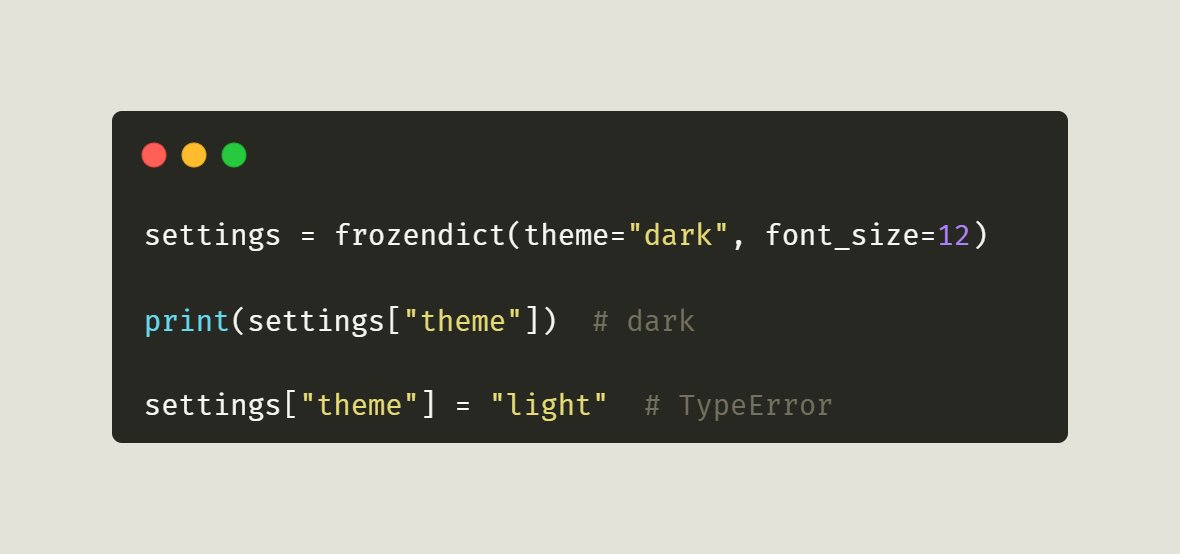
Python 3.15 adds frozendict as a built-in type! 🐍
It works like a dict, but it's immutable. Once you create it, you can't change it. That also makes it hashable, so you can use it as a dict key or put it in a set.
Great for config data you don't want changed by accident.
Will you use it?
Here's a quick example:
Python 3.15 is officially out! 🐍🚀 Here are some of the new features I'm most excited to try:
1. Lazy imports with the new lazy keyword for faster startup times
2. frozendict is now a built-in type
3. A new sentinel built-in type
4. Unpacking in comprehensions
5. UTF-8 is now the default encoding
6. Tachyon, a new sampling profiler in the profiling package
7. A faster experimental JIT compiler
8. Better error messages and more color in the CLI
Which one will you use first?
Shared some notes on Python 3.15, using it with uv, and features from Python 3.11 I'm excited to use now that 3.10 is no longer the minimum supported version for my own projects https://t.co/rlGKf8WI62
Python 3.15 is out! 🐍🎉
A few of my favorite new features:
• UTF-8 default encoding on Windows (boring but big)
• profiling.sampling!
• lazy import json
• [*x for x in nested]
• sentinel()
• frozendict
• pprint(data, expand=True)
More 👇
https://t.co/9OdE07wmLj
SQLAlchemy 2.1 was released 2 weeks ago, it adds several typing improvements and has @psycopg's latest version as the default for Postgres 🎉
SQLModel 0.0.48, just released, adds support for it, so you can get the new cool stuff by default. 🥳
https://t.co/EQ1OrhlO1P
in general, beware of forming a whole opinion based on one single thing
for example, making broad characterizations about programming languages based on a single benchmark about them
@pamelafox@TalkPython Thanks for the shoutout Pamela! Very surprising result (on the memory side). Here the full background article referenced for folks reading the tweet but not watching the talk: https://t.co/gIIFfuQd4L
Make DjangoCon US part of your 2027 plans.
Join the Django community for five days of learning and connection in Riverside, California.
September 13–17, 2027
Get your ticket: https://t.co/X1izH7DJWV
#DjangoConUS#Django#Python