@Romi2656 This story is just insanely creative! The visuals are so real it's like a movie — and that escape plot? Absolutely thrilling, couldn't look away! So grateful for this ArtArch journey 🚀✨ come on and start with us at 🥰https://t.co/IyyM4maQce
Without speed references, a running shot can look slow. In a MiniMax H3 test, fast foreground posts and slower background retreat made motion easier to read. That does not prove absolute speed or cross-model stability.
One topic became a Vox-style explainer. ArtArch shaped 12 script beats, visual prompts, and narration for an explanation of how The Big Short made money. The CLI laid out the production on a canvas and ran it in stages.
For character reenactment, we supplied a motion video and a character image. ArtArch separated motion from identity. The CLI created the canvas, generated a depth pass, and produced a new video that keeps the source timing, movement, and framing.
Most creative projects do not start with a perfect prompt. Ours started with: "Make a bright, restrained product film for a Japanese audience." ArtArch turned it into a character reference, an art reference, a 16-panel storyboard, and a video.
Object swaps drift when you name only the new prop. Add screen position, floor contact, scale, perspective, and a nearby anchor. In one MiniMax H3 A/B, B held the relations, but A stayed coherent too: no clear winner.
Name one unwanted person, protect the main subject and camera, and rebuild the cleared background. Our MiniMax H3 A/B runs hit media-read 403 before any video artifact, so this E0 prompt structure remains unverified.
Use a 4.0-6.0s window, one fix, entry/exit states, and locks for subject, prop, camera, and light. A/B both hit InvalidParameter downloading shared video, so this E0 structure did not validate local regeneration.
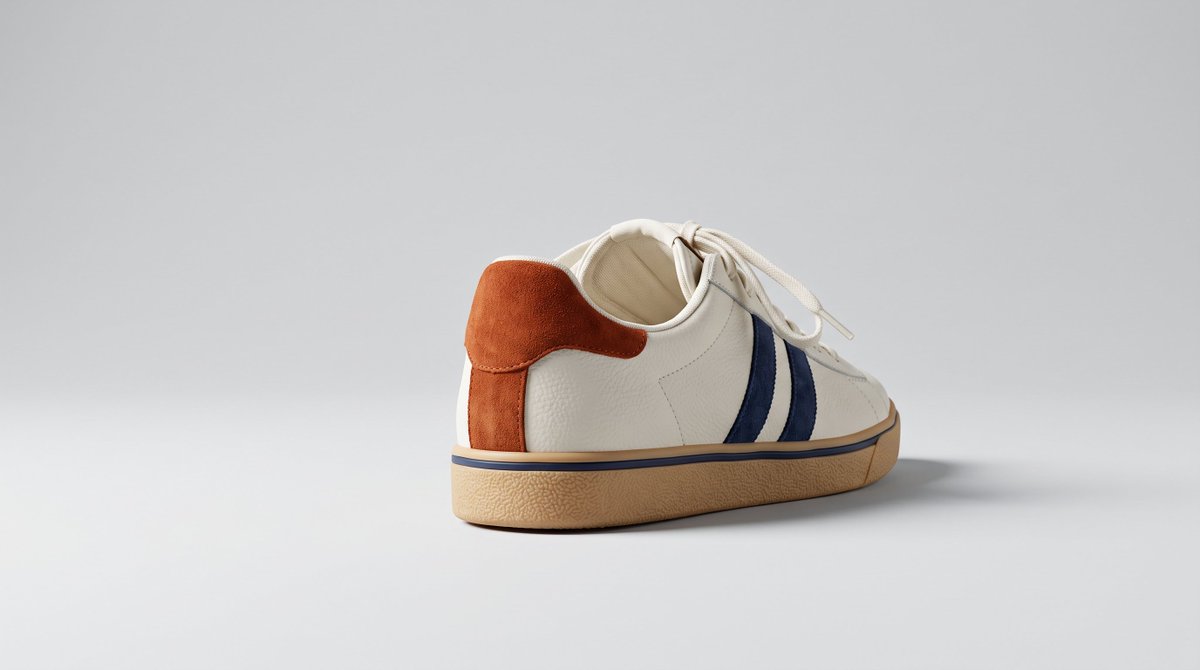
Camera angle changed which details stayed readable. Front view favored the toe and laces; a rear three-quarter prompt exposed the heel, side stripes, and sole depth. Evidence is limited to one Nanobanana 2 A/B.
Tyndall light made a beam read clearly in one Nanobanana 2 edit. I placed it above the left window, added suspended dust, and kept it behind the subject. 4:3 A/B only, so this does not generalize across models or scenes.
Name one light source and carry it through highlights, shadows, and bounce. One Nanobanana 2 A/B produced clear warm relighting, but clothing drifted, so identity preservation remains unproven.
Outpainting needs room anchors: window grid, brick, floorboards, shelves, perspective and light. The 16:9 control kept them; the technique run returned no image. This is a prompt structure, not a winner.
A punch reads better when the bag answers. I added a backward jolt and swing at contact, holding the boxer, gym, camera and MiniMax H3 fixed. The control failed, and stills could not confirm bag motion: no winner.