A Brazilian YouTuber killed the Photoshop subscription.
It's called PhotoGIMP. It takes GIMP, the free image editor, and makes it look and feel exactly like Photoshop.
Same toolbar. Same panel layout. Same keyboard shortcuts. Your hands already know how to use it.
Photoshop vs PhotoGIMP:
- Price: $275.88 a year → $0
- Account: Adobe login required → No login, ever
- Files: Saved to Adobe cloud → Saved on your computer
- Updates: Forced when Adobe says → Only when you want
- Works on: Windows and Mac → Windows, Mac, and Linux
No Adobe account. No cloud upload. No AI trained on your photos.
How small is the patch? Tiny.
→ Nine settings files. That's it.
→ Copy them into one folder. Done.
→ Open GIMP. It now looks like Photoshop.
→ Don't like it? Delete the folder. GIMP goes back to normal.
Three steps to install. One command to uninstall.
8,751 stars. 272 forks. 30+ people from around the world helping translate it.
One honest note: the license is GPL-3.0. Free for everything. Personal work, paid client work, your own edits. No "Pro" tier hiding behind it.
Dionatan Simioni runs the biggest Linux YouTube channel in Brazil. He built this from Marau, a small town in Rio Grande do Sul. No VC. No team. No fundraise.
This is what Photoshop should have been from the start.
(Link in the comments)
@ChampRDS I dont understand how you give a decision in favor of the challenger in that fight. At the very least, it was a draw and the champ should retain. All Strickland did is defend the takedown very well for one round and throw jabs. The rest was neutral or he was controlled.
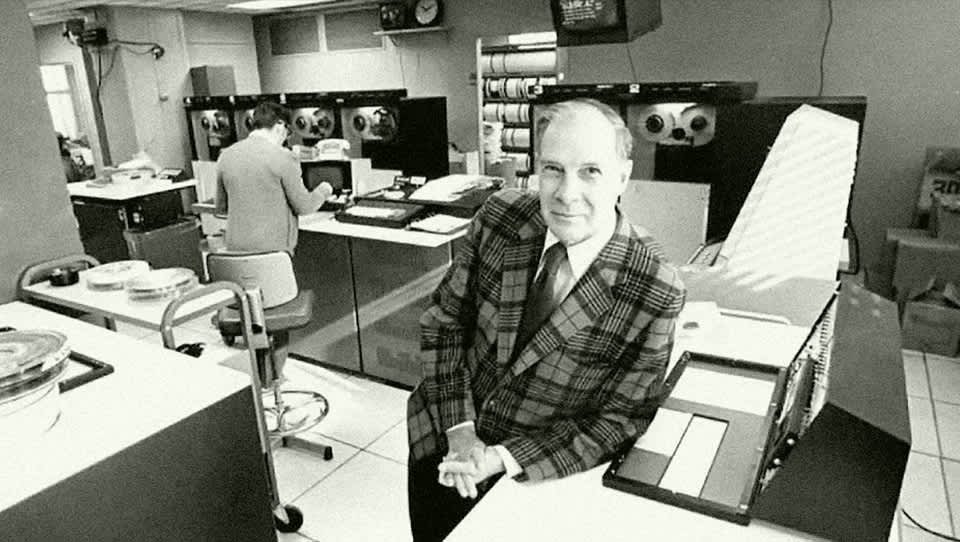
A mathematician who shared an office with Claude Shannon at Bell Labs gave one lecture in 1986 that explains why some people win Nobel Prizes and other equally smart people spend their whole lives doing forgettable work.
His name was Richard Hamming. He won the Turing Award. He invented error-correcting codes that made modern computing possible. And he spent 30 years at Bell Labs sitting in a cafeteria at lunch watching which scientists became legendary and which ones faded into nothing.
In March 1986, he walked into a Bellcore auditorium in front of 200 researchers and told them exactly what he had seen.
Here's the framework that has been quoted by every serious scientist for the last 40 years.
His opening line landed like a punch. He said most scientists he worked with at Bell Labs were just as smart as the Nobel Prize winners. Just as hardworking. Just as credentialed. And yet at the end of a 40-year career, one group had changed entire fields and the other group was forgotten by the time they retired.
He wanted to know what the difference actually was. And he said it wasn't luck. It wasn't IQ. It was a specific set of habits that almost nobody is willing to follow.
The first habit was the one that hurts the most to hear. He said most scientists deliberately avoid the most important problem in their field because the odds of failure are too high. They pick a safe adjacent problem, solve it cleanly, publish it, and move on. And because they never swing at the hard problem, they never hit it. He said if you do not work on an important problem, it is unlikely you will do important work. That is not a motivational line. That is a logical one.
The second habit was about doors. Literal doors. He noticed that the scientists at Bell Labs who kept their office doors closed got more done in the short term because they had no interruptions. But the scientists who kept their doors open got more done over a career. The open-door scientists were interrupted constantly. They also absorbed every new idea passing through the hallway. Ten years in, they were working on problems the closed-door scientists did not even know existed.
The third habit was inversion. When Bell Labs refused to give him the team of programmers he wanted, Hamming sat with the rejection for weeks. Then he flipped the question. Instead of asking for programmers to write the programs, he asked why machines could not write the programs themselves. That single inversion pushed him into the frontier of computer science. He said the pattern repeats everywhere. What looks like a defect, if you flip it correctly, becomes the exact thing that pushes you ahead of everyone else.
The fourth habit was the one that hit me the hardest. He said knowledge and productivity compound like interest. Someone who works 10 percent harder than you does not produce 10 percent more over a career. They produce twice as much. The gap doesn't add. It multiplies. And it compounds silently for years before anyone notices.
He finished the lecture with a line I have never been able to shake.
He said Pasteur's famous quote is right. Luck favors the prepared mind. But he meant it literally. You don't hope for luck. You engineer the conditions where luck can land on you. Open doors. Important problems. Inverted questions. Compounded hours. Those are not traits. Those are choices you make every single day.
The transcript has been sitting on the University of Virginia's computer science website for almost 30 years. The video is free on YouTube. Stripe Press reprinted the full lectures as a book in 2020 and Bret Victor wrote the foreword.
Hamming died in 1998. He gave his final lecture a few weeks before. He was 82.
The lecture that explains why some careers become legendary and others disappear is still free. Most people who could benefit from it will never open it.
🚨Architects are going to hate this.
Someone just open sourced a full 3D building editor that runs entirely in your browser.
No AutoCAD. No Revit. No $5,000/year licenses.
It's called Pascal Editor.
Built with React Three Fiber and WebGPU -- meaning it renders directly on your GPU at near-native speed.
Here's what's inside this thing:
→ A full building/level/wall/zone hierarchy you can edit in real time
→ An ECS-style architecture where every object updates through GPU-powered systems
→ Zustand state management with full undo/redo built in
→ Next.js frontend so it deploys as a web app, not a desktop install
→ Dirty node tracking -- only re-renders what changed, not the whole scene
Here's the wildest part:
You can stack, explode, or solo individual building levels. Select a zone, drag a wall, reshape a slab -- all in 3D, all in the browser.
Architecture firms pay $50K+ per seat for BIM software that does this workflow.
This is free.
100% Open Source.
Why is no one talking about this?
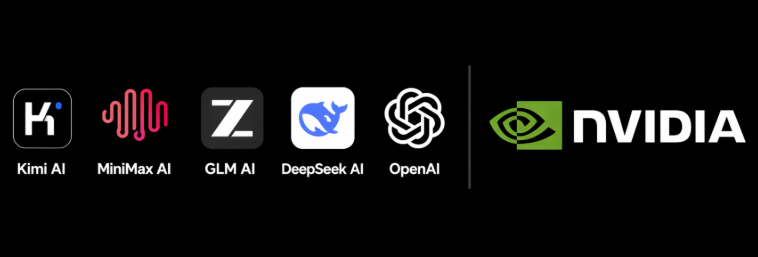
@nvidia is offering around 80 AI models via hosted APIs absolutely for free.
You get access to MiniMax M2.7, GLM 5.1, Kimi 2.5, DeepSeek 3.2, GPT-OSS-120B, Sarvam-M etc.
This plugs straight into OpenClaude, OpenCode, Zed IDE, Hermes agent and even with Cursor IDE.
Setup:
– Grab API key: https://t.co/Wfdclm0hY2
– base_url = "https://t.co/VOGC10LmGP"
– api_key = "$NVIDIA_API_KEY"
– select model (e.g. minimaxai/minimax-m2.7)
If you’re building or experimenting, this is basically free inference.
Lock in and start building today anon.
Thank me later.
Imagine every pixel on your screen, streamed live directly from a model. No HTML, no layout engine, no code. Just exactly what you want to see.
@eddiejiao_obj, @drewocarr and I built a prototype to see how this could actually work, and set out to make it real. We're calling it Flipbook. (1/5)
I watched a junior engineer debug latency.
He ran ping 10.0.0.45.
It showed 200ms.
He shrugged and said the network was slow.
I asked him if he enjoyed one-way measurements or just hated the return path.
He looked confused and said ping was standard.
I told him ping shows round trip but not asymmetry. The request could be fast and the reply slow. He wouldn't know which direction had the problem.
I showed him mtr --tcp --port=443 10.0.0.45.
The return path was taking a scenic route through a saturated link.
I told him ping-only thinking costs us hours of blaming the wrong side of the circuit.
I forced him to write a bidirectional latency test script.
Second company is "pivoting" to AI. 1st one was from shoes manufacturing to AI, and the next one is the space exploration to AI https://t.co/5MKbwk2Uy8
"Does anyone truly “belong” to the United States? Even if you were born here, your family’s story started somewhere else. America is not a place of one origin, but a place of many journeys." https://t.co/2sk8dMZ5EM
The 10 Most Valuable AI Learning Repositories on GitHub
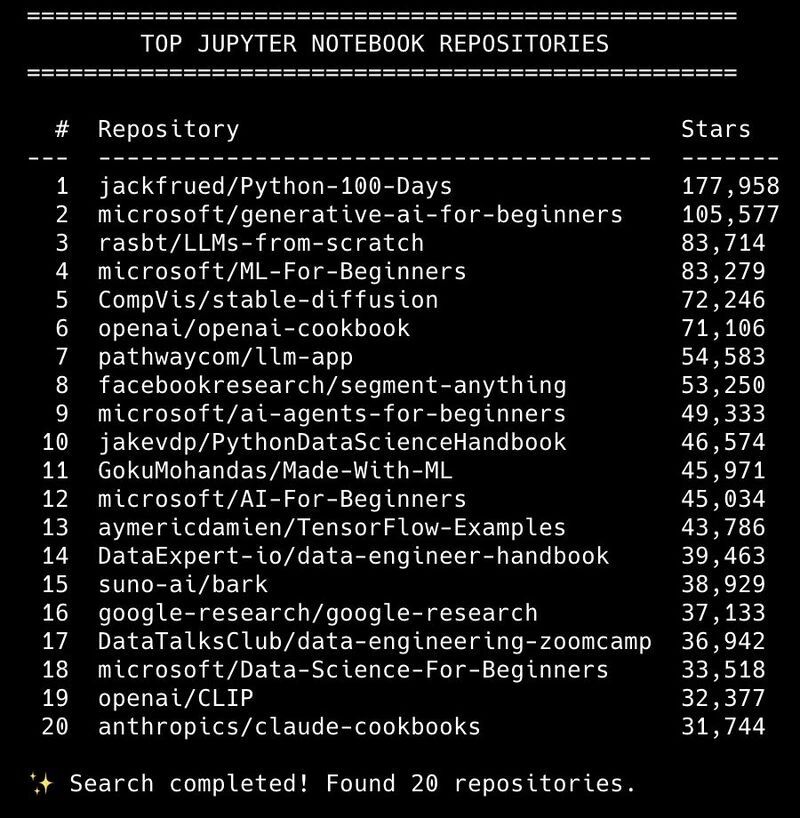
I analyzed the top GitHub repositories where Jupyter Notebooks (.ipynb) are the primary format and filtered out pure hype, keeping only the most practical, structured learning resources.
Here are the 10 repositories that will actually make you better at AI 👇
1. microsoft/generative-ai-for-beginners ⭐ ~105 k
Full repo for Microsoft’s Generative AI course with Jupyter notebooks and lessons on building GenAI apps.
🔗 https://t.co/kYbNYapApg
2. rasbt/LLMs-from-scratch ⭐ ~83 k
Educational implementation of GPT-style LLMs from scratch (code + notebooks).
🔗 https://t.co/wfWVRxm0ab
3. microsoft/ai-agents-for-beginners ⭐ ~49 k
Course on building agentic AI systems, tools, memory, planning, and workflows.
🔗 https://t.co/Dx0SaQnm3F
4. microsoft/ML-For-Beginners ⭐ ~83 k
Classic machine learning fundamentals curriculum (26 lessons).
🔗 https://t.co/ZdQUctcYFX
5. openai/openai-cookbook ⭐ ~71 k
Official OpenAI API examples, production-ready patterns, recipes, and demos in notebooks.
🔗 https://t.co/shhPvbpmnA
6. jackfrued/Python-100-Days ⭐ ~177 k
Intensive Python learning roadmap with 100 days of exercises/notebooks.
🔗 https://t.co/xGUZNhkwlz
7. pathwaycom/llm-app ⭐ ~54 k
RAG templates and real-world deployable LLM apps (prod-ready pipelines).
🔗 https://t.co/hU0mZ45Czk
8. jakevdp/PythonDataScienceHandbook ⭐ ~46 k
Foundational data science notebook collection (NumPy, Pandas, Matplotlib, Scikit-Learn).
🔗 https://t.co/wEboVo3HKM
9. CompVis/stable-diffusion ⭐ ~72 k
Original Stable Diffusion text-to-image model code (excellent learning material).
🔗 https://t.co/Kiteg9Ar4x
10. facebookresearch/segment-anything ⭐ ~53 k
Meta’s Segment Anything Model (SAM) for interactive image segmentation.
🔗 https://t.co/i78tc4AyGj
Cardiologist wins 3rd place at Anthropic's hackathon. Out of 13,000 applications. Built in 7 days by Michał Nedoszytko MD. Coded day and night - in the hospital, in the cloud, while flying from Brussels to San Francisco.
A few years ago, it would have been impossible for a doctor to build this alone in just a couple of days. AI changed that.
The project is called https://t.co/wAliajqjVF. It is an AI agentic care platform for patients. Including reverse AI scribe it is a companion that guides the patient from the moment they leave the doctor's office.
Powered by the massive context window of Opus 4.6, it allows patients to explore their full medical history, connected devices, Evidence Based resources and external data sources — all in one place.
Today, the barrier to entry has vanished; even a practicing physician can build an application from scratch.
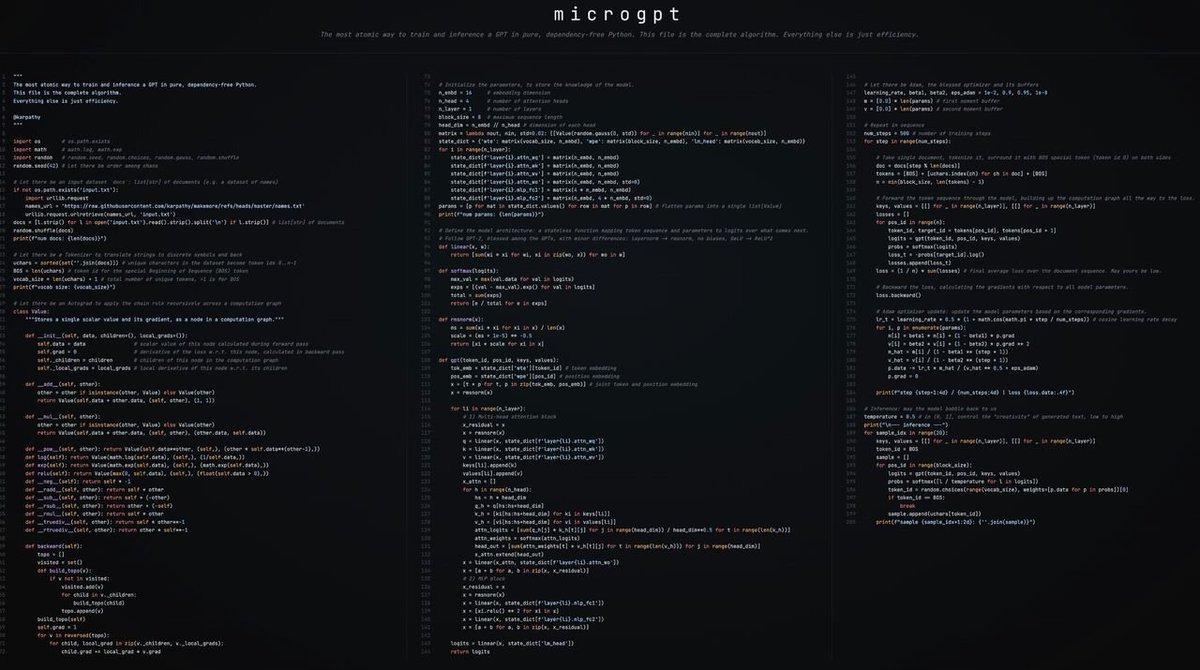
Most beautiful code I have seen shared in public recently.
Built by Andrej Karpathy - single file of 200 lines of pure Python with no dependencies that trains and inferences a GPT. This is how it should be taught to everyone trying to get into learning LLMs.
This might be the cleanest, most elegant public code drop in AI this year.
Karpathy's new "art project": microgpt (https://t.co/itMLfmOu5l)
→ Single Python file (~200 lines)
→ No PyTorch, no NumPy, no external libraries at all
→ Full working GPT: data loading → character tokenizer → tiny autograd engine → GPT-2-style transformer → Adam optimizer → training loop → inference/sampling
It's the bare-metal essence of what makes large language models tick - everything else (CUDA kernels, distributed training, mixed precision, flash attention, massive datasets…) is optimization & engineering around this core.
Perfect starting point for anyone trying to truly understand LLMs instead of just calling APIs.
Highly recommend reading + running it. Changes how you see "AI is just matrix multiplies + softmax" from abstract → concrete.
OpenClaw has 186K GitHub stars and 1.5M compromised API keys. I needed a secure alternative.
So, I built it with n8n and Claude Opus 4.6.
It can already:
- Reply to your Telegram messages
- Access selected folders from your laptop
- Access Gmail, Drive, Notion, Linear, etc.
- Install new local tools in a sandbox
- Run autonomously for hours
- Create multiple subagents
- Learn from experience
- Wake up regularly
But, unlike OpenClaw, it:
- Can't access your API keys
- Can't modify its environment
- Can't access folders you haven't shared
- Can't access tools you haven't approved
- Must get your confirmation, e.g., when sending emails
These aren’t prompt instructions. They’re hard architectural boundaries — Docker isolation, mounted folder permissions, n8n’s tool approval system.
Key components:
✅ The VPS on Hostinger hosts n8n and a sandbox container. Agents can also connect to my laptop's sandbox via a Claudeflare tunnel + Desktop Commander MCP.
✅ The Manager agent is the brain. It plans, decides, delegates, and talks to the user. It never touches files. It never runs scripts. It works entirely from executor summaries.
✅ The Executor agents are the hands. Each receives a task (what to do + why it matters), decides how to execute it, and reports back. They can install new tools and execute code only in their dedicated sandboxes.
✅ Data Tables in n8n store both memories and sessions — no external database, no vector store, no infrastructure. Just rows in a table. Turns out, that's enough.
Two memory types:
- Manager memory: user preferences, facts, corrections, relationship, skills, context
- Executor memory: what tools are installed, what’s broken, workarounds
✅ Sessions are short-term state for multi-step tasks. Original request, plan, assumptions, and what happened so far. When the Manager loops with fresh context, the session is all it gets. That's a Ralph Wiggum loop.
I've been using it for 5 days. And already can't imagine not having it on my phone.
What's next:
- Heartbeat via Cron (a scheduled prompt)
- Civic Nexus governance + MCPs
- Supermemory integration
- WhatsApp as an additional surface
- Hardening
The architecture supports all of it.
OpenClaw proved people want personal AI agents.
It also proved that 'just trust the prompt' isn't a security model.
Docker isolation, mounted folder permissions, tool approval — none of this is new technology. It's just discipline.
You can easily do this even with n8n — no coding required.
---
Want to try it or read more?
More, what I learned, and a setup guide: productcompass[.]pm