A Thread🧵
Silence in Dionysian Thought:
Dionysian theology is often mischaracterised as though apophaticism were the final destination of his approach to God. However, this is not the case. Negative theology is not the terminus, but rather a stage within a greater ascent towards Divine greatness.
Reminds me of the best Apostolic work:
‘He said to me: 'Hold fast to simplicity of heart and innocence. Yes! Be as infants who do not know the wickedness that destroys the life of men.’
•The Shepherd of Hermas (100-150 AD), Second Mandate
'From the twelfth white mountain these are the believers that come: They are innocent as babes into whose hearts no guile enters and they do not know what wickedness is, constant in their innocence. These believers, then, undoubtedly live in the Kingdom of God, because they have not sullied the commandments of God in any regard
•The Shepherd of Hermas (100-150 AD), Parable 9, Ch. 29
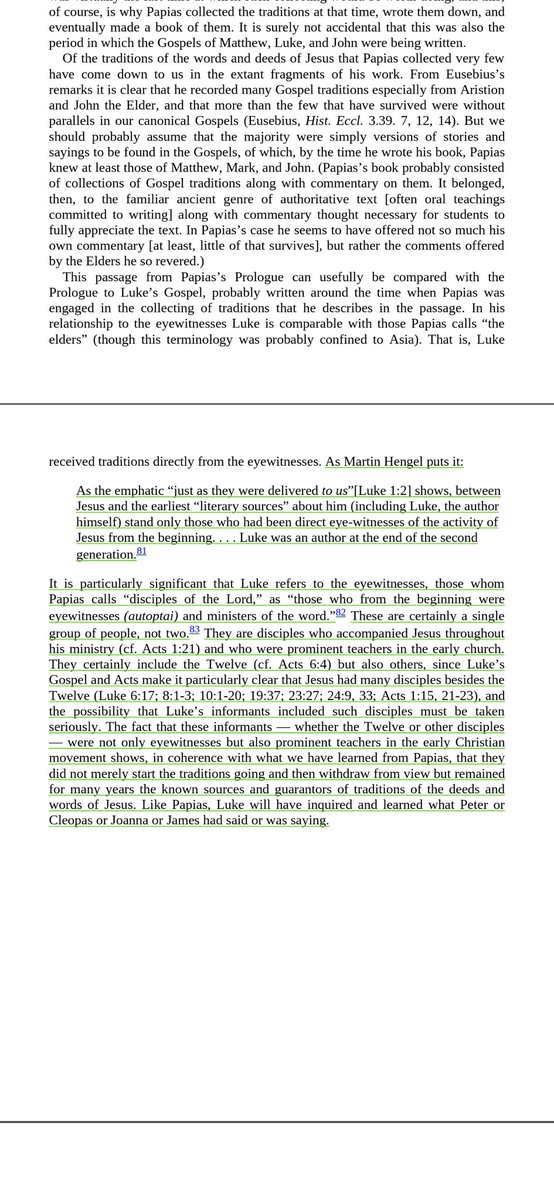
I love how you didn’t address anything and instead make separate claims but even if I grant that the Gospels were anonymous (which is not true, at least in the sense that you think it is), they were AT MINIMUM products of these early apostolic communities and Papias is a witness to the fact that the Early Church sought the teachings of the eyewitnesses FIRSTHAND and even preferred that to mere written work. Papias confirms 2 authors of the Gospels (GMark and GMatthew) and, according to Richard Bauckham’s scholarship, believed that GJohn was written by John the Apostle, of who he was a student of. GJohn also admits there were more still more traditions than the actual written ones we have received through the written Gospels, which is also in line with ancient biographies. You evidently aren’t well-read regarding these issue and parrot others.
Yes they did exactly that:
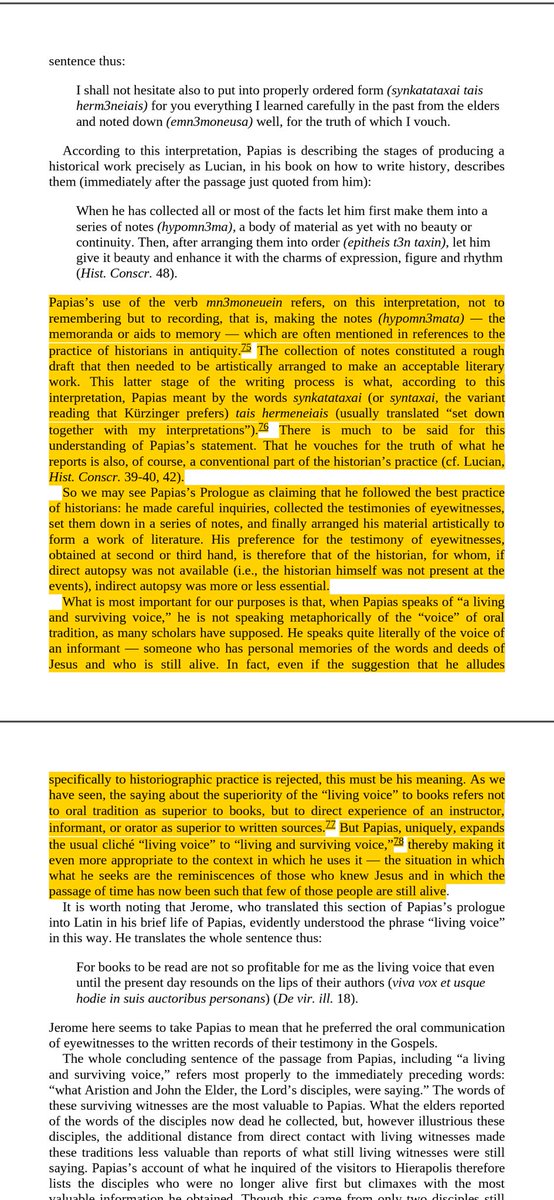
The two screenshots are from Richard Bauckham’s Jesus and the Eyewitnesses
‘We have seen that the “living voice” had a wide currency as a proverb of general import, but also that it is possible to identify three cultural worlds in which it has a more specific application. In rhetoric, it reinforces the centrality of live performance. Among craftsmen, it expresses the widely-felt difficulty of learning practical skills without live demonstration. And in the schools generally it serves as a reminder of the primacy of person-to-person oral instruction over the study (or the production) of manuals and handbooks’
•Loveday Alexander, “The Living Voice,” p.p. 242
“it is not oral tradition as such that Papias esteemed, but first-hand information. To the extent that he was able to get information directly, he did so and preferred to do so.”
•H. Y. Gamble, Books and Readers in the Early Church (New Haven: Yale University Press, 1995) 30-31
Yes they did exactly that:
The two screenshots are from Richard Bauckham’s Jesus and the Eyewitnesses
‘We have seen that the “living voice” had a wide currency as a proverb of general import, but also that it is possible to identify three cultural worlds in which it has a more specific application. In rhetoric, it reinforces the centrality of live performance. Among craftsmen, it expresses the widely-felt difficulty of learning practical skills without live demonstration. And in the schools generally it serves as a reminder of the primacy of person-to-person oral instruction over the study (or the production) of manuals and handbooks’
•Loveday Alexander, “The Living Voice,” p.p. 242
“it is not oral tradition as such that Papias esteemed, but first-hand information. To the extent that he was able to get information directly, he did so and preferred to do so.”
•H. Y. Gamble, Books and Readers in the Early Church (New Haven: Yale University Press, 1995) 30-31
@cappadocianist@harrishanafite how do we know the testimony catholic church is right/true?
how do we know your interpretation Gjohn n GLuke is right?
did the gospel writers explain their gospels to their disciples/people?
The same passage literally is addressing a Bishop (Episcopos) and instructing the Bishop to gather the believers, not the believers to assemble independently.
As our (Apostolic) Fathers wrote:
‘For to the high priest the proper services have been given, and to the priests the proper office has been assigned, and upon the Levites the proper ministries have been imposed. The layman is bound by the layman's rules.’ Let each of you, brothers, give thanks to God with your own group [order], maintaining a good conscience, not overstepping the designated rule of his ministry, but acting with reverence… Those, therefore, who do anything contrary to the duty imposed by His will receive death as the penalty.’
- St Clement of Rome (? - 99 AD), Epistle to the Corinthians, Chapter 40-41
‘It is essential, therefore, that you continue your current practice and do nothing without the bishop…, but be subject also to the council of presbyters as to the apostles of Jesus Christ, our hope, in whom we shall be found, if we so live…Similarly, let everyone respect the deacons as Jesus Christ, just as they should respect the bishop, who is a model of the Father…Without these nο group can be called a church.’
- St Ignatius of Antioch (?–107AD), Letter to the Trallians, Chapter 2 & 3
'Now let me tell you about the stones that go into the building. The square, white stones that fit accurately in their joinings, these are the apostles, bishops, teachers, and deacons who walk in accordance with God's reverence by administering with purity and sanctity the office of bishops, of teachers, and deacons for God's elect. Some of them rest in the Lord and some are still living. Now, they have always been in mutual agreement; they are at peace with one another and listen to one another. For this reason in the tower-building [the Church] their joinings fit accurately.'
•The Shepherd of Hermas (100-150 AD), Vision 3, Chapter 5
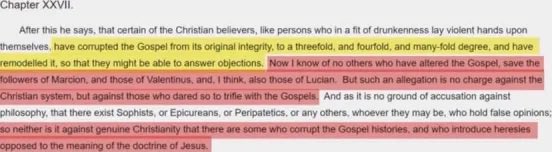
These are the worst accounts because I don’t think they acc read these sources but accumulate these images from elsewhere and post it, because this is clearly not what Origen is saying😂. He’s defending the faith against a pagan and is talking about what HERETICS did i.e. reject certain gospels and only use one (Ebionites- GMatthew, Valentinians- GJohn) and he’s referencing the Marcionites’ use of GLuke while also talking about how they removed certain passages from Luke linking Jesus to Judaism.
Origen believed that Christians corrupted the Gospel The Early Church father: Ante-Nicene church fathers Vol.4, Fathers of the third century, Origen against Celsus, Book II, Chapter 27
The final movement of Dionysian theology therefore does not terminate in negation, but in silence.
The structure Dionysius provides offers a moving pattern for prayer. Initially, we should dwell on how we perceive God in our own lives and his effects on the created order. Then, we should dwell on how his glory transcends all that can be known. Finally, having passed through both affirmation and negation, the soul should be brought into contemplation, stillness, and awe at our incomprehensible God.
A Thread🧵
Silence in Dionysian Thought:
Dionysian theology is often mischaracterised as though apophaticism were the final destination of his approach to God. However, this is not the case. Negative theology is not the terminus, but rather a stage within a greater ascent towards Divine greatness.
This does not imply God is a bare existential—that with existence but devoid of form—but rather as one whose existence and essence are identical, both of which transcend the human field of givenness.
While in any case existence is a transcendental and thus ‘that it is’ in creatures is unknowable, in God both ‘that He is’ and ‘what He is’ are beyond human grasp. Any phenomenon upon apprehension of God’s energies or effects cannot hope to even mediately reach the noumenon, that is, the essence itself. Any sense cannot hope to accurately describe the form of the Divine referent. This is not just because of semantic restraint, but because the Divine essence completely transcends the conditions of human cognition. Thus, even Negative Theology renders itself incomplete.
@Zombobwaver I have to keep repeating myself, it seems. The key word is ‘recent’. They’ve looked over the 20th Century scholars’ conclusions and showed that they failed to truly explore Irenaeus’ writings. Like I said, read both the Irenaean corpus and the 21st C explorative scholarship.
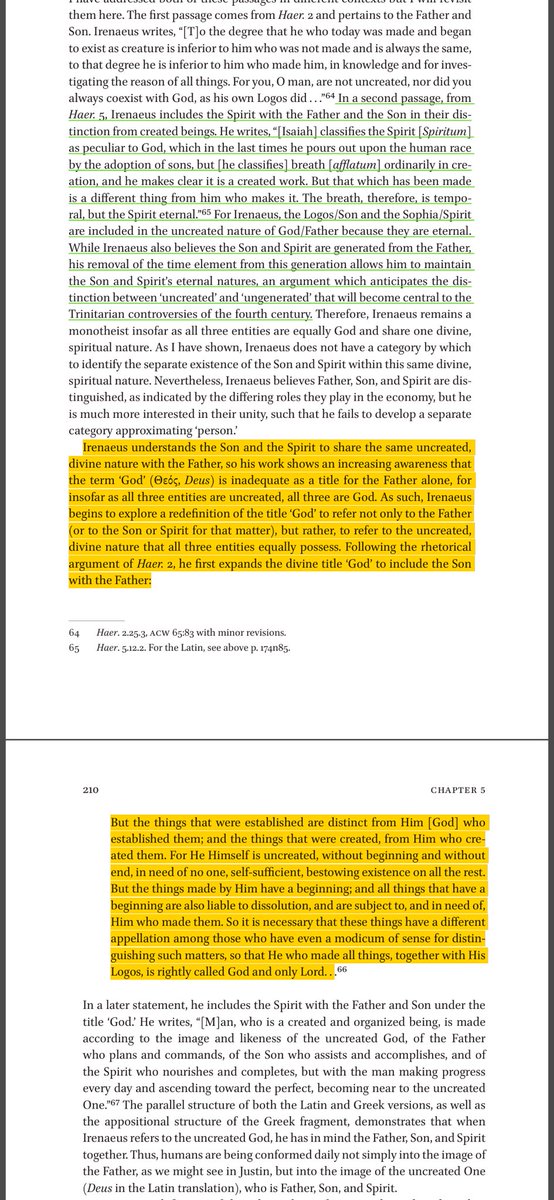
People need to stop parroting what others say and should research (honestly) instead. Read the recent scholarship on Irenaeus and IRENAEUS HIMSELF. (See pic #1 + #2 is ‘God and Christ in Irenaeus’, Anthony Briggman while #3 and #4 is ‘Irenaeus on the Trinity’, Jackson Lashier)