@Midnight_Captl Isn’t this just their negoatiring tactis to get long term recurring contracts . I imagine they’d take lower margins for a 5 year contract that helps them plan capacity
@hdpayens I think first clement may have been written in the 60s during the way Roman Jewish war - look at the line about the troubles in judea. It’s very strange they didn’t write to John, perhaps Rome was sending or withholding financial support
@JamesYo43532848 This makes perfect sense - it’s a bit surprising no one did this kind of research before. 1) money creation 2) asset inflation 3) capex inflation. 4) commodity inflation 5) wage inflation
@botblastcap@ilblackdragon I think near osa back door zec play because near facilities a lot of zec buying. Vvv plus zec is a more diversified position of ai and privacy
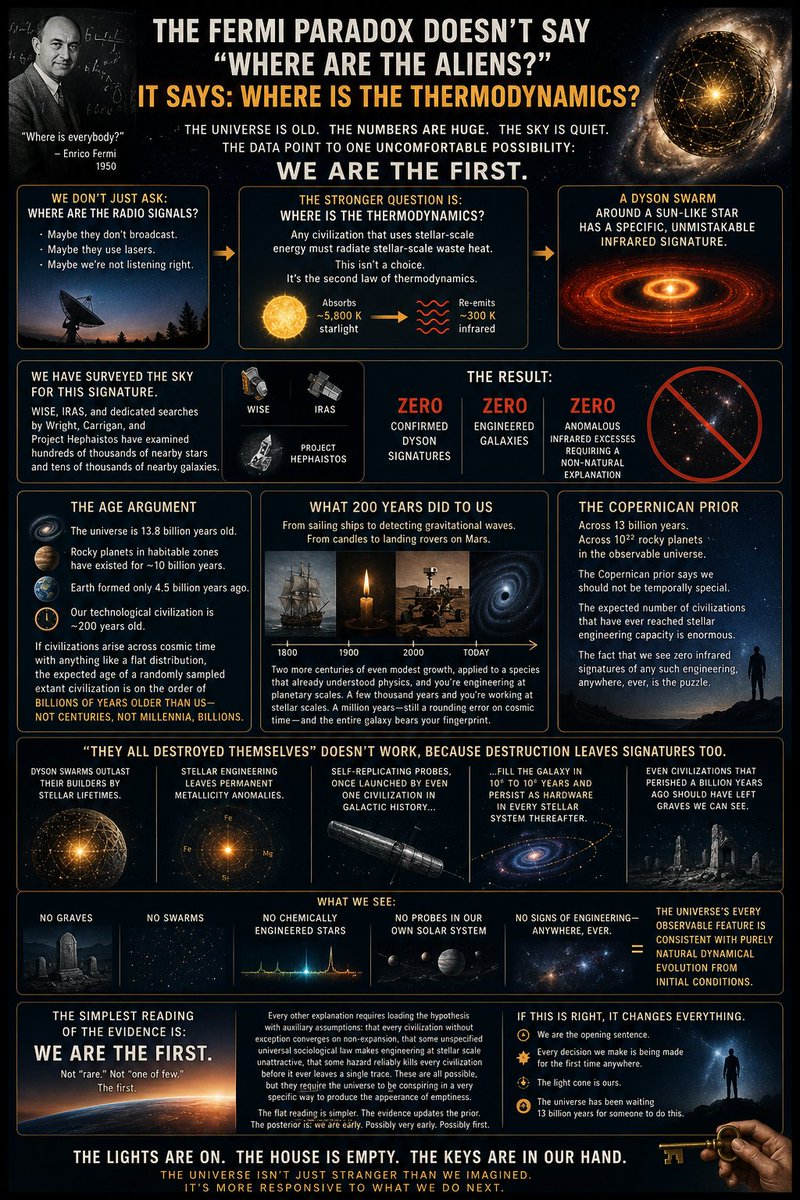
It is extremely likely we are alone in the Universe.
This is because nobody solved yet the strongest version of the Fermi's paradox.
The Fermi paradox doesn't say "where are the aliens?" It says: where is the thermodynamics?
The popular version of Fermi asks why we haven't heard radio signals. That's the weak version. It lets you wave it away with "maybe they don't broadcast" or "maybe they use lasers." The strong version is much harder to dismiss.
Any civilization that uses stellar-scale energy must radiate stellar-scale waste heat. This isn't a choice. It's the second law of thermodynamics. A Dyson swarm around a Sun-like star absorbs ~5,800 K starlight and re-emits it at ~300 K — a specific, unmistakable infrared signature.
We have surveyed the sky for this signature. WISE, IRAS, and dedicated searches by Wright, Carrigan, and Project Hephaistos have examined hundreds of thousands of nearby stars and tens of thousands of nearby galaxies. The result is zero confirmed Dyson signatures. Zero engineered galaxies. Zero anomalous infrared excesses requiring a non-natural explanation.
Now the age argument. The universe is 13.8 billion years old. Rocky planets in habitable zones have existed for about 10 billion years. Earth formed only 4.5 billion years ago, and our technological civilization is roughly 200 years old. If civilizations arise across cosmic time with anything like a flat distribution, the expected age of a randomly sampled extant civilization is on the order of billions of years older than us — not centuries, not millennia, billions.
Look at what 200 years did to us. From sailing ships to detecting gravitational waves. From candles to landing rovers on Mars. Two more centuries of even modest growth, applied to a species that already understood physics, and you're engineering at planetary scales. A few thousand years and you're working at stellar scales. A million years — still a rounding error on cosmic time — and the entire galaxy bears your fingerprint.
So the strong Fermi argument is this: across 13 billion years, across 10²² rocky planets in the observable universe, the Copernican prior says we should not be temporally special. The expected number of civilizations that have ever reached stellar engineering capacity is enormous. The fact that we see zero infrared signatures of any such engineering, anywhere, ever, is the puzzle.
It gets sharper. The "they all destroyed themselves" answer doesn't work, because destruction leaves signatures too. A Dyson swarm outlasts its builders by stellar lifetimes. Stellar engineering leaves permanent metallicity anomalies. Self-replicating probes, once launched by even one civilization in galactic history, fill the galaxy in 10⁶ to 10⁸ years and persist as hardware in every stellar system thereafter. Even civilizations that perished a billion years ago should have left graves we can see.
We see no graves. We see no swarms. We see no chemically engineered stars. We see no probes in our own solar system, which has been sitting here as a perfectly accessible target for the entire 4.5-billion-year history of the galaxy. We see a universe whose every observable feature is consistent with purely natural dynamical evolution from initial conditions.
This is the part nobody wants to say out loud: the simplest reading of the evidence is that we are the first.
Not "rare." Not "one of few." The first.
This sounds arrogant, but it isn't — it's just what the data say if you take them at face value. Every other explanation requires loading the hypothesis with auxiliary assumptions: that every civilization without exception converges on non-expansion, that some unspecified universal sociological law makes engineering at stellar scale unattractive, that some hazard reliably kills every civilization before it ever leaves a single trace. These are all possible, but they require the universe to be conspiring in a very specific way to produce the appearance of emptiness.
The flat reading is simpler. Somebody had to be first.
The Copernican principle says we shouldn't assume we're special, but the Copernican principle is a prior, not a theorem — it gets updated by evidence. And the evidence, after a century of looking, is overwhelmingly that the sky is empty of engineering. That update has to push the posterior somewhere. The somewhere is: we are early. Possibly very early. Possibly first.
If this is right, it changes how we should think about what we are. We are not one of countless civilizations whose story has been told a billion times across the universe. We are the opening sentence. Every decision we make about how to develop, how to expand, how to avoid extinguishing ourselves, is being made for the first time anywhere. The light cone is ours.
That's not a depressing reading of Fermi. It's the most consequential reading possible. The universe has been waiting 13 billion years for someone to do this, and we are the ones who showed up.
The lights are on. The house is empty. The keys are in our hand.
Nice note but it’s a little like comparing a retiree to a younger high income person - the retiree may have more assets (walkable cities) more time ( 30 days pto) less debt( house is paid off) but they are deleting wealth while the younger high income person is increasing it. Income is a better predictor of future wealth.
In 458 BC, Rome was on the brink of collapse.
An invading army had trapped the Roman consul and his legion in a mountain pass. Panic spread through the city. The Senate did the only thing they could think of:
They sent messengers to find a 60-year-old farmer plowing his field.
His name was Lucius Quinctius Cincinnatus. He had once been a senator, then lost his fortune paying his son's bail. Now he worked his own four-acre plot just to feed his family.
When the Senate's envoys arrived, they found him sweating behind a plow. They asked him to put on his toga so they could deliver an official message.
The message: Rome was making him dictator. Absolute power. Total command of the army. No checks. No oversight. No term limit.
He accepted.
Within 16 days, Cincinnatus had raised an army, marched out, surrounded the enemy, and forced their surrender. The republic was saved.
He had legal authority to rule for six months. He could have stayed. He could have expanded his power. He could have done what every other ruler in human history did when handed unlimited control.
Instead, he resigned on day 16.
He took off the toga, walked back to his farm, and finished plowing the field he'd left half-done.
Twenty years later, when Rome faced another crisis, they called him back. He was 80 years old. He took command, crushed the conspiracy, and resigned again, this time after just 21 days.
He died poor. On his farm.
2,200 years later, when George Washington was offered a kingship after winning the American Revolution, he refused and went home to Mount Vernon. The reason he was hailed as "the American Cincinnatus" is because Europeans literally could not believe a man who had won would willingly give up power.
King George III, on hearing Washington would resign rather than rule, said: "If he does that, he will be the greatest man in the world."
The lesson isn't that Cincinnatus was humble.
The lesson is that for most of human history, the people most qualified to lead were the ones who didn't want to. And the moment a society starts rewarding those who chase power instead of those who flee from it is the moment the republic begins to die.
Cincinnati, Ohio is named after him.
Most people who live there have no idea why.
It’s very similiar to how reits pay out more than their earnings each year and have to raise capital to buy new buildings. They usually pay earnings plus depreciation. Fortunately their rents rise with inflation and the depreciation over stated how much they need to maintain the value of the property
Ponzi everywhere!
6 days from now, on May 11th, the statute of limitations expires on the possibility of indicting Anthony Fauci for denying under oath that he funded gain-of-function research involving bat coronaviruses in Wuhan, the origin city of the pandemic.
The DOJ has ONE WEEK left to charge Anthony Fauci for the worst cover-up in modern medical history.
He lied to Congress about funding gain-of-function research in Wuhan. Millions died. Trillions were spent. And Fauci walked away with book deals and fawning media coverage instead of handcuffs. I re-upped my criminal referral to the DOJ because the evidence is overwhelming, and justice has been delayed long enough.
RT if you’re ready to see Fauci behind bars.