Expanding on why I believe "ETH as store of value (SoV)" makes much more sense to focus on than "ETH as fee-burning token".
Three primary reasons:
1. ETH as fee-burning token never was as strong as it seemed
2. Optimizing for ETH as fee-burning token would demand Ethereum and ETH function in ways that are very hard to make compatible with decentralization and capture resistance.
3. Meanwhile, optimizing for ETH as SoV is aligned with Ethereum focusing on its unique strengths (decentralization and CROPS)
EIP-1559 (including its burn) is fine and good, we should keep them. But we should not feel sad if fee burn is < 10% of breakeven indefinitely; the value of ETH comes from elsewhere.
The core idea: the big thing that people appreciate about Ethereum is decentralization and CROPS. The main pragmatic benefit that these things translate into is stability. SoV is the category where that is not an unneeded extra we merely put effort into for ideological reasons, but rather a pragmatic strength from the perspective of people putting in their assets. And in the era of AI disruption, stability will be highly valued.
We are investigating a cluster of large outflows from Binance hot wallets that began at approximately 20:24 UTC on 29 October 2026. On-chain, the transfers look consistent with unauthorized movement from those wallets, but this has not been confirmed by Binance, and we cannot yet rule out an internal treasury or operational sweep.
Observed chains: Ethereum, Arbitrum, and Avalanche, with related receipts also visible on Optimism.
Observed scale (approximate, still being reconciled):
Ethereum: about $2.5 billion from Binance 14 and Binance 16, plus an additional 780,000,000 USDC from a Binance smart account
Arbitrum: about 8,426 ETH (~$19.5 million)
Avalanche: about 1.81 million AVAX and 8.4 million USDT (~$24 million)
Affected Binance wallets include:
Ethereum Binance 14: 0x28C6c06298d514Db089934071355E5743bf21d60
Ethereum Binance 16: 0xDFd5293D8e347dFe59E90eFd55b2956a1343963d
Ethereum smart account: 0xEe7aE85f2Fe2239E27D9c1E23fFFe168D63b4055
Arbitrum Binance 56 / Hot Wallet 1 / Binance 89: 0x1b5b4e441f5a22bfd91b7772c780463f66a74b35, 0xf92402bb795fd7cd08fb83839689db79099c8c9c, 0x3931dab967c3e2dbb492fe12460a66d0fe4cc857
Avalanche Binance 49 / 85 / 110 / 118: 0x9f8c163cBA728e99993ABe7495F06c0A3c8Ac8b9, 0x6D8bE5cdf0d7DEE1f04E25FD70B001AE3B907824, 0xABa2D404C5C41da5964453A368aFF2604Ae80A14, 0x3BCE63C6C9ABf7A47f52c9A3a7950867700B0158
Primary collection address (same across the affected chains): 0x5227f603C1eE34CE3C06eFe6477003BDfCCB2f8c
Further destination wallets currently holding a large share of the funds include: 0x9749292D74Fd460982d0912eA9515EA24736C762, 0x0Ddf0480016e6bCb2C1F5d190D221FBA1320697e, 0x8532fa14acaf483729c449b8458aeddb900543d4, and 0x8d53903625b8e839b9DF4bd28B0EFb1CD6b8639A.
We recommend treating this as unconfirmed until Binance issues an official statement. We will update as we verify more.
Introducing Blockaid's Risk Exposure:
A real-time onchain compliance solution that lets organizations monitor addresses, transactions, and act the moment they're exposed to illicit funds.
Powered by Blockaid’s first-party signals to make policies programmatically enforceable.
Update on the NPM attack: The attack fortunately failed, with almost no victims.🔒
It began with a phishing email from a fake npm support domain that stole credentials and gave attackers access to publish malicious package updates. The injected code targeted web crypto activity, hooking into Ethereum, Solana and other chains to hijack transactions, and replacing wallet addresses directly in network responses.
The attackers’ mistakes caused crashes in CI/CD pipelines, which led to early detection and limited impact. Still, this is a clear reminder: if your funds sit in a software wallet or on an exchange, you’re one code execution away from losing everything. Supply chain compromises remain a powerful malware delivery vector, and we’re also seeing more targeted attacks emerge.
Hardware wallets are built to withstand these threats. Features like Clear Signing let you confirm exactly what’s happening, and Transaction Checks flag suspicious activity before it’s too late.
The immediate danger may have passed, but the threat hasn’t. Stay safe.
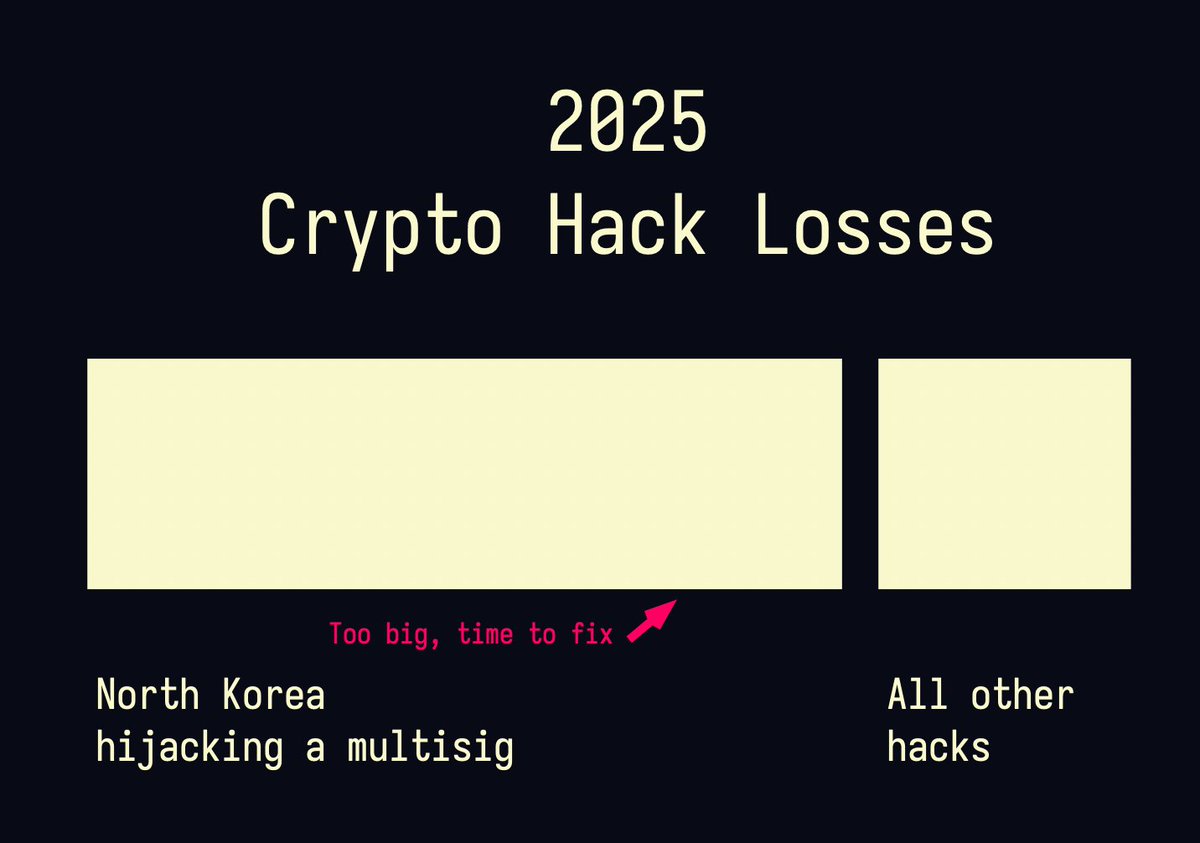
North Korea hijacking multisigs is now the biggest loss category in crypto hacks.
After talking with teams and building three prototypes, I think I know the next security layer in fixing this, and it requires less from signers, not more. 🧵 1/14
zWallet v0.0.1 is an onchain wallet. It is fully open-source. And so simple, it fits inside an html file on @IPFS. Rooted on @ensdomains, with all of its data sourced and guarded by smart contracts. It is more secure by default.
In Bolivia, real prices in shops are displayed in USD₮.
A quietly revolutionary shift: digital dollars are powering daily life, commerce, and economic stability.