I am happy to announce that I was awarded the 2022 DOE CSGF to continue my studies at @UofAlabama with Dr. Szilvási (@SzilvasiGroup). It is also an honor to be the first student pursuing a Ph.D. within the state of Alabama to receive this award.
Defect simulations are notoriously sensitive to the many choices required 👨💻📊
In this Perspective, Alex Squires @lonepair@scanlond81 and I highlight best practices in calculating 𝘢𝘯𝘥 𝘳𝘦𝘱𝘰𝘳𝘵𝘪𝘯𝘨 point defect properties, hoping to establish guidelines for this field 🌟
CO puzzle is a fundamental issue in modeling heterogeneous catalysts. We show that a simple, self-consistent DFT+U scheme applied to the C and O p orbitals restores the experimental site preference, vibrational frequency, and adsorption energies within ±0.1 eV
If you are interested in the multi-scale simulation of polymer transformations, we created to tutorial how to apply our MUSIK approach that can provide agreement with experiments without parameter fitting.
Congrats, @sophyia__ !
https://t.co/bIe7p890ww
We also supply the inputs on Zenodo to assist with other computational researchers who wish to simulate their own systems under in situ conditions. https://t.co/tIzSpeFuVU
An article I co-authored (with Gbolagade Olajide and @SzilvasiGroup) just came out in @ACSCatalysis. In this work, we show that MLIPs can reveal some cases where atoms appear to disappear under in situ TEM microscopy due to low barriers and thermal motion.
If you work with experimental in situ TEM for catalysis or as a computational researcher looking to simulate TEM, please take a look at our article. Also special thanks to Toma Susi and the abTEM developers for assistance in setting up the proper simulation parameters.
Thank you @nvidia for supporting my group's research on applying machine learning interatomic potentials in materials science via an #NVIDIAGrant from @NVIDIAAIDev.
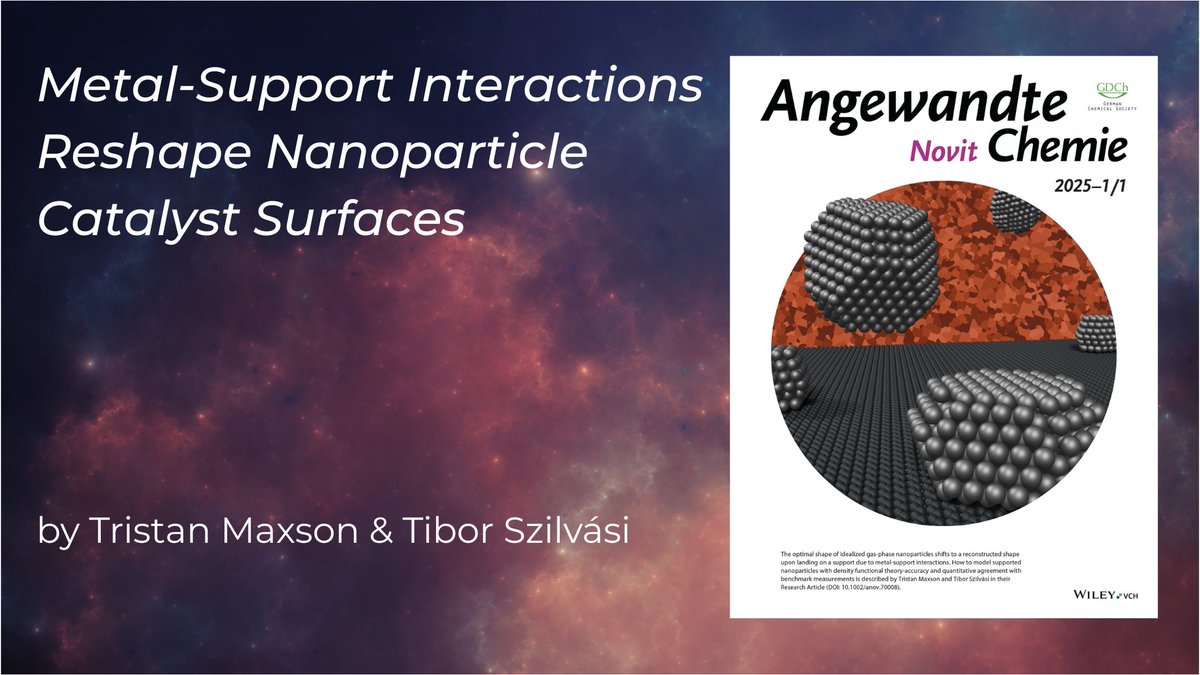
Published in #AngewandteChemieNovit: Global optimization via machine learning interatomic potentials enables identifying more realistic and stable of supported nanoparticles. By Tibor Szilvási & co-workers (@SzilvasiGroup). Read it here: https://t.co/kbCeBAlrDz
A potentially carrier defining paper is out in @angew_chem Novit! We show how to simulate supported nanoparticle catalysts with 1-5 nm in diameter under experimental conditions in quantitative agreement with benchmark microcalorimetric measurements
https://t.co/Q1aaQSptfu
Our materials science-focused MLIP benchmark dataset that goes beyond energy and forces is out in @JCIM_JCTC.
Congrats, @tgmaxson, @soyemiademola, @XZhangChem, and Benjamin Chen!
https://t.co/u0miNlPEAh
@BenBlaiszik@Andrew_S_Rosen@rlacombe@signulll I find that all of these AI tools require you to carefully outline what you want first, double check that it will do what you want it to, THEN you can ask it to try implementing. I have not used any of these LLMs in a real coding env, just as code complete or prompts.
Comp. chem. = Protestantism. All QM codes are incompatible; each hopes for supremacy and pretends the others don't exist.
Materials science = Catholicism. All codes work w/ the ASE; everyone privately criticizes the ASE and dreams of a new order but no one wants to break unity.