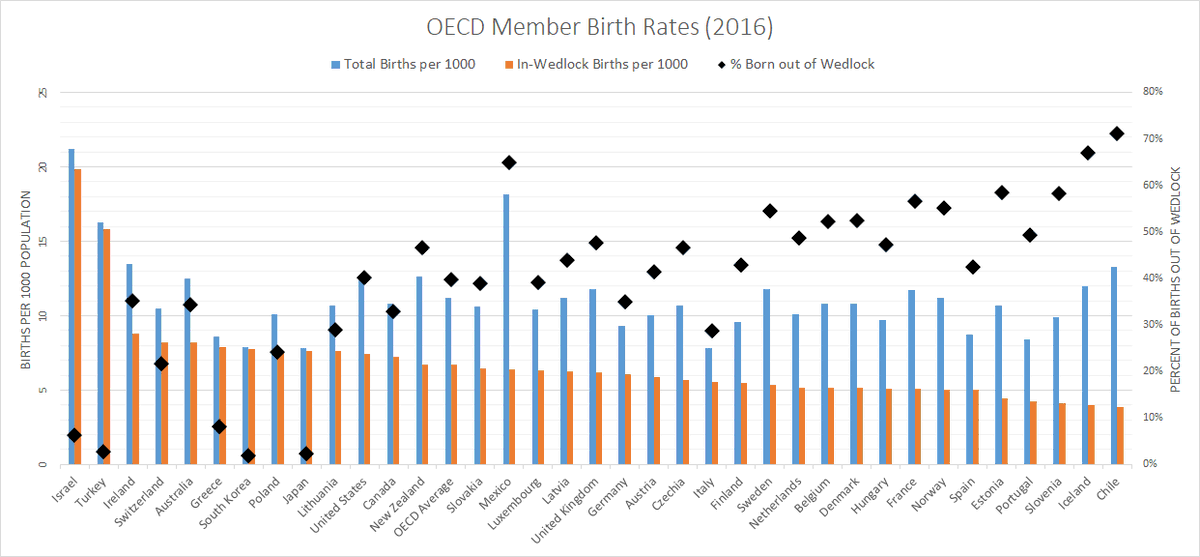
So after looking at a bunch of stats here’s a (fairly long) thread on my thoughts re Japanese demographic decline: married Japanese couples actually have a lot of kids – more than couples in almost any other rich country.
@bull_japanese@DavidMcNeill3 Do you mean to tell me that making vague references to "Japanese culture" or invoking hackneyed narratives about "weird Japan" are NOT viable substitutes for facts?
So after looking at a bunch of stats here’s a (fairly long) thread on my thoughts re Japanese demographic decline: married Japanese couples actually have a lot of kids – more than couples in almost any other rich country.
@bull_japanese@DavidMcNeill3 Really interesting to know re: comparative fertility rates. I was focused almost entirely on birth rates in this research so I totally overlooked that detail.
@slovborg Fantastic insight, thank you so much for sharing. I totally agree - and Japanese family law absolutely reinforces and incentives these trends. Does Slovenian law then in practice afford many/most spousal rights to cohabiting partners?
@StephJMort I did a quick search and this is the best summary I found: https://t.co/QhVOSMCCOj
Most Icelandic parents have a separate pseudo-marriage legal status called consensual union, which apparently legally/culturally stems from an 1800s law limiting marriage status to landowners.
@rebeccawire It's new that Japan has surpassed the US and France, but even in the 1980s the low point on the M-curve was over 50%, roughly on par with the total average in Italy today: https://t.co/ElYrbq6V9o
It just doesn't seem like the big differentiating variable one would expect.
@rebeccawire Agree 100%. Workforce participation absolutely does not mean higher standards of treatment/equality of advancement opportunity/etc. But for purposes of this topic specifically, most women do work full time so I don't think it contributes much to the higher marital birthrates.
@TaraMcEndo The OECD data I used only goes back to 1970, but in that time span the ratio for Japan and Korea has been mostly static. However, in 1970 most of Western Europe was at the same level. The Japanese case only really became an outlier in the late-80s to mid-90s or so.
@rebeccawire Non-regular in the Japanese context means on a fixed-term (typically a couple years) non-renewable contract, not that they aren't working full-time. The 46% only reflects full-time employees, as roughly 60% of women overall are non-regular workers.
@patrickgallagh6 An important enabling factor but from a comparative standpoint not a useful explanation. Similar or greater access to abortion exists in many European countries, while abortion in Korea is much more restricted. Yet Japanese trends match Korea and drastically diverge from Europe.
@observingjapan@MichaelTCucek Thanks so much!!
To be totally honest I usually find it safe assume that anything new I learn about Japanese politics/society @MichaelTCucek is already an expert on!
@rebeccawire I will definitely look around to see if there are any cohabitation statistics, though. Not sure the OECD datasets I used had them but the UN or EU sources might. Thank you for the advice!
@Urbandirt Very good to know, thanks so much for the tip. That could basically mean that the high marital rate is mainly a product of would-be extramarital births getting rolled in. Will definitely look into that - the wealth of statistics maintained by the Japanese gov't always impresses.