Bitcoin Core bug of the week: one inv message, the same wtxid 50,000 times, an orphan with thousands of missing parents, and your node stops doing anything for 12+ seconds. Found by an LLM. Fixed with a dedupe. https://t.co/qhVIcpJXyx
167 years of humans failing at Riemann, then a mathematician at Anthropic opens a chat window on IPO week. Rough week to be a number theorist. Discrete logs next?
Independent mathematicians have now finished the full verification of the proof of the Riemann hypothesis announced yesterday by Anthropic mathematician Levent Alpöge. The results are real, they say.
https://t.co/Gkc2sOlSFD
Every SaaS product that's basically a grid, a canvas or a chart woke up today with a text box as its newest competitor. Anthropic one-shotted at least 3 big SaaS products here....
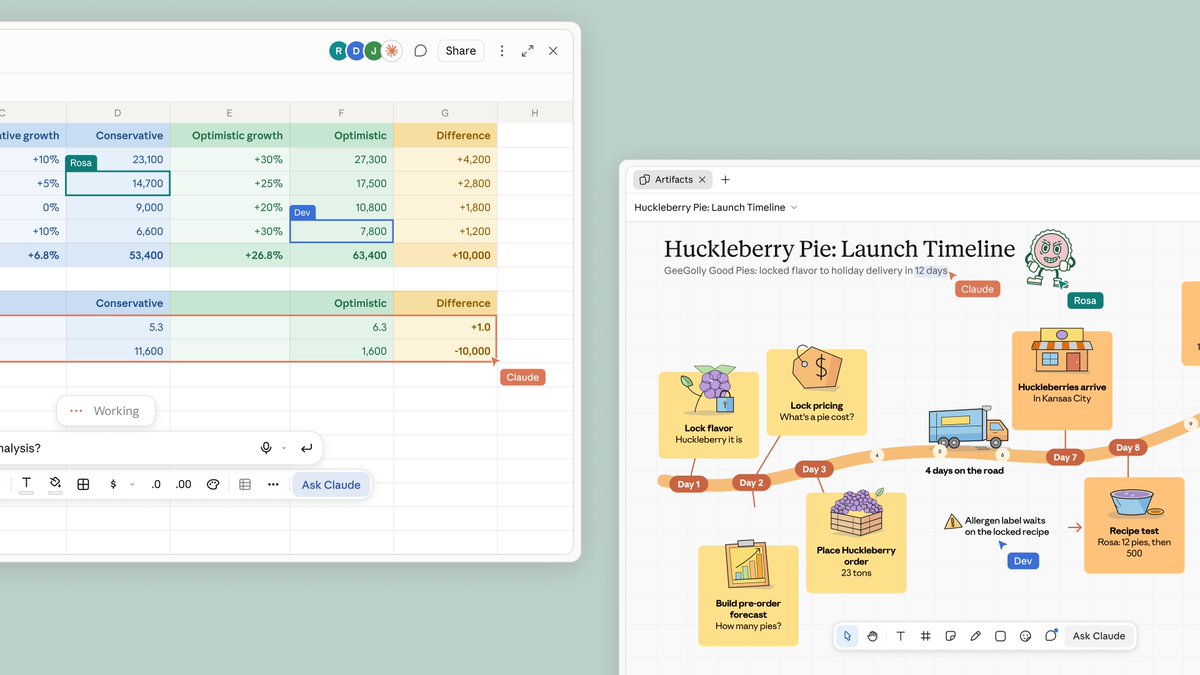
With Claude Whiteboards, talk through a messy plan and Claude lays it out on a board your team can edit. With Claude Sheets, ask for a tracker or a budget and you get a working spreadsheet you can all keep building.
In beta on paid plans.
We're partnering with @ether_fi to bring Cap-powered yield to its users.
https://t.co/9PAES85NhX, one of the top teams in DeFi, now allows users to access a promotional yield rate, with the flexibility to enter and exit positions instantly.
Here's why https://t.co/9PAES85NhX selected Cap. 🧵
Hash-based signatures are big, which is hard when the whole validator set signs. Ethereum's answer is leanVM ( aggregates leanXMSS sigs), and @drakefjustin says it's now formally verified. Bitcoin's PQ work is still BIP drafts.. https://t.co/gHr9WWcdbQ
On the NCSC's timeline, UK systems should be fully post-quantum by 2035. That's 9 years. Bitcoin hasn't picked a signature scheme yet, and after that comes a soft fork and years of moving coins. 9 years doesn't feel long. https://t.co/AuPdtUaIgz
Bank of England is consulting on letting CCPs take tokenised collateral. It says the rules aren't the barrier if the token can be realised under stress. Margin calls are where slow collateral costs money. Closes 12 Feb. https://t.co/3Ej7kSOG7Y
Awaiting EU response to @Apple pointlessly changing the AC charger design. Brussels spent so long regulating one end of the cable, they forgot about the other. Awaiting the Common Plug Directive.
US federal systems have a date for post-quantum signatures, 2031, and NIST finalised its transition report yesterday. Bitcoin has candidates like SHRINCS. Hopefully Bitcoin won't be out-shipped by gov IT! https://t.co/qcyw5f0W8L
The Electrum fee-bump bug is a reminder that a light wallet trusts whatever its server shows it. Fake pending tx, lookalike address, you hit bump and sign it over. Fixed in 4.8.3. How many people check more than the last four characters before signing?
https://t.co/r3b7vPWYZc
Bitcoin Core treats LLM bug-finding as part of its threat model. Bugs a model could spot from the fix get patched in every maintained release and published straight away - a marked improvement. This is now table stakes for all dev teams.
https://t.co/T5QH96fiIp
Big for Ethereum. JPMorgan brought JPM Coin to Ethereum for institutional clients, a year after launching on Base. Most tokenised assets already live on Ethereum, and now JPM is settling deposit money there around the clock.
https://t.co/OeyAW8EIou
Options are turning into the main way to package Bitcoin for different holders. @BlackRock launched PBIT to buffer ~10% of losses. @Lombard_Finance LBTC sells volatility, run by Bitwise, to earn income on BTC, whilst maintaining valuable collateral in DeFi.
Innovating inside Deutsche taught me that scope is how you get things through. Its crypto custody is exactly that: BTC, ETH, USDC, EURC, EURAU. Custody and transfer only, Germany only, Asia ambitions. Not a crypto desk. Settlement first.
Sensible note from Coinbase on quantum Bitcoin. No panic, just planning. Swappable signatures and an early start. The hard part is old coins. ~30% of BTC already has its public key on-chain, and Chainalysis estimates 3-4m BTC may be lost for good. Who moves those?
https://t.co/HlrlbX4l34
Today I call upon the blockchain industry to calmly begin planning for "bunker mode". My personal recommendation is to set in motion a controlled mass migration of assets to fresh addresses, i.e. addresses whose pubkeys remain hidden behind a hash.
Holders, starting with large and sophisticated ones, should consider moving the bulk of their funds to addresses that have never signed a transaction. And when they do sign one, they should also move remaining funds to a new address (possibly generated from the same seed phrase).
Don't rush. While I believe there is cause for action a rushed migration would do more harm than good. Don't panic either. Moving assets to protected addresses is a simple, preventative step which does not require new cryptography or new wallets.
IMO it is now reasonable to brace for the possibility that ECDSA breaks before qday, in the worst case in months not years. By "break" I mean fast private key recovery (e.g. in one week) on available hardware (e.g. a large GPU cluster).
Recent days have been humbling for human mathematical intuition. Long-held, unquestioned hypotheses have fallen. This includes the n log(n) bound for integer multiplication and the 3SUM conjecture. In hindsight, May's unexpected disproof of the Erdős unit distance conjecture was our warning shot.
Yesterday's OpenAI drop made it clear that mathematical superintelligence is upon us. They say there are weeks where decades happen. We are about to live through weeks where centuries of mathematical progress happen. Could our magic 64-byte ECDSA signatures be too good to be true? Was it just security through obscurity all this time?
Elliptic curves feel especially vulnerable to superintelligence. Curves carry rich structure, with room for fancy tricks like Schoof, Frobenius, pairings. (By contrast, hashes are designed to minimise algebraic structure.)
Separately, as Ewin Tang can attest, an efficient quantum algorithm sometimes foreshadows an efficient classical one. We should be open to the possibility of a classical counterpart to Shor that breaks elliptic curves and RSA at once.
Also noteworthy is the striking under-representation of cryptographic breakthroughs among the 722 mathematical results OpenAI published. I've witnessed first-hand the US government censoring academic quantum cryptanalysis results. Backroom interventionism is my base case.
I urge large, sophisticated actors to lead by example. Project11's "risq list" (bitcoin-risq-list.projecteleven[.]com) is a great tracker of exposed BTC pubkeys. Binance, Bitbank, Robinhood, Bitfinex, and Tether have an opportunity to harden their cold storage. Next month I'll address institutions in London in a live Q&A (forum.ethereuminstitutional[.]org/london-2026).
Again, please do not rush. Wallets holding under 50 BTC enjoy partial cover from "Satoshi's shield", i.e. his 20K exposed addresses that hold 50 BTC each. Load-bearing signers like oracles and L2 security councils should consider rotating ECDSA pubkeys with every signed message and/or multi-signing with a hash-based schemes like SPHINCS.
Exiting bunker mode safely will require post-AI cryptography. My inclination is to go all-in on hash-based cryptography and avoid structured mathematical assumptions entirely, whether from curves, lattices, or isogenies. A single battle-tested hash (e.g. from the SHA or BLAKE families) yields plausible post-AI security.
The Ethereum roadmap on strawmap[.]org fully embraces hash-based cryptography with end-to-end formal verification as a response to the quantum threat. Those timelines must now be revisited and accelerated in light of mathematical superintelligence. I'll be pushing for maximum defensive acceleration.