We're close to releasing a TLSNotary Android app, but Google requires a round of closed testing before we can publish it.
Got an Android device and want to help? DM us your Gmail and we'll add you to the test:
https://t.co/iWsLQxa3dG
TLSNotary v0.1.0-alpha.15 is out.
TLSNotary now supports proxy mode alongside MPC mode: a faster, lighter alternative when the security tradeoff fits your use case.
Also: chunked HTTP responses, an SDK core refactor, no-OS-RNG verifier builds.
https://t.co/lUThZpSM7r
Say what you want about CT sentiment but builders will keep building
In the last week at PSE:
- New client-side private payment design https://t.co/4sHrsQpXhY
- New zkVM exploration https://t.co/6hNbKr56lM
- Proxy TLS https://t.co/ty1JsYFR5l
- ACTA: privacy layer for ERC-8004 https://t.co/Pl6MbivKvU
- OpenAC making strides in adoption in countries: https://t.co/2eXJr1bi8J
SpeakUp: a new zkVM we're prototyping for private, client-side proving of WebAssembly programs - built to run on low power devices such as mobile phones and browsers.
The underlying proof system explore different tradeoffs for different use cases from mainstream zkVMs. SpeakUp is interactive, and uses vector oblivious linear evaluation (VOLE), which provides a fast linear-time prover and post-quantum security at the cost of larger proofs.
See the early design draft below, we're looking for public feedback 👇
https://t.co/udhRQ1hD1R
We benchmarked the upcoming Proxy mode against MPC across cable, 5G, and fiber for both native and browser. As expected, Proxy is faster. Proxy finishes a 1KB/2KB attestation in 1–2s vs 3–15s for MPC.
https://t.co/ER7zPplFq2
We’ve updated the performance numbers in the alpha.14 blog post after fixing an issue in the benchmark harness.
Good news: the numbers look even better now 📈
https://t.co/hoA26qb9xE
OpenAC is now live on ePrint: https://t.co/DrV84hCfNT 🚀
This new version incorporates the feedback we received, improves several explanations, and expands key sections to make the ideas clearer and easier to explore in depth.
Appreciate all the thoughtful input. More to come soon.
The recording of our @fosdem talk “Liberate Your User Data with zkTLS: Verifiable HTTPS Using TLSNotary” by @heeckhau is now available.
How can users generate cryptographic proofs from HTTPS without server changes?
https://t.co/BLiDdJnb5a
How do you benchmark MPC-TLS under realistic network conditions (and in real browsers)?
We wrote up how TLSNotary’s reproducible testing/benchmark harness works: https://t.co/7bYLZLpp2k
If you’re exploring zkTLS or verifiable web data, this is worth your time.
At Devconnect, we hosted a full zkTLS Day with talks from across the ecosystem.
All recordings are here: https://t.co/smU04213dx
New benchmarks for TLSNotary alpha.14 are out.
What do the performance improvements actually look like in practice?
We measured end-to-end proving time on real TLS sessions, native and WASM, across varying bandwidth, latency, and response sizes.
@tlsnotary v0.1.0-alpha.14 has been released.
This version focuses on usability improvements and brings more performance gains, particularly for WASM targets.
https://t.co/OHuDlOtHwH
Our tech lead @sinu_eth blogged about why #zkTLS is the missing primitive for @ethereum, unlocking universal data portability and selective disclosure for the internet.
https://t.co/HGHfzicsF7
This year I will try to communicate more. Here is what motivates me to work on @tlsnotary, which I consider to be working on @ethereum, and why I think it continues to be the best use of my time.
you may now pass go
https://t.co/mtDOmnTjGW
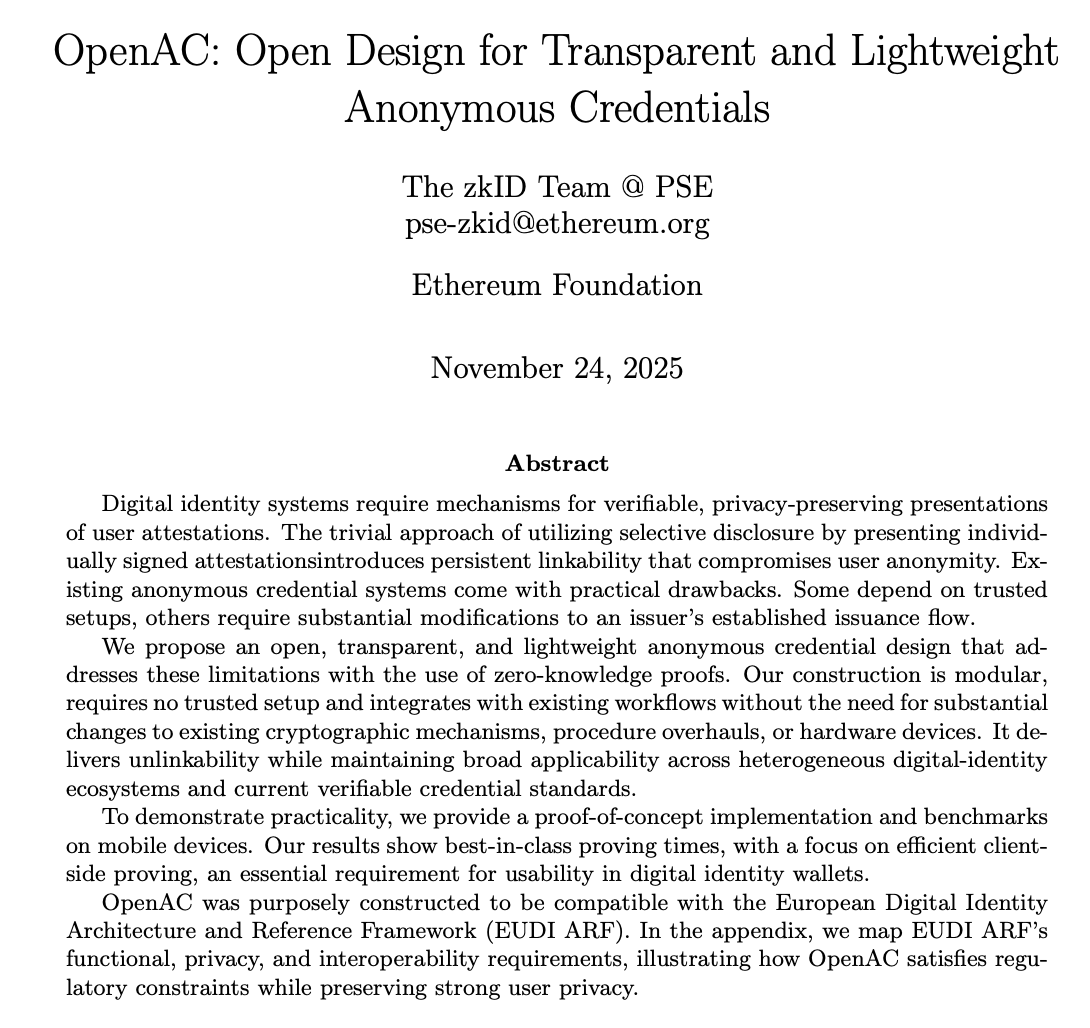
1/ 🌱 The zkID team published OpenAC: Open Design for Transparent and Lightweight Anonymous Credentials earlier this week with a show proof time of 0.129 seconds.
It describes a zero-knowledge identity construction designed to work with existing identity stacks and was purposely constructed to be compatible with the European Digital Identity Architecture and Reference Framework (EUDI ARF).
https://t.co/1T8QxFxuJT
🔞 Alterskontrolle 🆔 soll VERPFLICHTEND für alle 📧 E-Mails, 💬 Messenger & 🗨️ Chats werden! 😱
⚠️ Der wohl größte Anschlag 💣 auf digitale Anonymität aller Zeiten! 🚫👀
📰 Die Berliner Zeitung sprach mit mir über die EU-Pläne zur #Chatkontrolle 👇
https://t.co/ptnzZCZkj5