Keeta Network, day by day: network progress, new anchors, builder wins and practical ways to bring Keeta into your business. Home of the builder hub. $KTA
@gaspardlezin Most of this stack already lives on one network with @KeetaNetwork
Ledger (05) is the chain. Identity (07) and key controls (06) are protocol features. Ramps and fiat rails (03, 04) plug in as anchors. The network that wins collapses this diagram into one layer.
$KTA
@gaspardlezin Most of this stack already lives on one network with @KeetaNetwork
Ledger (05) is the chain. Identity (07) and key controls (06) are protocol features. Ramps and fiat rails (03, 04) plug in as anchors. The network that wins collapses this diagram into one layer.
$KTA
If one dev and an AI agent can rebuild a Keeta node from public code and docs, building an app on top is the easy part. What would you build first?
$KTA @KeetaNetwork
You can now run your own node on Keeta.
Three weeks ago I put the first external node on Keeta mainnet. Now slop node is out for everyone – it's a few lines with Docker.
The true digitalization of finance, especially in cross-border contexts, has stalled. Blockchain technology may bring about a new chapter where money is as fast as the internet is. However, current blockchains are unscalable and clunky and I don't see them being the next financial backbone at all.
Keeta is insanely fast. Settlement is sub-second and deterministic. Using its components, for the first time in history, a solo developer with an AI agent can set up an entire neobank in just minutes. I believe Keeta will power a new wave of financial apps, where the best user experience, security, and feature set will win.
I can't wait to see how Keeta develops, but right now its source code isn't fully public and third parties are not able to run their own nodes. I fed Claude Opus 5.5 the public parts of the code, my understanding of Keeta, its docs and forum discussions. Then came about 6 hours of refinement and setting up an environment where the agent could evaluate itself. Finally, it ran for a few days autonomously.
The end result is a fully functional Keeta node. It's primarily for experimentation, please don't rely on it for high value applications (yet?).
$KTA
AI agents are starting to spend money on traditional bank accounts. Here's what it looks like when an agent gets its own bank account instead: network-enforced limits, every currency in one account, final in 400 ms, and pay-per-API-call with x402.
https://t.co/cfP7HJGURj
keeta:native
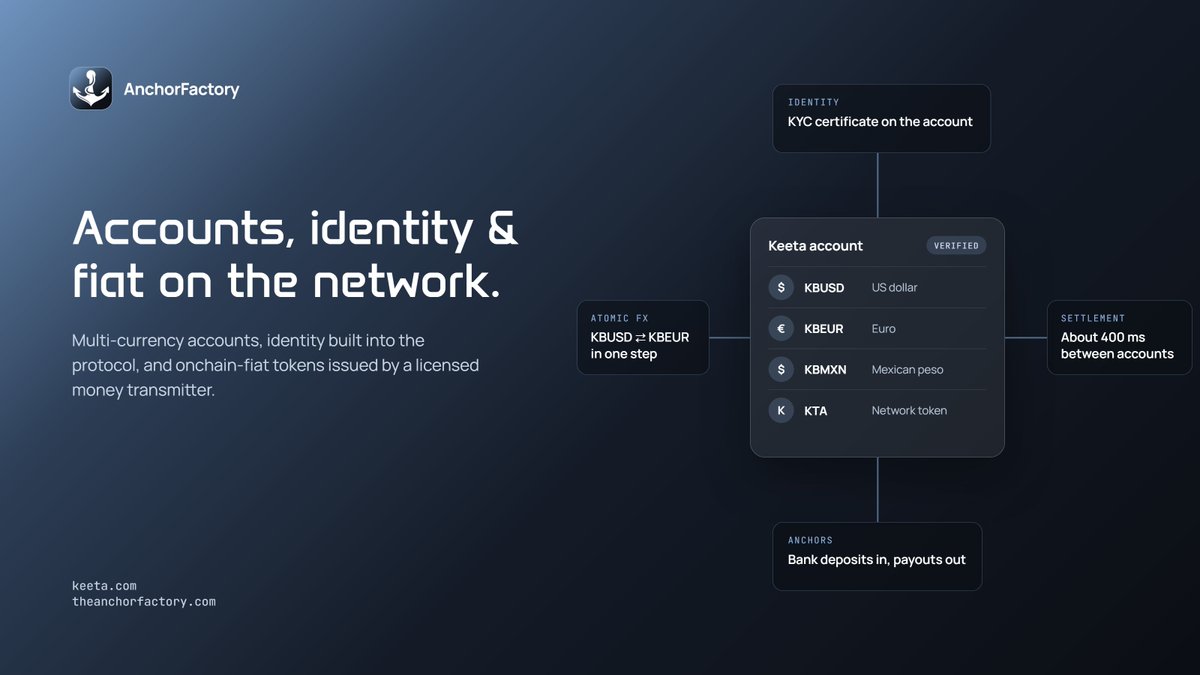
If you’re building a fintech product, it’s worth seeing how much of the plumbing Keeta already handles. Accounts hold multiple currencies natively, identity verification is part of the protocol, and regulated fiat tokens like USD, EUR and CHF are already live on the network.
Keeta’s new stablecoins are worth understanding properly, because they aren’t the same kind of asset as USDC or USDT. Here’s what they actually are and why it matters if you’re building payment or banking products.
base:0xc0634090f2fe6c6d75e61be2b949464abb498973 @KeetaNetwork
Keeta Stablecoins sit in the same account as your dollars, euros, and crypto. Hold them, send them, and switch between them in Keeta Personal and Keeta Business today.
https://t.co/oW1KyYkmZ0
Bivo is just the first issuer, and Keeta expects other regulated entities to issue their own. Each covers the jurisdictions it’s licensed in, so more issuers should mean wider coverage and less dependence on any single provider, which is hard to get from a one-issuer stablecoin.
That changes the conversation with partners. A bank, payroll provider or regulated fintech already understands deposits held in an account, so explaining that your app moves tokenized deposits is often an easier starting point than explaining exposure to a crypto reserve asset.