With 5.6 Sol, a lot of people are still prompting the model exactly as they did 5.5
It's important to note that 5.6 Sol is a lot more tenacious and thorough than previously models.
Check out the guide I wrote here to get better outcomes
https://t.co/nk1rHm0sWY
Andrej Karpathy could have charged $10,000 for this course.
He put it on YouTube.
The man who built Tesla Autopilot from scratch.
Co-founded OpenAI.
Understands AI at a level most engineers at Google and Meta never reach.
Sat down. Recorded 2 hours. No frameworks. No libraries. No shortcuts.
Then dropped it for free.
The gap between people who watch it this week and those who save it for later is not 2 hours.
It is everything those 2 hours quietly unlock for the rest of your career.
What does every big company think about the agent harness?
Anthropic, OpenAI, CrewAI, LangChain. They all build agents. They all wrap their models in infrastructure to make them useful. They each call it the harness.
But they agree on one thing. And disagree on everything else.
The agreement: the model is not the product. The infrastructure around the model is.
The disagreement: how much of that infrastructure should exist.
This is the most important architectural bet in AI right now. And each company is placing a different one.
𝗔𝗻𝘁𝗵𝗿𝗼𝗽𝗶𝗰 bets on the model. Their harness is deliberately thin. A "dumb loop" that assembles the prompt, calls the model, executes tool calls, and repeats. The model makes all the decisions. The harness just manages turns. Their bet: as models get smarter, you need less infrastructure, not more.
𝗢𝗽𝗲𝗻𝗔𝗜 takes a similar but slightly thicker approach. Their Agents SDK is "code-first," meaning workflow logic lives in native Python, not in some graph DSL. But they add more structure: strict priority stacks for instructions, multiple orchestration modes, and explicit agent handoff patterns.
𝗖𝗿𝗲𝘄𝗔𝗜 adds a deterministic backbone. Their Flows layer handles routing and validation with hard-coded logic, while their Crews handle the autonomous parts. Intelligence where it matters, control everywhere else.
𝗟𝗮𝗻𝗴𝗚𝗿𝗮𝗽𝗵 bets on explicit control. The harness encodes the logic. Every decision point is a node in a graph. Every transition is a defined edge. Planning steps, routing strategies, multi-step workflows are all spelled out in the harness, not left to the model.
Notice the spectrum.
On one end: trust the model, keep the harness thin.
On the other: encode the logic, make the harness thick.
And here's where it gets interesting.
The scaffolding metaphor makes this concrete.
Construction scaffolding is temporary infrastructure that lets workers reach floors they couldn't access otherwise. It doesn't do the building. But without it, workers can't reach the upper floors.
The key word is temporary.
As the building goes up, scaffolding comes down. Manus demonstrated this perfectly. They rebuilt their agent five times in six months. Each rewrite removed complexity. Complex tool definitions became simple shell commands. "Management agents" became basic handoffs.
The scaffolding did its job. So they removed it.
This is also why Anthropic regularly deletes planning steps from Claude Code's harness. Every time a new model version ships that can handle something internally, the corresponding harness logic gets stripped out.
But there's a catch.
Models are now trained with specific harnesses in the loop. Claude Code's model learned to use the exact scaffolding it was built with. Change the scaffolding, and performance drops. The worker trained on THIS scaffolding. Swap it out, and they stumble.
So the field is converging on a principle:
Build scaffolding that's designed to be removed. But remove it carefully, because the model learned to lean on it.
The "future-proofing test" for any agent system: if dropping in a more powerful model improves performance without adding harness complexity, the design is sound.
Two products using the exact same model can perform completely differently based on this one decision: how thick is the harness?
LangChain changed only the infrastructure (same model, same weights) and jumped from outside the top 30 to rank 5 on TerminalBench 2.0.
The model didn't improve. The scaffolding around it did.
The article below is a deep dive on agent harness engineering, covering the orchestration loop, tools, memory, context management, and everything else that transforms a stateless LLM into a capable agent.
Claude Managed Agents Clearly Explained
In 12 minutes we cover:
- What it actually is (platform as a service for AI agents) - Who it's for and who should avoid it (4 personas)
- Live console walkthrough (sessions, analytics, costs)
- Real cost breakdown ($2.58 to fulfill a $1,000 service)
Link to the full episode is in the first comment 👇
If you want your OpenClaw or Hermes Agent to be able to have perfect total recall of all 10,000+ markdown files, GBrain is here to help.
It's exactly my OpenClaw/Hermes Agent setup. MIT-licensed open source. Hope it helps you build your mini-AGI.
https://t.co/yFpFU4pn5b
Anthropic didn't build a better model to make Claude Code work.
They built a better environment around it.
55 directories. 331 modules.
Context compaction so sessions run for hours. Streaming tool execution that saves seconds per turn.
Read this article for full breakdown.
Andrej Karpathy builds a personal wiki to think with LLMs.
I took that idea and went further.
Claude Code + Obsidian = an AI that actually knows you. Your goals. Your context. Your history.
Not a chatbot. A second brain that remembers.
Here's exactly how to build it:
This 16-minute talk by two Anthropic engineers who built Claude Skills will teach
you more about building them right than most developers figure out on their own in months.
Bookmark this & watch, no matter what.
Then read the guide below by @eng_khairallah1
THE 1-HOUR OBSIDIAN LECTURE THAT CHANGES HOW YOU THINK ABOUT YOUR VAULT
> Nick Milo breaks down Obsidian Bases
> the feature that finally makes Obsidian a real database, not just a folder of markdown files
> save this. watch it before you set up your vault👇
This 1-hour Stanford lecture will teach you more about how AI agents actually work than every "automation hack" thread you've read this year.
Bookmark this & give it 1 hour today, no matter what. Then read the article below.
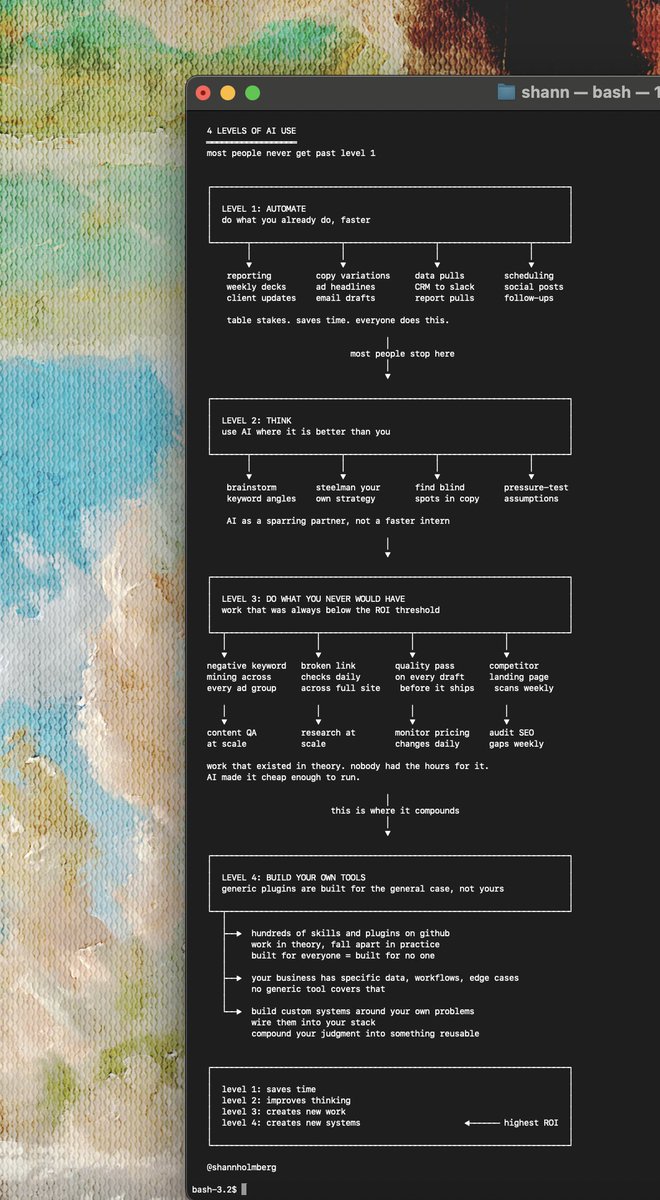
anthropics growth marketer mapped out 4 levels of AI marketing use
most people sit at level 1, automating what they already do
> level 1: automate what you already do (reporting, copy, data pulls)
> level 2: use AI as a thinking partner where its better than you
> level 3: do work that was below the ROI threshold before
> level 4: build custom tools only you would ever build
level 3 is work that never existed before. stuff nobody did because the manual cost was never worth it
mining negative keywords across every ad group. checking your full site for broken links daily
same logic applies to content, research, QA, competitor monitoring. all work that existed in theory but nobody had the hours for
level 4 is where the ROI compounds
there are hundreds of AI marketing skills and plugins floating around github right now. most of them work in theory but fall apart in practice because they are built for the general case, not your case
your business has specific data, specific workflows, specific edge cases that no generic tool will ever cover. the people building custom tools around their own problems are the ones pulling ahead