Not every layer of infrastructure is made of code.
Some are made of culture.
In Web3, we often talk about networks, protocols, and technological innovation.
But technology alone doesn't explain why people feel connected to an ecosystem.
Shared symbols.
Recognizable characters.
Stories that bring people together.
A sense of belonging.
These are the less visible ingredients of a community.
That's one reason I find the direction of @conso_xyz interesting.
The CONSO Network and its collection of 5,555 CONSO BOTS offer an interesting intersection between technology, digital identity, and community culture.
A digital character can be more than a collectible.
It can become a shared symbol while allowing individuals to express their own personalities.
Code can connect systems.
Culture can connect people.
And perhaps the most memorable Web3 ecosystems will be those that understand the importance of both.
What makes you feel connected to a Web3 community beyond its technology?
For years, businesses have built websites for one primary audience: people.
Customers visit, browse products, read descriptions, compare prices and decide whether to contact you.
Your website was designed around that experience.
But the way people discover businesses is changing.
Imagine someone looking for a manufacturer, supplier or service provider.
Instead of opening 15 different websites, they ask an AI assistant:
"Find me three reliable companies that offer this service and compare what they provide."
The AI agent now has a job to do.
It needs to find businesses, understand their offerings and compare relevant information.
Now imagine that agent comes across your company.
Your products are listed on one page.
Your specifications are in a PDF.
Your certifications are somewhere else.
Your capabilities are buried in a company description.
A human might eventually piece everything together.
But can an AI agent understand your business just as easily?
This is an important distinction.
Having a website means your business has an online presence.
It doesn't automatically mean your business information is organised in a way that AI agents can easily understand and use.
And that's the gap businesses should start paying attention to.
Does this mean your existing website is becoming useless?
Absolutely not.
Your website still matters.
It remains important for your brand, customers, product presentations and human visitors.
We're not suggesting that businesses should abandon what they've already built.
We're suggesting that they prepare for another kind of visitor.
Think about it this way:
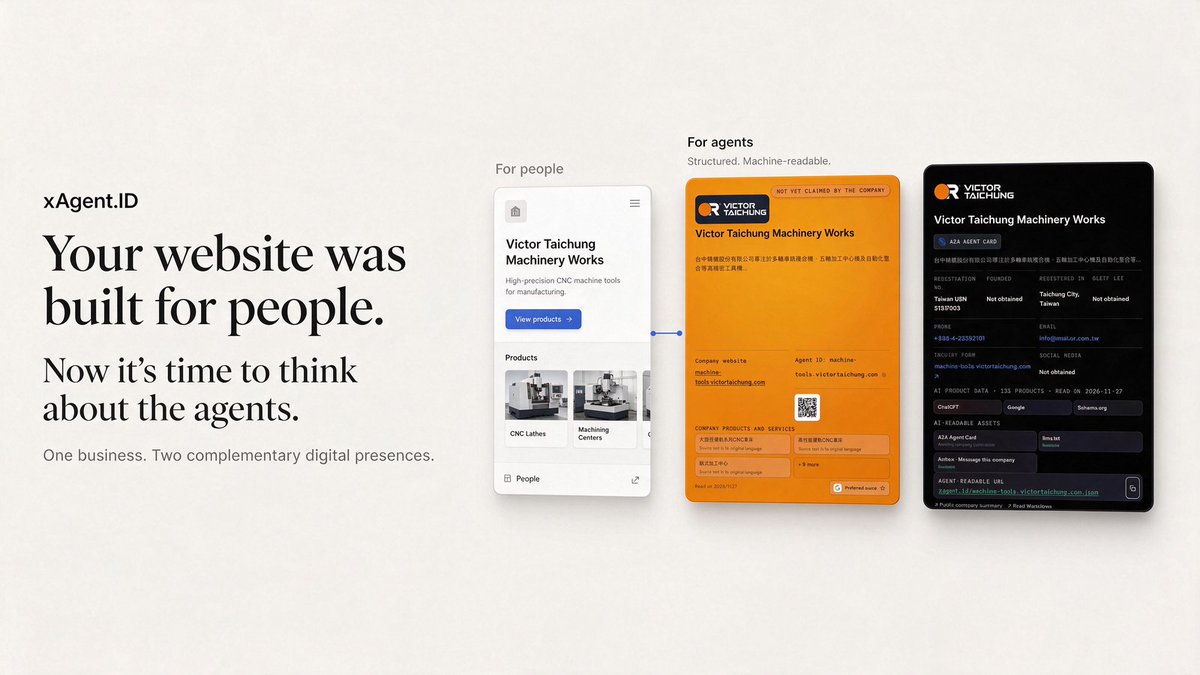
Your traditional website is built for people.
But what about the AI agents increasingly helping those people research, compare and make decisions?
Shouldn't your business have a digital presence that speaks to that audience too?
This is where the idea of a second digital presence comes in.
Not another website just for the sake of having one.
A structured, agent-facing presence that helps AI systems understand:
• Who your business is
• What you offer
• What your capabilities are
• What products or services you provide
• How an agent can interact with your business
Think of it as having two complementary sides to your digital presence.
One serves human visitors.
The other is designed to help AI agents understand your business.
Both are important.
And one doesn't need to replace the other.
This is exactly the problem https://t.co/LrbEnKH1A1 is designed to address.
https://t.co/LrbEnKH1A1 gives businesses a business-controlled Agentic Card: a structured digital presence built to help AI agents understand a company's identity, products, services and interaction pathways.
Instead of leaving your business information scattered across different online sources, https://t.co/LrbEnKH1A1 brings it into an organised, agent-friendly representation.
The idea is to make your business information easier for AI agents to identify, interpret and use.
Think about the possibilities.
A manufacturer can organise its products, specifications and capabilities.
A supplier can present its business information in a structured way.
A hotel can organise its services and facilities.
An online retailer can provide clearer product information.
Different businesses. One emerging need: an agent-friendly presence.
And this isn't only about being discovered.
As the Agentic Economy develops, businesses will also need better ways to interact with AI agents.
Discovery is one part of the journey.
Understanding and interaction are the next steps.
That's why an agent-facing business presence matters.
The internet is changing.
Your customers may increasingly rely on AI agents to find businesses, compare options and initiate interactions.
The question is no longer just whether your business has a website.
It's whether your business is preparing for the agents that will increasingly participate in the digital economy.
Your website was built for people.
Now it's time to think about the agents.
Give your business a presence in the Agentic Economy with https://t.co/LrbEnKH1A1
Explore: https://t.co/a6lsjIJWqF
#xAgentID #Twin3 #AgentEconomy #AgentCommerce
A location tells us where we are.
An experience gives us a reason to remember it.
Think about your favorite place in the world.
What makes it special probably isn't its coordinates, but the memories, discoveries, and connections associated with it.
That's an interesting perspective through which to explore @4Dlabs_Official.
Its Landmark Spotlight activities, including the Pyramids of Giza, offer a glimpse into how physical locations can become part of digital experiences.
And with the ongoing Community Sprint on Zealy, more people have an opportunity to discover the ecosystem ahead of the 4D App's early access.
What excites me about spatial technology is the possibility of adding new layers of meaning to places that already exist.
The physical world doesn't need to be replaced.
It can be rediscovered.
Perhaps the next frontier of digital innovation isn't another virtual world, but a deeper connection with the one we already inhabit.
If you could bring a digital experience to any landmark in the world, which one would you choose?
Getting users onto a blockchain is one challenge.
Giving them a reason to come back is another.
Blockrium Crate Round 2 is now live on Interstellar by @dac_chain, with a $3,000 prize pool.
But beyond the rewards, I'm interested in the bigger picture.
How do you turn occasional visitors into an active community?
Gamification offers an interesting approach.
Instead of asking users to interact with a blockchain purely for its technology, it gives them opportunities to explore, discover, and engage with its ecosystem.
A reward might spark the first interaction.
Curiosity might encourage the second.
But a meaningful experience is what can make people stay.
That's what makes Interstellar worth watching from an ecosystem design perspective.
The real measure of success isn't just how many people arrive when a campaign begins.
It's how many still want to be there when it ends.
Explore Interstellar:
https://t.co/bnPdf7fh6s
What keeps you coming back to a Web3 ecosystem: rewards, discovery, or the experience itself?
@ama_protocol I'd prefer a risk-free trial first. Seeing how an agent makes decisions before granting real permissions would make delegation much more comfortable.
You have probably clicked approve on something you did not fully read.
A wallet pop-up, a permissions screen, a terms box.
Most of us do it to get on with our day, and it is how a lot of people lose money.
So when you hand a job to an agent, the real question is who gets the final say.
Would you rather test a plan with nothing at risk first, or just start small and watch?
Building a great ecosystem is one challenge.
Bringing it into the real world is another.
I've been following the recent developments from @RetiumChain, from Whisk's refreshed look to the $WSK whitelist and now its presence at CryptoCon Sydney.
Each represents a different part of the ecosystem's journey.
Product development.
Community participation.
Real-world connections.
What interests me most about events like CryptoCon is the opportunity to move beyond the familiar conversations on our timelines.
Builders can meet users.
Communities can exchange perspectives.
Ideas can reach people who might never have discovered them online.
Technology creates possibilities, but human connections help those possibilities travel further.
If you're attending CryptoCon Sydney, RETIUM has announced its presence at Stand C26.
From building onchain to connecting on the ground.
That's a side of ecosystem growth worth paying attention to.
If you could meet the RETIUM team in person, what would be the first question you'd ask?
Draws your players can check for themselves 🎲
QVRF pulls every random number from quantum hardware and publishes the proof behind it, so players don't have to take the operator's word for it.
How Quip Network works for gaming ↓
https://t.co/bkzpfINmtF
@KiiChainio Money shouldn't have office hours. Weekend FX access could make a huge difference for people managing cross-border payments. Enjoy the weekend, KiiChain fam!
It's Friday! Banks may be closed tomorrow, but we're open 24/7!
With KiiChain's onchain FX, you can exchange currencies without having to wait until Monday or deal with the headache of standing in long queues at the bank!
Let us know down below what's on your weekend agenda 👇
@sndcapp Syndicate is evolving from a rewards discovery app into a daily Web3 workspace. The biggest opportunity here is reducing information overload.
Syndicate just became more than drops 💎
our biggest update ever: quests, web3 jobs, alpha, trading signals, an AI assistant and every event in crypto – in one app
meet Syndicate PRO 🧵
@twin3_ai Websites were built for people. But people are increasingly letting AI agents search and compare for them. Business info needs to be structured so agents can actually understand and use it — not just humans.
Gold doesn't need to be reinvented.
The way we use it does.
For centuries, gold and silver have served as stores of value, preserving wealth across generations, economic cycles, and technological revolutions.
But what if preserving value was only the beginning?
That's what makes the HardFi vision of @strato_net particularly interesting to me.
Instead of replacing traditional assets, STRATO is building an onchain financial ecosystem around them.
Gold and silver can become more than assets people simply hold.
They can form the foundation for new financial possibilities through borrowing, liquidity, and other onchain applications.
To me, the most meaningful innovation isn't always about creating something entirely new.
Sometimes, it's about discovering new possibilities within something that has already stood the test of time.
The assets are timeless.
The financial infrastructure is evolving.
The possibilities are expanding.
Old value. New possibilities.
That's the HardFi narrative worth watching.
What would you do differently if your gold could become part of an onchain financial ecosystem?
The people who improve a product aren't always the people who write its code.
Sometimes, it's the user who discovers an unexpected bug.
The tester who challenges an assumption.
The creator who explains a feature better than a product manual.
Or the community member who introduces an app to someone who genuinely needs it.
That's what makes DECA Rewards from @deca_labs interesting to me.
By bringing different forms of participation into a cross-app rewards layer, DECA recognizes that building a software ecosystem involves more than just building software.
It also involves the people who use, test, explain, and help improve it.
Every meaningful contribution adds another thread to the bigger picture.
Developers build the product.
Communities help shape what it becomes.
Perhaps the future of software isn't just agent-led.
It's also community-shaped.
What's your favorite way to contribute to a project beyond simply using its product?
@kendi99999 I'd prefer a preview of its intended action, assumptions and potential risks before execution. That would make human oversight much more meaningful.
Even the best performers rehearse before stepping onto the stage.
Why should AI agents be any different?
An agent may understand an objective, develop a strategy, and decide what to do next.
But knowing what to do isn't the same as knowing what might happen.
That's why I find the topic of simulation particularly interesting in the context of @ama_protocol.
Before an agent takes action, simulation offers an opportunity to explore different scenarios, identify potential weaknesses, and question its own assumptions.
The goal isn't to eliminate uncertainty.
It's to become better prepared for it.
As AI agents evolve from answering questions to making decisions and taking action, I believe preparation will become just as important as execution.
Intelligence isn't only about performing well when the curtain rises.
It's also about what happens during the rehearsal.
Would you trust an AI agent more if you could evaluate its decisions before it acts?