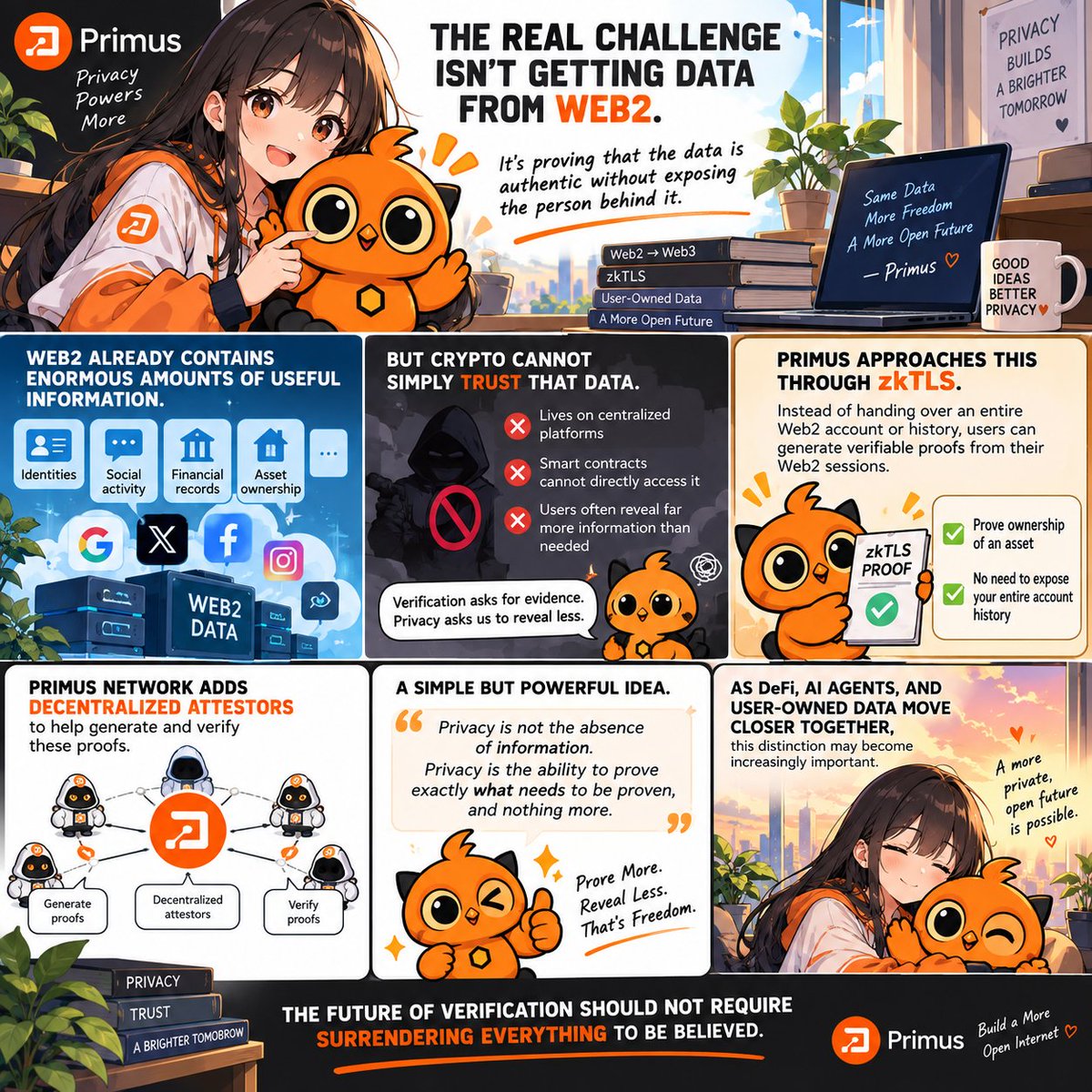
The problem is no longer getting data from Web2.
The harder problem is proving that the data is authentic without exposing the person behind it.
Web2 already contains enormous amounts of useful information: identities, social activity, financial records, asset ownership.
But crypto cannot simply trust that data.
It lives on centralized platforms. Smart contracts cannot directly access it. And when users need to prove something, they often end up revealing far more information than the application actually needs.
This creates a difficult trade-off:
Verification asks for evidence.
Privacy asks us to reveal less.
Primus approaches this through zkTLS.
Instead of handing over an entire Web2 account or history, users can generate verifiable proofs from their Web2 sessions.
For example, someone could prove ownership of an asset held on a centralized platform without exposing their entire account history.
Primus Network adds decentralized attestors to help generate and verify these proofs.
The deeper idea is simple:
Privacy is not the absence of information.
Privacy is the ability to prove exactly what needs to be proven, and nothing more.
As DeFi, AI agents, and user-owned data move closer together, that distinction may become increasingly important.
The future of verification should not require surrendering everything to be believed. @primus_labs
Cross-chain execution does more than move value.
It can also move an execution across multiple environments, each with its own public state and history.
That creates a deeper privacy question:
What happens to the confidentiality of an action when it crosses blockchain boundaries?
Fluton approaches this as an application-level confidential execution problem. Its documentation describes private actions across chains, including swaps, bridging, payments, and yield, without requiring users to migrate to a separate privacy blockchain.
The architectural idea is important.
Cross-chain privacy is not simply about making each individual transaction private. The execution itself can span multiple environments, so confidentiality needs to remain meaningful across that broader context.
This changes the question from:
“Can this transaction be private?”
to:
“Can the sensitive context of this execution remain protected as the action interacts with multiple chains?”
Fluton’s model is designed around confidential execution across existing blockchains rather than replacing them.
That does not mean every cross-chain action exposes nothing, nor does it imply perfect confidentiality or eliminate every form of information leakage.
The deeper point is architectural:
Cross-chain systems move value and state across boundaries.
Confidential execution must also account for the information that describes those actions.
When one economic action spans several chains, privacy becomes a property of the execution context, not merely an attribute of one transaction.
Cross-chain execution should move value across networks without forcing the full context of that action to travel with it. @FlutonIO