@AmericanAir now on my return flight AA2172. You pushed back 9 mins early just to hit your internal "D-0" departure stats, but now we're just sitting on the tarmac. 📉 Stop gaming your metrics while passengers miss connections. @USDOL
Introducing GLM-5.2: Frontier Intelligence, Open Weights
- Significant improvements in coding and agentic tasks
- Strong long-horizon capabilities with a 1M context window
- Two levels of reasoning effort: GLM-5.2 (max) pushes the limits, while GLM-5.2 (high) strikes a strong balance between performance and token efficiency
- MIT-licensed open weights
- Same API pricing as GLM-5.1
Tech Blog: https://t.co/LAsxUdN0JZ
Weights: https://t.co/g0A1C4UWx4
API: https://t.co/Kc3E22cbN7
Coding Plan: https://t.co/Nk8Y98HNhU
Chat: https://t.co/WCqWT0qCQb
The research behind this is wild. Your kitchen sponge has the same density of bacteria as human stool. German scientists found 54 billion bacterial cells per cubic centimeter inside used sponges in 2017. Yours is sitting right next to your sink.
Sponges are the perfect home for bacteria. They are wet, warm, full of food bits, and never fully dry between washes. Across all 14 sponges, the team found 362 different types of bacteria. The most common species include strains that can make people sick.
In 2011, the public health group NSF International swabbed 30 things in 22 American homes. The dirtiest object in the entire house was the kitchen sponge. It was dirtier than the toilet seat. 75% of the sponges tested positive for the kind of bacteria that includes Salmonella and E. coli.
Microwaving does not clean the sponge. The 2017 study found microwaved sponges had higher amounts of the smelliest, most harmful bacteria. Heat kills the weak strains. The strong ones survive and refill the sponge with no competition for space.
A 2021 Norwegian study compared kitchen sponges to dish brushes. In brushes, Salmonella was wiped out within three days because the bristles dry out between uses. In sponges, bacteria climbed to about a billion cells per sponge. The lead researcher told CNN that one kitchen sponge can hold more bacteria than there are people on Earth.
Three things actually work. Switch to a dish brush, because brushes dry fully between uses while sponges stay wet for hours. Replace your sponge every one to two weeks. Never leave it sitting wet in the sink. Norway and Denmark already do this by default, but most other countries don't.
The detergent is fine. Your sponge is the problem.
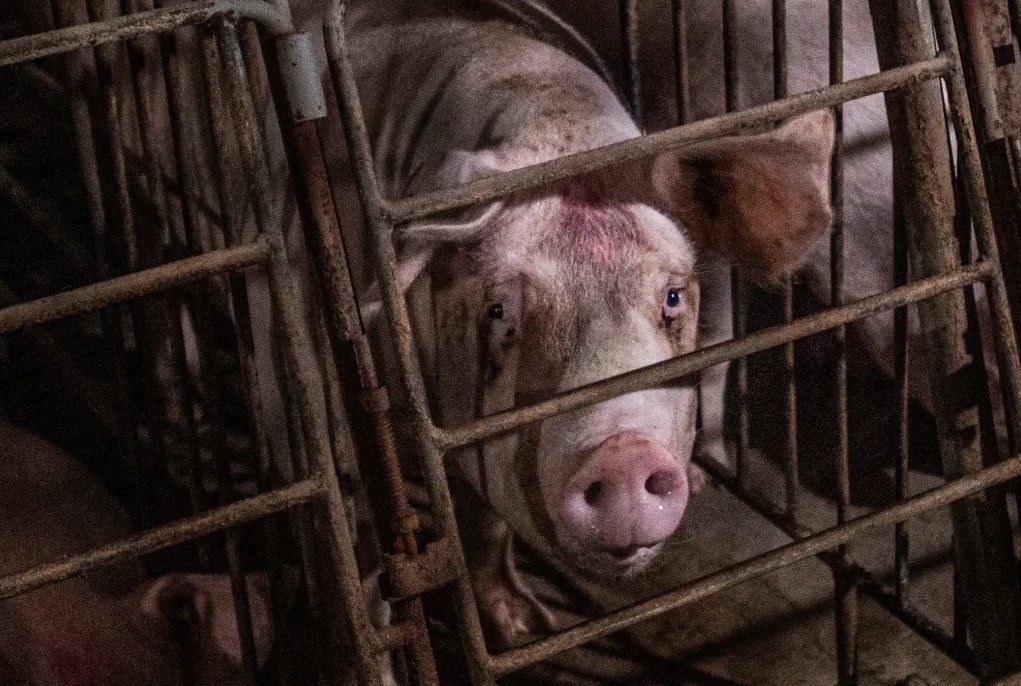
Hidden on page 744 of the farm bill the House Agriculture Committee passed Thursday is a provision that would condemn millions of pigs to a lifetime in gestation crates.
Rebranded the 'Save Our Bacon Act,' it's a pork-industry play to wipe out every state law banning the sale of pork from crated pigs — laws the conservative Supreme Court upheld in 2023.
Over 85% of Democrats and Republicans oppose these crates. Voters have backed ballot measures to ban them in state after state.
The pork industry knows it can't win a straight vote on this. So it's burying the provision in an 800-page bill and hoping no one notices.
Contact your senators and representative today and tell them: oppose the farm bill unless the Save Our Bacon Act is stripped out. You can reach them at https://t.co/MQvByA4atR and https://t.co/v6ghw99u1K — it takes two minutes and it matters.