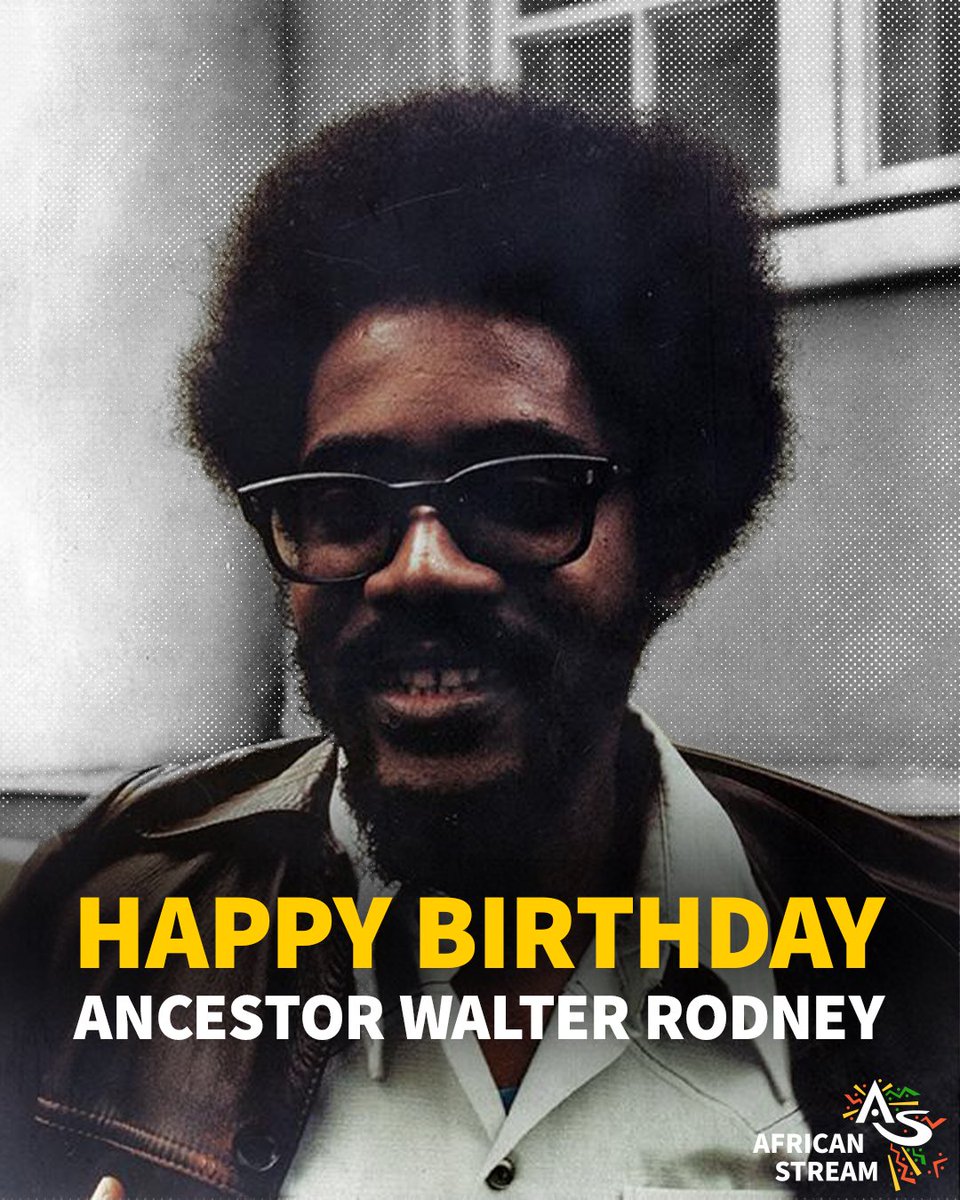
Revolutionary Guyanese writer and activist Walter Rodney would have been 83 years old today. We remember the guerrilla intellectual, who left a lasting legacy on academia and the struggle for social justice.
Rodney's intellectual journey began at university in Jamaica, where he rejected the path of a technocrat and instead focused his curiosity on Africa during its period of independence.
He earned his PhD from London’s School of Oriental and African Studies aged 24. His research challenged established narratives on Europe’s role in the slave trade and exposed the detrimental effects of European colonialism on Africa's development.
Rodney's determination to make a difference took him to Tanzania‘s Dar Es Salaam University, where, in the late ‘60s, he taught and left his mark on a generation of historians living under the leadership of Mwalimu Julius Nyerere.
Returning to Jamaica, he embraced the struggles of the marginalised and connected with students and the working poor through his teachings and community engagement. His ability to bridge the gap between intellectuals and the masses was met with government surveillance and eventual expulsion from Jamaica. This sparked widespread riots and cemented his radical legacy.
Throughout his life, Rodney remained dedicated to the cause of social justice, forging alliances with intellectuals, including Rastafarian leaders and Black-power activists. Notably, his impact extended to figures such as Ralph Gonsalves, who now serves as the prime minister of St. Vincent and the Grenadines.
After his expulsion from Jamaica, Rodney returned to Tanzania, where he played a key role in the Dar Es Salaam school of intellectual inquiry. There, he completed his magnum opus, How Europe Underdeveloped Africa, which continues to provoke passionate debates among historians and pan-Africanists today.
Tragically, his life was cut short when he was killed by a car bomb in 1980. 30,000 showed up to send him off at his funeral, illustrating how dearly he was held by the people.
Why is this court declaration of Israel’s occupation of Palestinian Territories as an illegal violation of the UN Charter and violation of the right of Palestinians to self-determination not making headlines? Why are there no TV/radio panels dissecting it and its implications?
"Sons and Daughters of Africa, we are standing on the threshold of a historic era. We are about to witness momentous events. We are blazing a new trail & we invite you to be, with us, creators of history. Join us in the march to freedom. March with us to independence."
-Sobukwe
Stand with South Africa against Trump’s wrath
When the powerful punish the principled, we glimpse the unmasked face of empire. Donald Trump’s vindictive executive order denying aid to South Africa — punishment for its support of Palestine and pursuit of land reform — offers precisely such a moment of clarity.
The contours of our new global struggle are now etched with brutal exactitude: a struggle between those who bow to imperial diktat and those who defy it. On the questions of Palestine and its right to undertake land reform, South Africa stands on the right side of this divide, and it must not stand alone.
South Africa’s so-called “crimes” are acts of courage. First, its steadfast support for Palestine’s struggle against Israel’s genocidal war machine. Second, its determination to redress the inequalities wrought by colonialism and apartheid through land reform. Both are acts of resistance against the imperial order that demands the Global South remain subservient, impoverished and pliant.
The parallels with Greece’s humiliation at the hands of the Troika are impossible to ignore. When I served as finance minister in 2015, our democratically elected government was brutally disciplined for daring to challenge austerity orthodoxy. The message was clear: democracy ends where creditor power begins. South Africa now faces a similar lesson — sovereignty ends where solidarity with Palestine and moves towards land reform begin.
But let us not mistake this for mere coincidence. What happened to Greece was not an aberration; it was a calculated demonstration of power. The European left, with a few honourable exceptions, stood by as our economy was strangled and our people impoverished. Southern European governments, cowed by the threat of similar treatment, offered little more than sympathetic murmurs. Greece was made an example of, a warning to others who might dare to challenge the neoliberal consensus.
This is precisely why South Africa must not face its current predicament alone. Unlike Greece in 2015, it must be encircled by a wall of solidarity from the Global South and from principled forces within the Global North.
Palestine remains the great moral clarifier of our time. It represents the ultimate test of our commitment to universal human rights. Either we believe in the equal value and dignity of all human lives, or we accept a world of hierarchical humanity where some lives matter immeasurably more than others. There is no middle ground.
The courage of South Africa in taking Israel to the International Court of Justice on charges of genocide exemplifies precisely the moral leadership the world desperately needs. That this action is being aggressively punished reveals the hollowness of Western pretensions to support international law. The empire demands obedience to its power, not adherence to international law.
South Africa’s moral authority on this issue is unassailable. Having emerged from the horrors of apartheid, it speaks with a clarity born of lived experience. Even its most vocal domestic critics — trade unions, grassroots movements such as Abahlali baseMjondolo — recognise the gravity of its stance. This is not merely a matter of foreign policy; it is a matter of principle.
The West’s claim to moral leadership has always been a grand illusion, sustained by a relentless ideological apparatus that regenerates itself after each catastrophic exposure. From the colonial massacres in Algeria and Vietnam to the destruction of Iraq and Libya, the empire has cloaked its brutality in the language of benevolence. Today, as genocide is livestreamed from Gaza, this illusion lies in tatters. The moral bankruptcy of the West is plain for all to see.
Trump’s attack on South Africa reveals something else: the bipartisan nature of imperial logic. While Republicans and Democrats may squabble over domestic policies, they remain united in their commitment to disciplining Global South nations that assert genuine independence. The rhetoric may differ, but the underlying commitment to maintaining Western hegemony never wavers.
The mechanics of this punishment should be understood clearly. By weaponising aid, Trump follows the well-established playbook of economic coercion. Aid has never been about altruism; it has always been about leverage. When a nation such as South Africa refuses to align its foreign policy with Washington’s demands, the mask of benevolence slips, revealing the true transactional nature of imperial “generosity”. The hypocrisy is staggering: an administration that professes to champion “democratic values” punishes a democratic nation for making sovereign choices.
So, what is to be done? The answer is solidarity — real, practical, material solidarity. The Global South must develop alternative financial mechanisms to reduce its dependence on imperial powers. When Greece faced financial asphyxiation, we lacked such alternatives. We were at the mercy of institutions — the European Central Bank, the International Monetary Fund, the European Commission — that were determined to crush our experiment in economic sovereignty. Had robust alternative structures existed, our story might have been different.
The only defence against divide-and-rule tactics is collective resistance. The recent formation of the Hague Group, a collection of nine countries, including South Africa, committed to collective solidarity with Palestine, is an important step forward. But more must be done.
Land reform — the other “crime” for which South Africa is being punished — is another arena of necessary solidarity. We must support South Africa’s right to undertake land reform, just as we support the right of Brazil to do the same, and the rights of governments in countries such as Bolivia and Senegal to put resources under national control.
The greatest power of the powerful lies in convincing us of our powerlessness. South Africa’s defiance challenges this manufactured fatalism. The question for all of us is simple: will we allow South Africa to be isolated and punished for its moral clarity? Or will we stand with South Africa, recognising that their fight against the arrogance of power is ultimately our fight too?
The answer will determine not only South Africa’s future but the possibility of a truly democratic international order. The choice is ours.
https://t.co/dZCo07pUgQ
"We should not fear victimization. We must fight for freedom - for the right to call our souls our own. And we must pay the price." - Mangaliso Robert Sobukwe
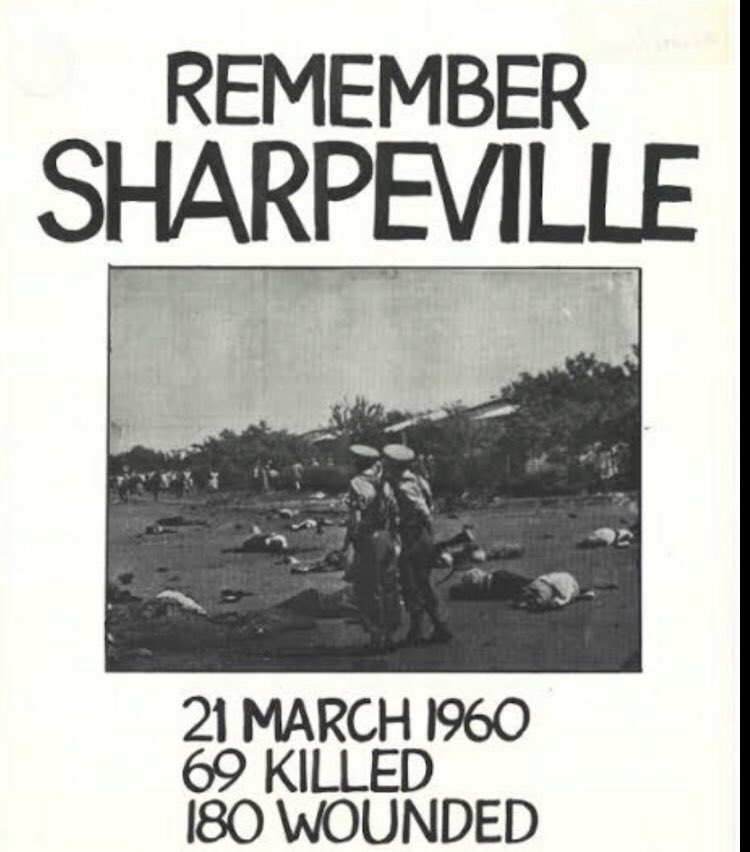
Langa Massacre. 21 March 1985. Uitenhage.
A massacre of people heading to a ‘prohibited’ funeral.
Fears of white apocalypse justify the cover up. A few tweets with images from the Report on the Massacre by Judge Donald Kannemeyer
RIP Chuck Roberts 💔
Songwriter, producer and vocalist Chuck Roberts has died aged 66.
Often labelled the “Voice of House Music”, Roberts is best known for his spoken-word sermon on Rhythm Controll’s 1987 track ‘My House’ — which starts with the iconic phrase “In the beginning there was jack”.
According to a statement, Roberts passed away “peacefully” at his home in Illinois on June 6 following a battle with cancer.
Among those to have paid tribute to Roberts is Terry Hunter, who shared the news on Facebook, writing: “I can’t believe I’m writing this! RIP Chuck The Voice Roberts!!!! In the Beginning There Was Jack!”
Mixmag visited Roberts in 2018 to record his inspiring sermon around New York, watch it below 🙏