Extreme rainfall across India is not just changing - it’s being driven by human influence.
Using a formal detection & attribution framework, our study disentangles the anthropogenic and natural drivers of these changes.
https://t.co/XyiZDsuKRS
@makrishna@DILEEPK12424783
𝗜𝗜𝗦𝗘𝗥 𝗕𝗵𝗼𝗽𝗮𝗹 𝗦𝘁𝘂𝗱𝘆 𝗦𝗵𝗲𝗱𝘀 𝗡𝗲𝘄 𝗟𝗶𝗴𝗵𝘁 𝗼𝗻 𝗜𝗻𝗱𝗶𝗮’𝘀 𝗠𝗲𝘁𝗵𝗮𝗻𝗲 𝗘𝗺𝗶𝘀𝘀𝗶𝗼𝗻𝘀 𝗮𝗻𝗱 𝗧𝗵𝗲𝗶𝗿 𝗜𝗺𝗽𝗮𝗰𝘁 𝗼𝗻 𝗚𝗹𝗼𝗯𝗮𝗹 𝗖𝗹𝗶𝗺𝗮𝘁𝗲 𝗖𝗵𝗮𝗻𝗴𝗲
A study led by Dr. Dhanyalekshmi Pillai, Thara Anna Mathew, and Jithin Sukumaran, Department of Earth and Environmental Sciences, IISER Bhopal, and collaborators, published in Atmospheric Chemistry and Physics, finds that India’s methane emissions may be lower than estimates from widely used global inventories. However, the findings also highlight the urgent need for stronger and more comprehensive monitoring systems.
Using advanced atmospheric modelling combined with satellite observations from TROPOMI and ground-based data, the team estimates India’s annual methane emissions to be between 21.9 and 24.9 teragrams. This is lower than some global estimates but slightly higher than India’s official reports.
𝗞𝗲𝘆 𝗵𝗶𝗴𝗵𝗹𝗶𝗴𝗵𝘁𝘀:
• Satellite-based observations provide a more detailed and dynamic picture of emissions
• Current global inventories may overestimate India’s methane emissions by up to ~24%
• Improved monitoring can help identify emission hotspots and support targeted climate policies
Methane is a potent greenhouse gas with a significantly higher warming potential than CO₂ over shorter timescales, making accurate measurement crucial for effective climate action.
This work demonstrates the importance of integrating satellite data, ground observations, and high-resolution models to better understand regional emission patterns and inform policy decisions.
📖 Read the full study: https://t.co/M8YGCutZui
📰 𝗠𝗲𝗱𝗶𝗮 𝗰𝗼𝘃𝗲𝗿𝗮𝗴𝗲:
PTI: https://t.co/WCS6GskRUr
ThePrint:
https://t.co/IdcqVZReRi
Deccan Chronicle:
https://t.co/iTdLRvpuoD
@EduMinOfIndia@IndiaDST@DBTIndia@ANRFIndia@dasgobardhan@Dhanya__Pillai
#IISERBhopal #ClimateScience #Methane #Sustainability #ResearchImpact #EarthScience #ClimateAction
Check out our recent publication on Atmospheric Chemistry and Physics journal. Our study emphasizes the urgency of extended methane monitoring network over India. Thanks to @Dhanya__Pillai, @JithinSKumar8 and all other co authors. @gmalab_iiserb
With the Indo-Japan-Belgium collaboration, GMA is stepping up to observe precise column GHG measurements using an advanced FTIR system. Thanks to the team from BIRA, NIES & KKC for their valued collaboration and IISERB for continuous support. @Dhanya__Pillai@iiserbhopal@moesgoi
Honoured to be at the KERA-AWD inception workshop 📍 Kerala Agricultural University🌾 . They discussed ways to reduce & account for CH4 emissions to mitigate climate impacts @Dhanya__Pillai .Great collaboration with experts from various fields! #LowEmission@iiserbhopal@moesgoi
Publication alert 👉 Check out our article "Assessing the accuracy of meteorological transport model ensemble towards estimating Indian carbon fluxes" at https://t.co/xGGIytFZAQ via @IOPenvironment
The Reverse Waterfalls of #Kavalesaad -viewpoint b/w monsoon giants #Amboli & #Kitwade at ~700 m elevation. Under active #Monsoon conditions, strong 925 hPa westerly winds (40-60+km/h) blew waterfalls upward, defying gravity. A stunning sight in the #WesternGhats,Taken on July 5
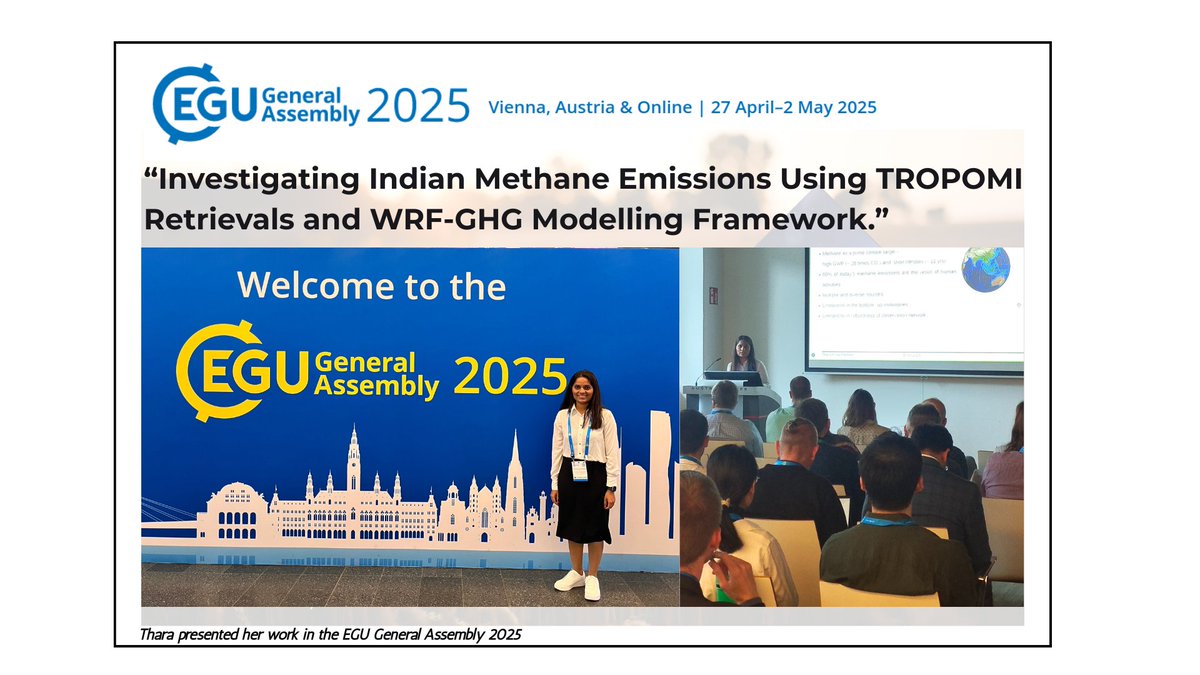
Kudos to @tharaannna and @JithinSKumar8 for taking their research to a greater scientific audience at EGU General Assembly 2025 held at Vienna between 27 April -02 May.
IISER Bhopal unveils new tech linking plant fluorescence to carbon processes, highlighting India’s green carbon sink potential. Thanks to Dr. Dhanyalekshmi Pillai and the team for their dedication.
#IISER#IISERBhopal
Congratulations Dr. Vishnu Thilakan M for your successful thesis defense ("Towards quantifying the source-sink distribution of CO2 over India: Utilising CO2 observations in combination with high-resolution atmospheric transport and ecosystem modelling"). @iiserbhopal
A recent article from Dr. Dhanyalekshmi Pillai’s group on "How Critical Is the Accuracy of the Atmospheric Transport Modeling to Improve the Urban CO2 Emission in India?—A Lagrangian-Based Approach".
https://t.co/CVAvKowuba
@iiserbhopal#IISERs@serbonline@EduMinOfIndia
🌍Climate change! India takes big steps to combat it!We need city-scale CO2 tracking for urban emission reduction strategies. Did you know how we predict atmospheric transport significantly influence carbon emission estimates?
@JithinSKumar8@Dhanya__Pillai@iiserbhopal@MPI_BGC
#Dubai Airport recorded 162.8 mm of rainfall in a span of 24 hours, nearly 1.5 years worth of rain. Additionally, #Fujairah received 145 mm of rainfall, #Sharjah 124.2 mm, & Al-Ain 107 mm, marking a rare widespread catastrophic synoptic #Rainstrorm event in the history of #UAE