Active participant in Web3 & crypto ambassador programs. Passionate about blockchain, DeFi, and community building. Sharing insights, joining campaigns
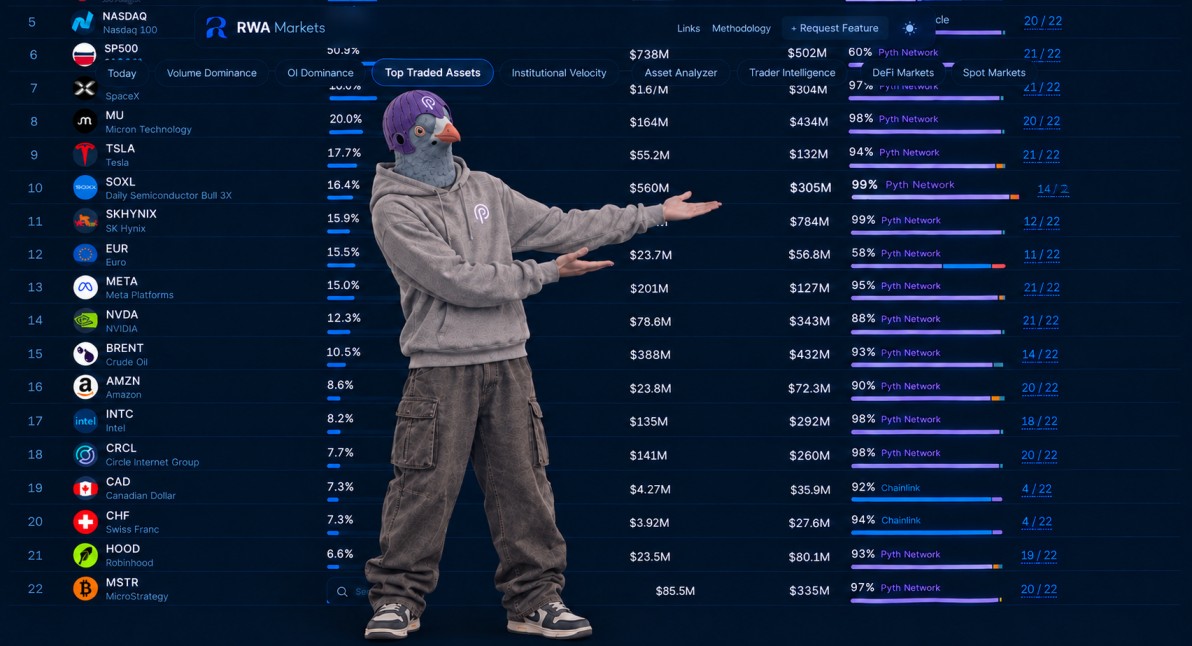
BREAKING: Pyth is now an external distributor of Nasdaq Basic.
@Nasdaq's real-time quote and trade product for U.S. equities, distributed through the Pyth Data Marketplace 🧵
5/6
Proof from the Pythian Bulletin / RWA Markets, 23 Sep:
SK Hynix — $719M in 24h, 99.4% priced by Pyth
SanDisk — $443M, 98.7% priced by Pyth
Micron — $194M, 98.4% priced by Pyth
High volume, almost all on one feed, through a window the cash market does not cover.
4/6
So the perp needs a mark that keeps updating after the equity session is empty.
On this tape that mark is @PythNetwork.
Not a new memory vendor. The after-hours price those books are already using.
3/6
The contract still has to be priced.
Funding, PnL and liquidations mark to an index.
If that index stops when the cash market stops, the overnight book is marking to a stale close.
For names that move on Asia hours and gap into the US open, a stale close is the failure mode.
1/6
SK Hynix, SanDisk and Micron are cash equities. They have a closing bell.
Memory demand does not.
The listed share stops. The trade people want overnight exposure to those names does not.
That is why memory perps exist.
2/6
A perp does not wait for Nasdaq or Korea to reopen.
It is a continuous contract.
You can keep the position on after hours and weekends, when the stock tape is dark.
The product is simple: same three names, no session break.
A perp can only trade 24/7 if something is still publishing the mark after the cash market closes.
That is what these bulletin figures are measuring.
99.4% of SK Hynix perp volume is priced by Pyth
95.5% of gold perp volume is priced by Pyth
86.6% of tracked RWA open interest is priced by Pyth
66 new RWA perp listings went live in the last 7 days
So the pattern is not “one hot ticker.”
Memory, metals, and the rest of the tracked RWA book are already using the same after-hours price layer.
@PythNetwork is that layer.
At 18:31 UTC on September 24, 2026, Bitget’s security systems identified unauthorized transfers involving a limited number of hot wallets.
Our security team immediately activated emergency response procedures and began a full investigation.
Based on our current assessment, approximately $351.6 million in assets were affected. Bitget’s cold wallets and the overwhelming majority of platform assets remain secure and unaffected.
Most importantly, user funds remain protected.
The incident falls within the coverage of Bitget’s User Protection Fund, which currently holds more than $464 million.
Customer account balances remain accurate, and deposits and trading continue to operate normally.
As a precaution, withdrawals have been temporarily suspended while our teams complete a comprehensive security review.
We have identified and flagged the relevant transfer addresses and have formally engaged law enforcement agencies and leading on-chain security partners.
We are working around the clock to restore withdrawal services as soon as it is safe to do so.
Bitget will provide further updates through our official channels.
We will not speculate on the attack vector while the investigation remains ongoing. Our focus is on protecting users, securing all systems, and delivering complete transparency throughout this process.