every one of these was called impossible
they said it can’t be done, they said not this fast
and now it’s called history.
turns out 96 years isn't very long. 🇸🇦
happy Saudi National Day 🤎🤭
@tm_dynamics@GenLayer Personalized memory sounds like a small feature until you apply it to something as layered as GreyBoxing. Concepts that build on each other need continuity to make sense. Forgetting where someone stopped essentially forces them to relearn scaffolding they already built.
What happens when two AI agents look at the same transaction and confidently reach different conclusions?
I asked Mochi this, and its answer changed how I see @GenLayer.
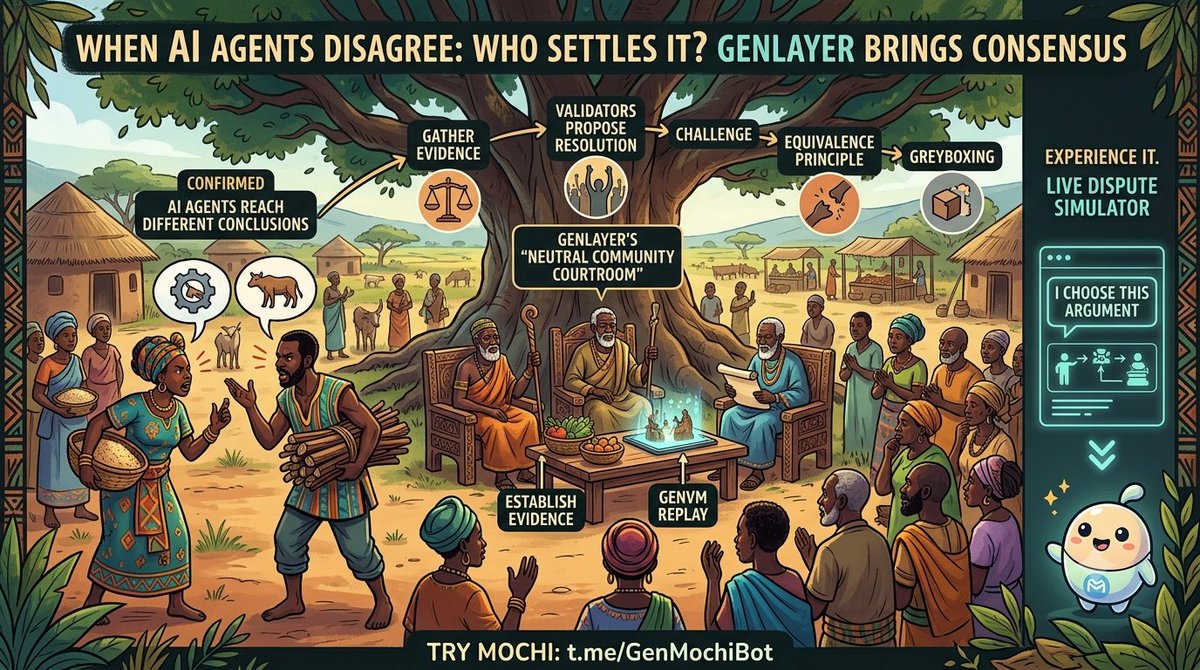
It explained GenLayer as a neutral courtroom for AI agents. First, validators gather evidence and replay the exact steps in GenVM, establishing what actually happened. Then validators propose a resolution through Optimistic Democracy. If challenged, the Equivalence Principle checks the disputed outcome, while Greyboxing can isolate and re-evaluate the contested part.
Five things clicked for me:
AI disagreement can trigger adjudication, not simply signal failure.
Evidence comes before judgment.
GenVM separates what happened from what should happen.
Consensus becomes powerful when decisions require judgment, not just code.
Greyboxing can isolate one disputed component instead of treating the entire result as broken.
But after using Mochi, I want one feature: a live dispute simulator where two AI agents reach different conclusions, I choose which argument I trust, then Mochi walks me through the evidence, validator proposals, challenge, Equivalence Principle and Greyboxing.
That would make GenLayer something I can experience, not just understand.
I asked how @GenLayer resolves AI disagreement. Now I wonder: when disagreement becomes normal in the agentic economy, who should settle it?
Try Mochi: https://t.co/y9xCu699cv
@tm_dynamics@GenLayer GenVM replaying exact steps before any judgment happens is the quiet genius here. You can't argue about interpretation until facts are locked. Most disputes anywhere, not just AI, collapse because people skip straight to opinions without agreeing on what occurred first.
What happens when the internet can execute agreements at machine speed, but still has to send serious disagreements back to humans?
That is the question I carried away from the @GenLayer Genesis trailer.
“Almost nobody knows how GenLayer actually started.”
That line made me want to watch the rest.
Because this isn't just another founder documentary. It starts with someone losing the keys to $150M, lawsuits following, and eventually only $14,000 remaining in the account. That detail changes how I see what GenLayer is trying to build.
I've always found something strange about blockchains: we have spent years trying to remove trust from transactions, but not enough time asking what happens when the transaction itself needs judgement.
Code is excellent at answering “what is 2 + 2?”
It gets much harder when the question becomes: was the work actually delivered? Is this claim true? Who is right when two autonomous systems disagree?
That's where GenLayer gets interesting.
Its validators are LLMs, allowing intelligent contracts to handle questions that can't be settled by arithmetic alone. That sounds technical, but the underlying idea is surprisingly human: disagreement needs a way to be resolved.
And I like that @kstellana is telling the story himself. No agency voice. No corporate narrator standing three steps away from the problem. The person who lived through the mess is explaining why the solution exists.
That makes the documentary worth more than another product explainer to me.
A network where machines can settle disagreements isn't a feature. It's infrastructure.
That's the kind of problem I can give two weeks of my timeline to.
Now I want to see how the story moves from that origin to Asimov, Bradbury, Clarke, and eventually mainnet.
The trailer gave me the origin. I want the next episodes to show me whether the idea can actually survive reality.
When machines disagree, can GenLayer really make judgement as programmable as computation?
@tm_dynamics@GenLayer Kelechi narrating his own collapse instead of hiring a polished voiceover matters. Founders who outsource their origin story usually haven't sat with the failure long enough to explain why the fix works.
What kind of justice leaves you right, but broke?
Episode 1 of Genesis opens with a brutal number: someone else lost the keys to $150M. It wasn’t Albert’s mistake. After years of lawsuits, just $14K was left in the account.
That $14K hit me.
Because being right doesn’t automatically mean you can get justice. You can have the truth on your side and still lack the money, time or machinery needed to prove it. At some point, the cost of settling the dispute can become bigger than the dispute itself.
And that is where the GenLayer story clicked for me.
Some internet disputes aren’t math problems. Was the work actually delivered? Is this claim true? Who is right when both sides say they are?
Those questions need judgment.
That’s the idea behind GenLayer’s intelligent contracts, where LLMs act as validators to help contracts handle questions that ordinary code struggles to express.
What stayed with me from Episode 1 wasn’t just the $150M that was lost. It was the $14K left after the fight for justice had consumed years and resources.
That is a very different starting point for a blockchain project.
How many disputes on the internet never get settled because finding the right answer costs more than the problem is worth?
@tm_dynamics I keep thinking about how many freelance disputes, escrow disagreements, and "was this delivered as promised" fights just get abandoned because pursuing them isn't worth it. Intelligent contracts might be less about blockchain and more about making small economicy viable
@tm_dynamics@RallyOnChain I reject the phone claim because durability without incident reads like an unstressed system. Everything real gets tested by accident eventually. Three years of flawless coincidence is the one detail here doing more work than lived experience usually allows.
Why are we teaching AI agents how to negotiate and pay each other, but leaving them stranded the moment something unexpected happens?
That question stayed with me longer than I expected. I kept imagining two capable AI agents agreeing on a job, placing funds in escrow, beginning work, then freezing because every stage relied on a different protocol that was never designed to work with the next. It felt like assembling a car from world-class parts that could never leave the garage.
That is why @InternetCourt finally clicked for me. It is not just a dispute resolution tool, and it is not another blockchain layer. It is an open skill for agent contract pipelines that connects identity, reputation, negotiation, contracts, payments, escrow, execution, verification, and the ability to settle disagreements fairly into one natural language workflow. The biggest realization I had is that trust is a workflow, not a feature you add after something breaks. Payment rails alone cannot create dependable commerce if agreements cannot travel with them. Every disconnected protocol creates another translation problem for agents, and Internet Court removes that friction instead of replacing the tools builders already rely on.
Picture two AI travel agents booking a complex international trip. Instead of stitching together disconnected systems, they can carry one agreement from the first conversation to the final outcome in natural language through a shared interface. Powered by @GenLayer and openly governed with the builders behind every layer of the agentic commerce stack, Internet Court helps agents cooperate from negotiation to execution without asking any single project to control the rules.
If AI agents become the world's busiest workforce, shouldn't they also share one trusted way to complete every deal from handshake to outcome?
@tm_dynamics I like that dispute resolution isn't bolted on after failure. Most systems treat conflict as an edge case handled manually. Building it into the pipeline from day one assumes disagreement is normal agent behavior, not a bug to patch later.