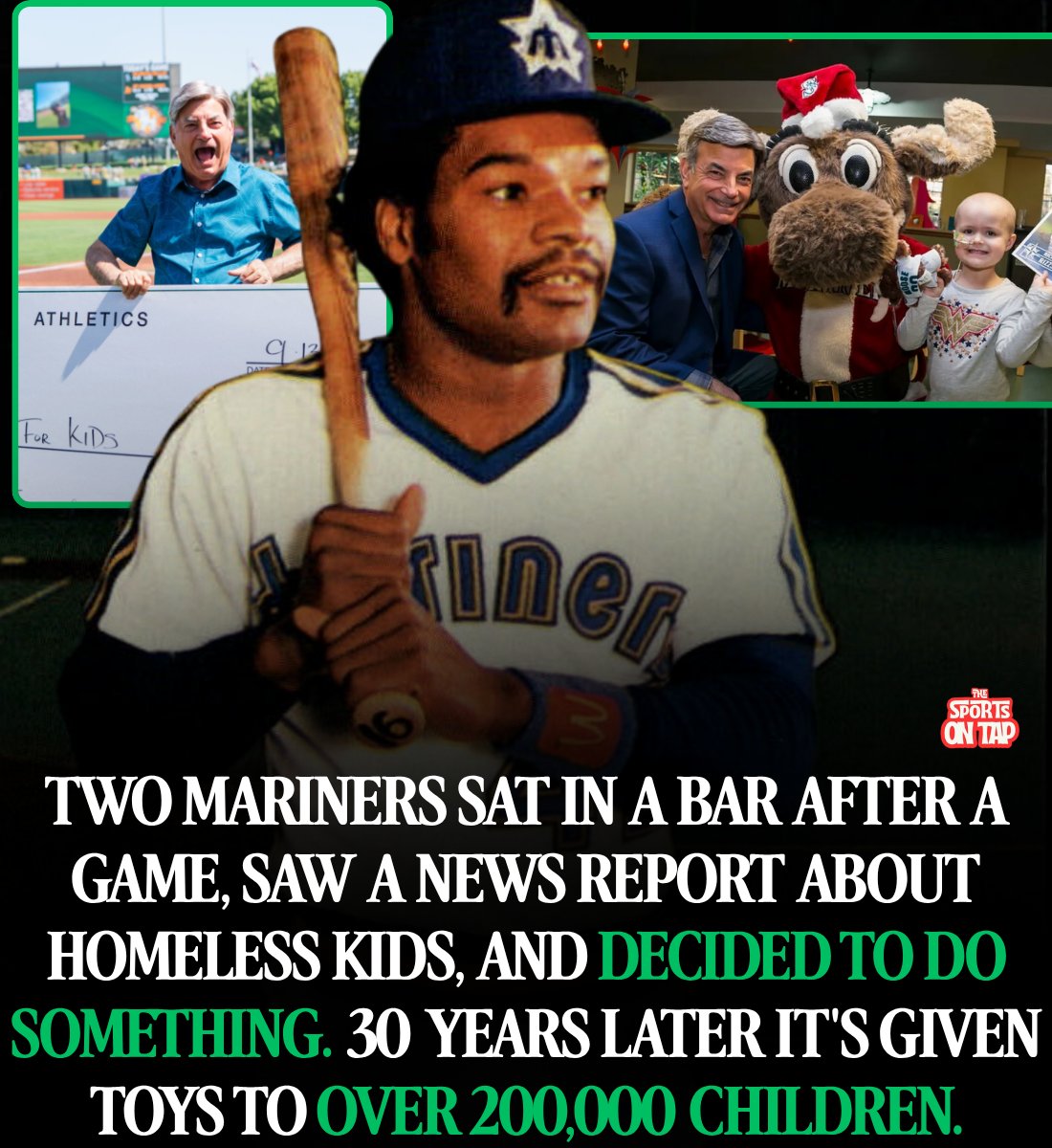
One night in 1995, Mariners broadcaster Rick Rizzs and former Mariners outfielder Dave Henderson were sitting in a bar in Pioneer Square after a game, having a beer.
A news report came on the TV about homeless people in Seattle. The two of them started talking, and one thought stuck. How many of those people had kids who wouldn't be getting anything for Christmas?
So they decided to do something about it. That night.
They passed the hat among Mariners players, guys like Edgar Martinez, Jay Buhner, Dan Wilson, and John Olerud, and raised $18,000. They bought about 500 toys and delivered them to homeless and women's shelters around the city.
They called it Toys for Kids.
It did not stay small.
Thirty years later, that idea born in a bar has raised well over a million dollars, bought brand-new toys for more than 200,000 children across Washington State, and thrown dozens of holiday parties for kids in shelters, hospitals, and impossible situations. Some years the fundraiser alone brings in more than half a million dollars.
Rizzs plays Santa himself. Not a symbolic Santa. He shows up, hands out the gifts, and looks the kids in the eye.
"It's not just a toy," he said. "To me, it represents hope that somebody cares about them and their moms."
Then came the hard part.
In December 2015, two days after Christmas, Dave Henderson died of a heart attack. He was 57. Rizzs lost his broadcast partner, his charity partner, and one of his closest friends all at once.
"I miss him like crazy," Rizzs said.
He could have let it fade. Instead, he kept it going, bigger every year, and made sure Henderson's name stayed on it. There's now a Dave Henderson Scholarship attached to the charity, handing college money to kids who write about what education means to them.
Henderson was the kind of guy who, on one of those holiday visits, met a woman working at a shelter, noticed her car was falling apart, and quietly bought her a new one.
"Who does that?" Rizzs said. "Dave Henderson does that."
Two friends, a beer, and a news report. Three decades later, hundreds of thousands of Seattle kids have woken up to a present because of it.
"What’s the idea of showing me up like this?
You think for one minute he’s got a better arm than me?
What a stupid statistic!"
Thurman Munson was furious to see a daily press note highlighting that Carlton Fisk led American League catchers in assists, fueled by National broadcaster Curt Gowdy's praise of Fisk.
That very night, Munson intentionally dropped multiple third strikes and threw the batters out at first base just to pad his assist stats, glaring at the press box and ultimately passing Fisk in the rankings."
"In fact, they did have civil exchanges during their encounters at the plate, but bottom line:
They really didn't like one another.
Though the two persistently denied any feud to the press, actions do speak louder than words.
Thurman would frequently check his rival's statistics in the newspaper, while Fisk was infuriated at the mention of Munson's name.
Fisk later remembered one instance in which Munson found out in the morning paper that he was losing to Fisk in the assist department during one year late in Thurm's career.
With Ron Guidry on the mound sporting a masterful ten-strikeout game, Thurman purposely dropped about a half dozen balls and threw them to first to edge Fisk for the title."
"Thurman Munson: A Baseball Biography."
Christopher Devine.
"Thurm an' Fisk."
Art by Bill Purdom.
This was 1998 at the old Tiger Stadium in Detroit! I was in the dugout when this happened and I told him when he came in I don’t feel so bad now because that catch was better than one you made on me at the old Yankee Stadium in 1990. I was the Mariners Hitting Coach in 98,99!
"Babe Ruth, who had not been told he had cancer out of his family’s fear he might do himself harm, was put on teropterin, a folic acid derivative and may have been the first human subject.
Ruth began receiving daily injections of teropterin, and a closely related drug, methotrexate, which is now widely used in treating cancer and other diseases.
Ruth said he knew teropterin had rarely been used on humans, ''but asked no questions,'' and probably signed no formal consent, as is required today, before receiving injections for six weeks.
Remarkably, Ruth had a dramatic clinical response with regression of adenopathy and symptomatic improvement, and his case was presented anonymously at a research conference in St Louis in September 1947.
'The Wall Street Journal' and 'Time' magazine reported the following week that scientists were on the verge of a “cure for cancer”.
Babe Ruth showed dramatic improvement during the summer of 1947, so much so that his case was written up by his doctors, without using his name.
Ruth was able to travel around the country, doing promotional work for the Ford Motor Company on American Legion baseball
Mickey Rivers frequently bet so much on horses that, even making a major league salary, Mickey frequently would run out of money before the next paycheck.
One day before a game, in his uniform pants, Rivers went into George Steinbrenner's office and said he wanted a bonus.
They went back and forth and Steinbrenner finally decided Rivers deserved it, and said it would be in his next paycheck.
"I want it now," Rivers said, "in cash." Steinbrenner went to the safe in his office and pulled out $10,000 in hundreds, which Rivers shoved into his back pocket.
During the game, Rivers stole second and the throw went into center field. He got up to go to third, but then flopped down on the base again and wouldn't move.
Did Mickey not see the throw was wild?
Was he wary of the center fielder's arm?
Had he hurt himself?
No!!!
Rivers still had the $10,000 in his back pocket, and when he slid, the money came out. He stayed on the base so he could grab it!
Rivers told that story at a charity softball game and everybody laughed.
His old Yankees teammate Willie Randolph, who also was at the softball game, said the story was absolutely true!!!