Half of investors seem to think we are in a bubble.
The other half do not.
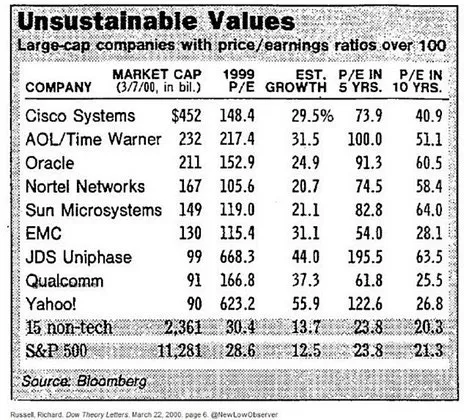
For reference, this is what valuation multiples looked like during the dot com bubble:
Jim Chanos called Enron before it collapsed - by reading the one page everyone skipped.
now he says the same trick is hiding in plain sight again.
the trick: in a spending boom, one dollar gets counted twice. booked as profit by the company selling the gear - quietly depreciated by the one buying it. earnings look unstoppable… until the spending stops.
his receipt: S&P 500 earnings rose ~30% into 2000, then cratered ~40% in twelve months. no recession did that. the telecom buildout just froze - firms had ordered 10,000 routers and needed 2,000.
he says the AI infrastructure boom runs on identical mechanics.
~20-min interview, free. the man who saw Enron in the footnotes on how every boom hides its own bust ↓
My entire AI stack is now Chinese 🇨🇳
87% cheaper. same revenue
swaps by task:
1. reasoning / backend brain
Opus 4.8 → Kimi K2.7
benchmark gap: ~8% · price: ~11x cheaper
2. code generation
GPT-5.5 → Qwen 3.7 Max
benchmark gap: ~18% · price: ~7x cheaper
3. agent loops + tool calling
Sonnet 4.7 → GLM 5.2
benchmark gap: ~3% · price: ~5x cheaper on input
4. cheap volume / bulk processing
GPT-5.5 mini → MiMo V2.5
benchmark gap: ~6% · price: ~12x cheaper
5. image generation
GPT-Image-2 → Wan 2.5
benchmark gap: ~5% · price: ~8x cheaper
6. video generation
Sora 2 → Kling 3.0
benchmark gap: roughly equal · price: ~6x cheaper
[ result after 30 days: ]
operating costs dropped 87%, output quality dropped 4% on average, revenue unchanged
the most important that these models will be not banned in a month and i can run them locally
nobody will steal my data and i can learn them as i need
full article drops tomorrow with:
> exact routing logic per task type
> the 2 cases where I still pay for American
> the migration playbook anyone can copy in a weekend
VERY IMPORTANT to get migrated now, while it's not too late
A French engineer who lives quietly in Paris has spent 30 years writing software that the entire internet now runs on without knowing his name.
He wrote the code that streams every YouTube video, every Netflix show, every TikTok clip. He wrote the code that runs the virtual servers underneath AWS, Google Cloud, and Microsoft Azure. He calculated more digits of pi than anyone in history. He has no Twitter. He has no marketing. He just keeps shipping.
His name is Fabrice Bellard.
Here is the story, because almost nobody outside the systems programming world knows what one man has built.
Fabrice was born in 1972 in Grenoble, France. He studied at École Polytechnique, the top French engineering school. He never went to Silicon Valley. He never built a startup empire. He just wrote code.
In 2000 he started a project called FFmpeg, an open-source multimedia framework for encoding, decoding, and streaming video. He was 28. The project did one thing nobody else had done well. It handled every video and audio format that existed, in one library, on every operating system. He led it himself for years.
Today FFmpeg is the invisible engine of the internet. YouTube uses it. Netflix uses it. VLC uses it. Chrome and Firefox use parts of it. Every Android phone, every iPhone, every smart TV, every video editing tool you have ever touched runs FFmpeg somewhere underneath. If you have watched a video on a screen in the last 20 years, Fabrice's code processed it.
He was not done.
In 2003 he started QEMU, a machine emulator and virtualizer. He wrote it solo until version 0.7.1 in 2005. QEMU lets you run any operating system on any other operating system. It became the foundation of modern virtualization. KVM, the Linux kernel hypervisor, runs on top of QEMU. Every major cloud provider, AWS, Google Cloud, Microsoft Azure, IBM Cloud, runs virtual machines on infrastructure built around it. The Quick Emulator is the most cited piece of cloud infrastructure code on Earth.
He kept going.
In 2001 he won the International Obfuscated C Code Contest with a small C compiler that grew into TCC, the Tiny C Compiler. TCC can compile and boot a Linux kernel from source in under 15 seconds. In 2004 he calculated the most digits of pi ever computed at the time, using a personal desktop computer and an algorithm he derived himself called Bellard's formula. In 2011 he wrote a complete PC emulator in pure JavaScript that runs Linux in your browser, a project called JSLinux that engineers still cannot believe is real.
In 2019 he released QuickJS, a small but complete JavaScript engine that fits where V8 cannot. In 2021 he released NNCP, a neural network based lossless data compressor that immediately took the lead on the Large Text Compression Benchmark.
Then he turned his attention to large language models. He built TextSynth Server, a web server with a REST API for running LLMs locally. He released ts_zip and ts_sms, compression utilities that use language models to compress text and short messages at ratios traditional algorithms cannot reach. He released TSAC, a very low bitrate audio compression system. In December 2025 he released Micro QuickJS, a new JavaScript engine for microcontrollers, separate from QuickJS, designed for environments with almost no memory.
Fabrice co-founded a telecom company called Amarisoft in 2012, where he serves as CTO. Amarisoft builds 4G and 5G base station software used by carriers and labs around the world. He has been running it for over a decade while continuing to ship personal projects from his own home page at bellard dot org
He has no Twitter. He has no Instagram. He gives almost no interviews. His personal website is a flat list of projects with no styling, no fonts, no marketing copy. Just titles and links.
A quiet French engineer who never moved to Silicon Valley wrote the code that quietly runs the internet.
He is still shipping.
🦔UC Berkeley's computer science department just posted its worst failure rates in years. 35.3% of CS 10 students got F's in spring 2026, up from under 10% in prior semesters. Professor Dan Garcia says the primary driver is a "vast increase in academic dishonesty" through LLMs. Students use AI to complete assignments, never learn the material, then fail exams. His office hours, once full, are now empty.
My Take
Companies are firing experienced engineers while the pipeline that produces new ones is being gutted by the same technology. Students use AI to bypass the hard part of learning, show up to exams without the understanding, and fail. One professor discovered a student's linear algebra class had an "open AI" policy for homework and exams. That student then couldn't do basic linear algebra in the next course.
Both ends of the workforce are eroding at the same time. Senior engineers are getting cut to fund AI spending. Junior engineers are graduating without the skills because AI did their coursework. And the companies spending trillions on these tools haven't connected those two facts yet.
Hedgie🤗
Two economists just published a mathematical proof that AI will destroy the economy.
Not might. Not could. Will — if nothing changes.
The paper is called "The AI Layoff Trap." Published March 2, 2026. Wharton School, University of Pennsylvania. Boston University. Peer reviewed. Mathematically modeled.
The conclusion is one sentence.
"At the limit, firms automate their way to boundless productivity and zero demand."
An economy that produces everything. And sells it to nobody.
Here is how you get there.
A company fires 500 workers and replaces them with AI. A competitor fires 700 to keep up. Another fires 1,000. Every company is behaving rationally. Every company is following the incentives correctly. And every company is building a trap for itself.
Because the workers who were fired were also customers.
When they lose their jobs faster than the economy can absorb them, they stop spending. Consumer demand falls. Companies respond by cutting costs — which means automating more workers — which means less spending — which means more falling demand — which means more automation.
The loop has no natural exit.
The researchers tested every proposed solution. Universal basic income. Capital income taxes. Worker equity participation. Upskilling programs. Corporate coordination agreements.
Every single one failed in the model.
The only intervention that worked: a Pigouvian automation tax — a per-task levy charged every time a company replaces a human with AI, forcing them to price in the demand they are destroying before they pull the trigger.
No government has implemented this. No major economy is seriously discussing it.
Meanwhile the numbers are already tracking the curve. 100,000 tech workers laid off in 2025. 92,000 more in the first months of 2026. Jack Dorsey fired half of Block's workforce and said publicly: "Within the next year, the majority of companies will reach the same conclusion."
Nobody is doing anything wrong. Companies are following their incentives perfectly. That is exactly the problem.
Rational behavior. At scale. Simultaneously. With no mechanism to stop it.
Two economists built the math. The math leads to one place.
Source: Falk & Tsoukalas · Wharton School + Boston University ·
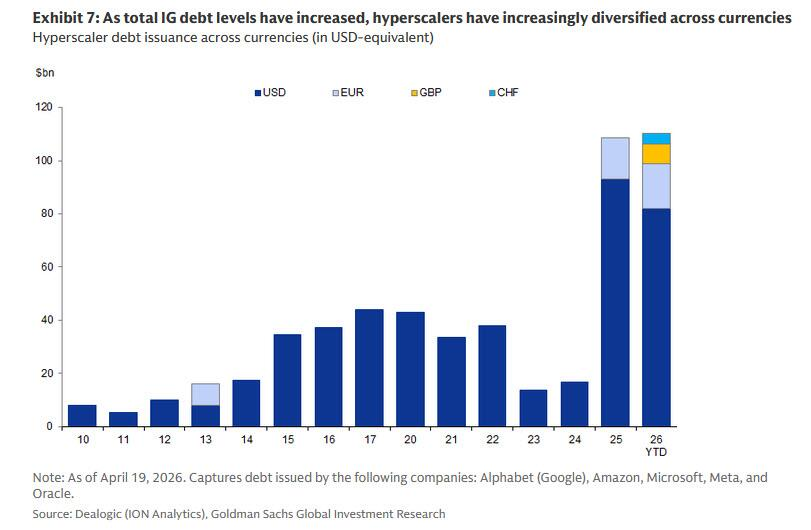
The AI bubble is primarily an earnings bubble rather than a valuation bubble. My report this week discusses the metrics investors should monitor to know when this bubble is about to burst.
Clients can read it here:
https://t.co/nPpZ5E1mas
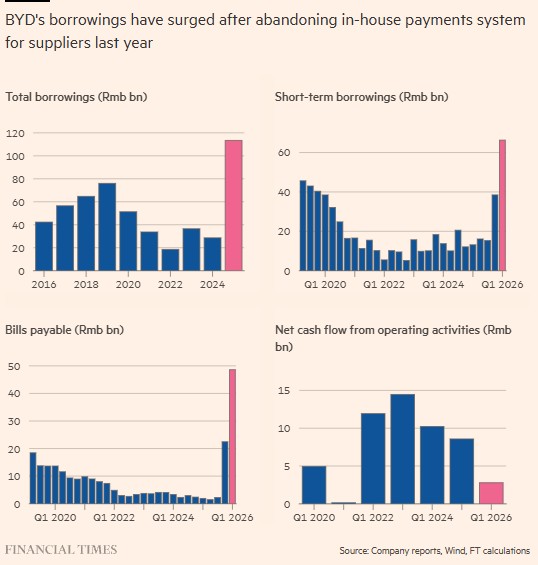
BYD for years used billions owed to suppliers as cheap financing to fund its rapid growth from a little-known component maker to a powerhouse reshaping the world’s auto industry. Now, Beijing is forcing it to clean up its books: https://t.co/Vw1cwqJ8AG
Jane Street, Goldman Sachs, JP Morgan, BlackRock, Hudson River Trading, Two Sigma, D.E. Shaw.
The most expensive engineering teams in the world released their financial tools on GitHub. Here are 7 repos, one from each.
1. Jane Street, janestreet/magic-trace
https://t.co/a2G20vnewK
5.3k stars. Process tracer powered by Intel PT. When your profiler is blind, magic-trace sees every CPU instruction.
2. Goldman Sachs, goldmansachs/gs-quant
https://t.co/SMYFwP3TWD
Derivative pricing the GS traders use at their desks. MIT licensed.
3. JP Morgan, finos/perspective
https://t.co/9rgy6FxYt4
What JPM traders use to watch markets in real time. A $24k/year terminal, for free.
4. BlackRock, blackrock/lcso
https://t.co/iHwsxZDZD9
Rust optimizer for portfolio problems. Where scipy gives up, this works.
5. Hudson River Trading, hudson-trading/corral
https://t.co/YhmrQFmYaZ
Structured concurrency for C++20. The foundation of HFT infrastructure at one of the largest U.S. trading firms.
6. Two Sigma, twosigma/flint https://t.co/ebEFqcDxJ6
Time-series joins on Apache Spark with temporal tolerance. Built for billions of ticks.
7. D.E. Shaw, deshaw/pyflyby https://t.co/uYDQKtnDVd
Auto-import for IPython and Jupyter. D.E. Shaw also funded the development of IPython itself.
Bookmarked it
🦔Google released Gemini 3.5 Flash this week, and the cheaper, faster model now costs 5.5 times more to run than its predecessor. Token prices tripled to $1.50 per million input and $9.00 per million output, and on agent tasks it burns through so many tokens that total costs end up 75% higher than Gemini 3.1 Pro, the model Flash was supposed to be cheaper than. Anthropic's Opus 4.7 has a hidden 30 to 40% price increase from token consumption. OpenAI's GPT 5.5 jumped 50 to 90% over 5.4.
My Take
The AI labs are all running the same playbook. Headline price per token reads as competitive, but the new models burn through more tokens per task, and the all-in cost to finish a job climbs release over release. Every developer and enterprise buyer should measure efficiency rather than token price now, because the two numbers have decoupled fast.
Anthropic, OpenAI, and Google all raised effective prices in the last six months, which gives us the first hard evidence that the unit economics of frontier AI are catching up with the marketing. The labs charge more because each model burns more compute per task, and the hyperscaler capex no longer pencils out at the old prices. Enterprises that built workflows on the assumption that token costs would keep falling are about to see their AI bills jump 30 to 90% on the next model upgrade, and the productivity gains that justified the AI spend have to clear that higher bar to keep working.
Hedgie🤗







![DeRonin_'s tweet photo. My entire AI stack is now Chinese 🇨🇳
87% cheaper. same revenue
swaps by task:
1. reasoning / backend brain
Opus 4.8 → Kimi K2.7
benchmark gap: ~8% · price: ~11x cheaper
2. code generation
GPT-5.5 → Qwen 3.7 Max
benchmark gap: ~18% · price: ~7x cheaper
3. agent loops + tool calling
Sonnet 4.7 → GLM 5.2
benchmark gap: ~3% · price: ~5x cheaper on input
4. cheap volume / bulk processing
GPT-5.5 mini → MiMo V2.5
benchmark gap: ~6% · price: ~12x cheaper
5. image generation
GPT-Image-2 → Wan 2.5
benchmark gap: ~5% · price: ~8x cheaper
6. video generation
Sora 2 → Kling 3.0
benchmark gap: roughly equal · price: ~6x cheaper
[ result after 30 days: ]
operating costs dropped 87%, output quality dropped 4% on average, revenue unchanged
the most important that these models will be not banned in a month and i can run them locally
nobody will steal my data and i can learn them as i need
full article drops tomorrow with:
> exact routing logic per task type
> the 2 cases where I still pay for American
> the migration playbook anyone can copy in a weekend
VERY IMPORTANT to get migrated now, while it's not too late](https://pbs.twimg.com/media/HL-p_PyWoAA42S2.jpg)