As a EU citizen, I'm really worried that the EU will disappear and be technology irrelevant.
It's one thing to not be able to produce the latest tech, but it's another thing to also cut yourself off from the latest tech because you have bureaucrats unable to understand a thing.
Our statement on the UK government’s demand that all content on all devices sold or used in the country be scanned, on the presumption of nudity, using a dystopian combination of age verification and content scanning. This proposal will not safeguard children. It endangers us all.
https://t.co/VdWe9uhi8p
Mais quel charabia d’Édouard Philippe sur l’intelligence artificielle.
« J’utilise très peu l’IA. Je fais un peu Chat GPT » dit-il.
Aucune curiosité, aucune conscience des enjeux. L’avenir l’ennuie. Et pourtant, il en réclame les clés.
Comment ceux qui n’aiment pas la technologie pourraient-ils la mettre au service de nos concitoyens ?
On ne demande pas à tous les dirigeants d’être ingénieur, mais d’avoir la lucidité de comprendre ce qui transforme le monde. De Gaulle n’était pas physicien nucléaire, il a pourtant doté la France de son arsenal nucléaire.
Il y a ceux qui vont nous condamner à subir le siècle qui vient et ceux qui veulent l’écrire.
Ma traque dans Paris jusqu'à la porte de mon domicile puis la diffusion illégale de photos portant atteinte à ma vie privée, auraient donc été organisées, financées et relayées par Xavier Niel.
De quel droit un milliardaire mécontent d'avoir eu à rendre des comptes peut-il, en toute impunité, utiliser ses moyens financiers et médiatiques pour intimider, surveiller et salir un parlementaire dont le seul tort est d'avoir enquêté sur ses contrats passés avec le service public ?
Avez-vous d’ailleurs entendu la moindre réaction de la Présidente de l'Assemblée, pourtant si prompte, il y a dix jours encore, à légitimer cette opération de déstabilisation parlementaire ?
Si certains pensent que ces méthodes mafieuses me feront taire, ils se trompent.
Je continuerai à exercer mon mandat avec la même détermination.
Et si défendre les intérêts des Français exige d’en payer un prix, je l’assumerai.
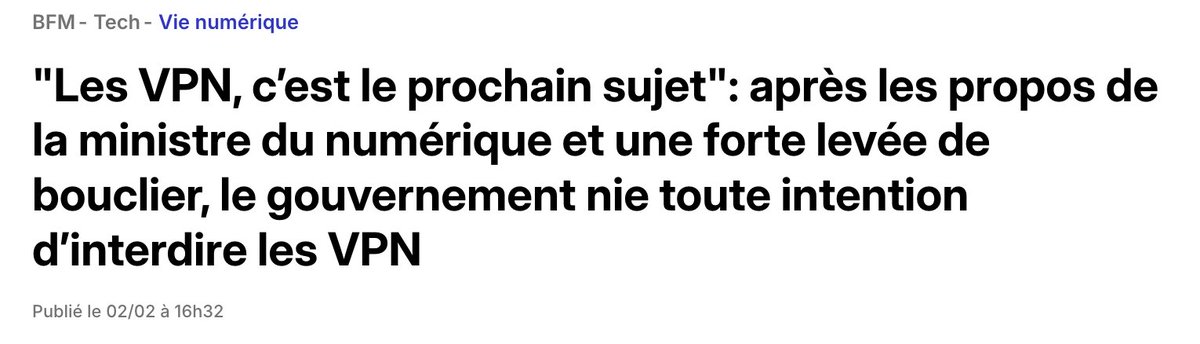
Pour le service de recherche du Parlement européen (EPRS), les VPN sont une "faille à combler" pour la vérification d'âge en ligne (les téléchargements de VPN ont explosé au UK après l'entrée en vigueur de l'Online Safety Act, ProtonVPN nous fait même un joli +1400%). La Children's Commissioner anglaise, veulent réserver les VPN aux adultes (ce qui implique un KYC pour préserver votre confidentialité pour ceux du fond qui dorment).
Comme déjà expliqué ici : https://t.co/IxiLHp5Oer le SDK est pourri, il ne faut donc pas compter sur des implémentations sans vulnérabilité "by design". En revanche, s'attaquer aux VPN pour forcer l'utilisation de ces passoires, dangereuses pour vos données personnelles... ça confine littéralement à la bêtise crasse.
https://t.co/i7ppDGUJnx
EU-Kommission plant eine neue, weit umfassendere Verordnung. 15 EU-Staaten fordern mindestens 12 Monate Speicherpflicht – nicht nur für Provider, sondern auch für:
Messenger (Signal, WhatsApp, Threema) VPN-Dienste Gaming-Plattformen Kryptobörsen https://t.co/cPFZjYVUBP
With your support, an @EP_EPRS briefing urging MEPs to regulate VPNs "to protect children" got 2.5M views on X — and was confronted with a Community Note citing research: 82% use VPNs for protection, not to bypass age checks.
A clear message: reconsider how EU taxpayer funds are spent on the next research. Don’t attack privacy and human rights tools.
Thank you everyone for your voice.
Be ready and defend your privacy as a human right. Every day. 🧡
This week so far....
🔵 Bluesky started asking for Age Verification
🤖 Chrome started downloading AI to your computer without asking
🇪🇺 The EU floated banning VPNs
🇺🇸 Utah anti-VPN law went live
Pour mes amis et camarades morts au service de la France.
Pour tous ceux qui ont donné leur vie pour protéger la France et les Français.
Merci. Du fond du cœur, merci.
Toute ma gratitude à vous et à vos familles depuis l’espace.
🚀 Monero (XMR) fait un bond en avant pour la confidentialité.
Jusqu'ici, quand tu envoyais des XMR, ta transaction se "cachait" parmi seulement 16 autres. Pas mal… mais perfectible.
Dès demain (bloc 2 997 100), une mise à jour majeure appelée FCMP++ entre en vigueur. Résultat ? Ta transaction ne se fond plus dans un petit groupe de 16 ... elle disparaît parmi les 150 millions d'outputs de toute l'histoire de la blockchain !
C'est la différence entre :
🚪 Se cacher dans une pièce avec 15 inconnus
🌆 Disparaître dans une mégalopole de 150 millions d'habitants
Personne ne peut plus pointer du doigt ta transaction. Pas de piste. Pas de lien. Rien.
C'est une multiplication par 10 000 de l'anonymat.
Longue vie à Monero.
@GeekProxy@WhyTHnot@okdoc9@jon_delorraine C'est vrai, mais il n'empêche que mettre cela en œuvre sur des milliers voir millions de sites reste un défi technique. Ca veut dire installer des logiciels supplémentaire, redévelopper quelque chose, ou faire appel à un WAF extérieur. Je ne pense pas que c'est ce qui sera retenu
@WhyTHnot@okdoc9@jon_delorraine Enfaite, tu peux facilement bloquer les VPN pour monsieur tout le monde, mais pour des gens du domaine, c'est beaucoup plus compliqué
@WhyTHnot@okdoc9@jon_delorraine Mouais.
DPI même la chine n'arrive pas à bloquer parfaitement les VPN. Les sites qui blackisent les VPN ca coute trop cher aux sites (payer les listes d'IPs) ; blocage des proto, là encore la chine elle même galère. BGP poisonning; RPKI ou solution de contournement (proxy, tor)
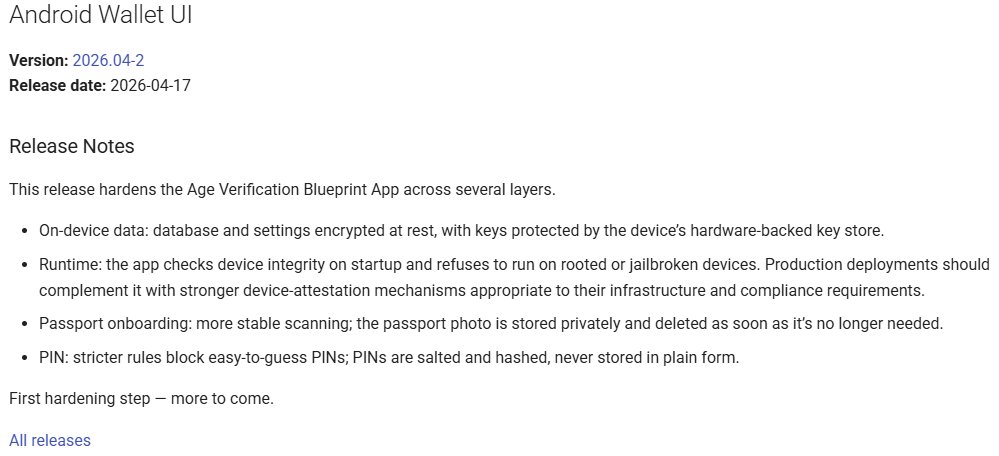
The @EU_Commission has released an update to patch out the issues I raised last week, v2026.04-2 (https://t.co/twlSbndQ0e)
Honestly, I don't know if I should laugh or cry.
Let's review each one:
1. On-device data: database and settings encrypted at rest, with keys protected by the device’s hardware-backed key store.
Sounds great, until you look closer.
They introduced https://t.co/9ejV5P6lqE:security-crypto, deprecated in 2025. Also https://t.co/9ejV5P6lqE.crypto.EncryptedSharedPreferences, deprecated in 2025. Finally, https://t.co/9ejV5P6lqE.crypto.MasterKeys, which were deprecated in 2020.
3 deprecated dependencies introduced following criticism over weak security. These weren't left over and missed during an update... they've added them now to "harden security". Remember, this isn't an isolated app. It's intended to lay the foundation for many production applications; all using deprecated security libraries from the outset.
Worse, they already correctly use KeystoreController in their codebase. The correct answer already existed and they still got it wrong.
2. Runtime: the app checks device integrity on startup and refuses to run on rooted or jailbroken devices. Production deployments should complement it with stronger device-attestation mechanisms appropriate to their infrastructure and compliance requirements.
They check for su, check package manager for root apps, run "which su" and checks if it's a custom ROM.
Paths:
/system/bin/su
/system/xbin/su
/sbin/su
/system/su
/data/local/su
/data/local/bin/su
/data/local/xbin/su
/system/app/Superuser.apk
/system/app/SuperSU.apk
Great... in 2015. These are all trivially bypassed in 2026.
3. Passport onboarding: more stable scanning; the passport photo is stored privately and deleted as soon as it’s no longer needed.
They're still not encrypted, so I'm not sure what "privately" means - but they are deleted correctly now.
4. PIN: stricter rules block easy-to-guess PINs; PINs are salted and hashed, never stored in plain form.
They salt correctly (a true CSPRNG), then use PBKDF2-SHA256 - which is outdated and only recommended where FIPS compliance is required, which doesn't apply here.
To make matters worse, they use just 210,000 iterations.
For those of a NISTy disposition, you're likely already shaking your head. 210,000 seems oddly specific.
It is. It's the @owasp minimum for PBKDF2-SHA512, not SHA256. Right number, wrong algorithm. In reality, OWASP recommended 600,000 iterations as a minimum in 2023.
Worse still, 600,000 is the baseline minimum for passwords, not PINs with 1 million permutations. You could use 1B iterations, you're not measurably increasing security when there are so few attempts required to break it. At the very least, use a modern hash with reasonable brute-force resistance against a 2026 threat model.
All this... cited as a "first hardening step". Again, utter security theatre.
None of this negates my fundamental point. This isn't fixable through code - it's fundamentally ill-conceived and poorly implemented.