Useful pattern I am lately using for coding/agentic work. After the agent writes a plan or finishes an implementation, ask it: "delegate to a sub-agent to perform adversarial review and implement its feedback"
@ianjcam@Teknium@NousResearch As I said, my suggestion doesn't change this. Hermes can still ship with all the skills Nous Research wants. My suggestion is about making this not bloat the context window
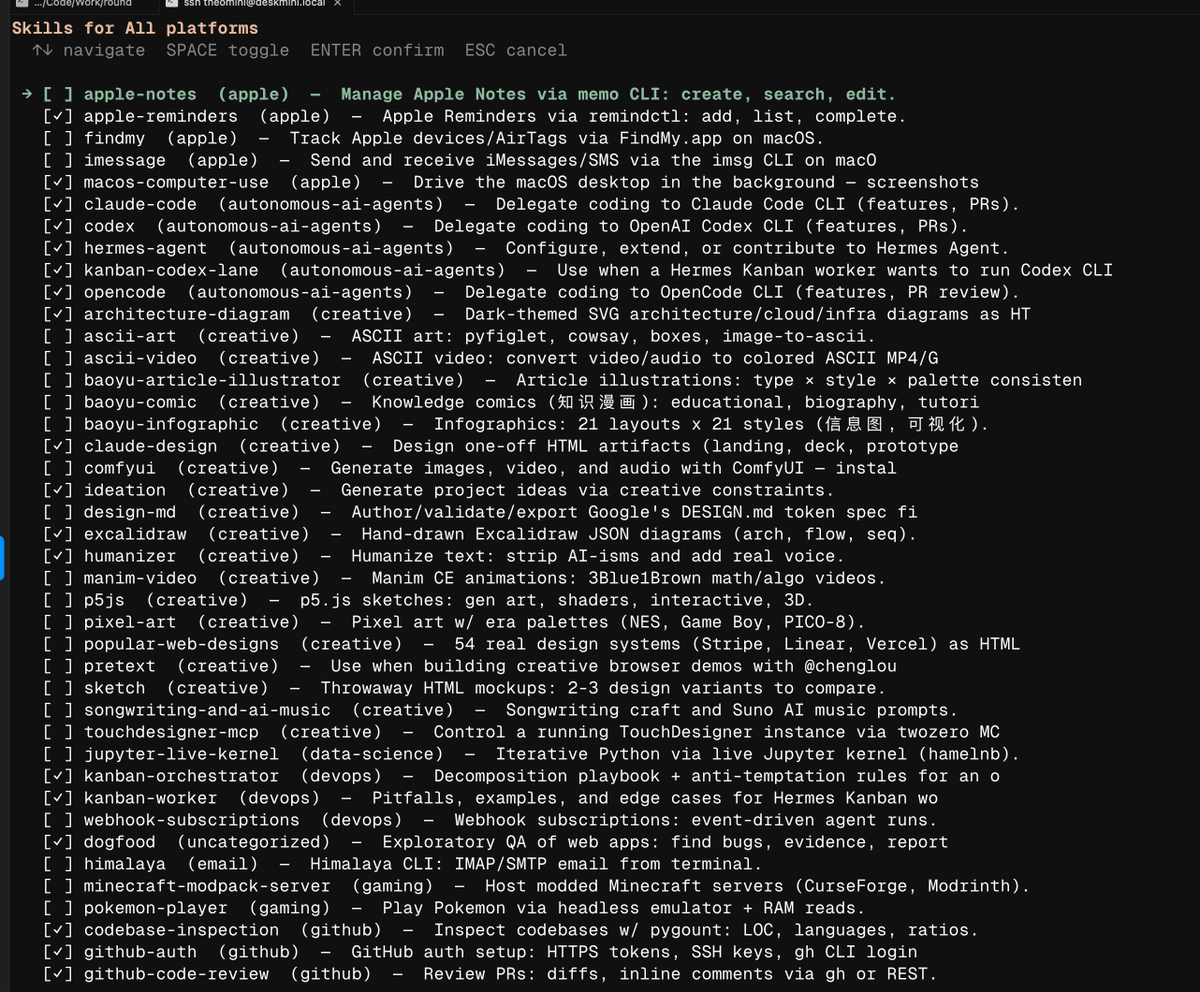
Hermes Agent comes with a truly absurd number of skills pre-enabled. Over 100 of them. This is roughly half.
I get what they're going for - they want an agent that comes "ready out of the box".
I just don't get why every user has to have a polymarket skill, 3 baoyu art skills (? never heard of this), a headless Pokemon skill, and Minecraft modpack server skills, all available the first time they run it.
I guess Hermes Agent just isn't for me.
@ianjcam@Teknium@NousResearch It is relevant because there's a grain of truth in his claims but we can have our cake and eat it too (i.e. keeping on having tons of skills without bloat)
@NousResearch@Teknium I might be missing something, but Curator seems focused on maintaining the skill catalog. The paper’s point is about context construction at run-time: even with a good catalog, injecting too many or overlapping skills can hurt, so the agent needs task-specific selection
We are all burning API credits trying to scrape X to avoid FOMO on the AI discourse. Turns out the new Digg does exactly what we’re all trying to achieve with OpenClaw or Hermes, but at a much higher execution level. And it's free. Kudos to @kevinrose 👏
@zetalyrae "[...] the returns to education are now higher, because intelligent, educated people with working reward circuitry stand to gain more from AI."
Just look at the questions @tylercowen asks ChatGPT to see exactly how true this is
The weirdest thing about the Netherlands is how such a developed, orderly country can still produce such consistently useless customer service experiences