Yesterday, we successfully brought together Bitcoin enthusiasts and the Swedish Tax Agency, shedding light on differing views. The agency argues that Bitcoin isn’t recognized as money due to its lack of a central issuer, widespread acceptance as a medium of exchange,
Turning a neighbourhood in the country with the world’s oldest central bank and one of the first to experiment with a CBDC into a Bitcoin-friendly area would be unexpected, but it would send a strong statement.
It will take time, but I’m committed.
CPI tells you what happened last month.
Money supply tells you what’s coming next.
So the real question is:
Is this really “where it’s supposed to be?”
Swedish news today headline that inflation came in at 0.9% in September: “It’s exactly where it’s supposed to be.”
But… for as long as I can remember, Sweden has been saying that inflation is “under control.”
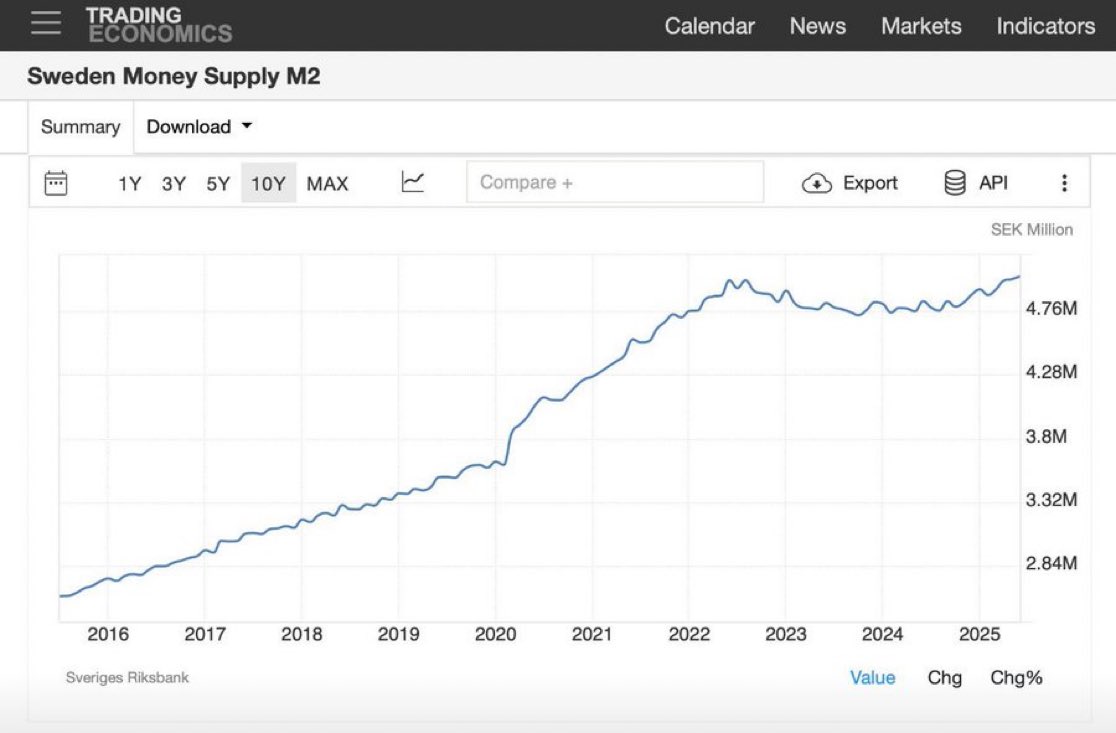
Meanwhile, the money supply has been expanding faster than most people realise.
From 2015 to 2025, Sweden’s money supply has almost doubled. Prices didn’t magically rise: they followed the monetary expansion. It’s basic cause and effect.
Spent the morning at Söderberg & Partners, one of the largest investment advisory firms in the Nordics, speaking to their investment department about Bitcoin.
My key takeaway: the knowledge level inside traditional finance is already far ahead of what many expect.
Update from September 2025:
One of the biggest banks in the Nordics - the same bank that forbade its employees from having any personal interest in Bitcoin - now offers Bitcoin ETPs to their customers.
The irony writes itself… however, the world is waking up!
I just heard from a @Nordea employee – the largest bank in the Nordics with around 28,000 staff – that employees are not allowed to have any personal interest in Bitcoin ??!
Imagine that. In 2025.
This morning I came across an article in Dagens Nyheter — one of Sweden’s leading newspapers.
It described how years of ultra-low interest rates encouraged households to borrow more, buy more, and stretch their finances further — believing those rates would last.
But they didn’t.
As rates rise, many families are now struggling to keep up. What was once called “economic stimulus” has become a burden.
The truth is: when central banks manipulate the cost of money, they distort reality. They reward debt, and quietly punish savers.