The AI Subsidy Era Ends. Microsoft canceled internal Claude Code (Anthropic) licenses due to unsustainable token costs, while Uber exhausted its entire 2026 AI budget in four months. To counter soaring expenses, US AI software prices jumped 20% to 37%, forcing GitHub (Microsoft) to abandon flat-rate plans for usage-based billing.
Rising costs compel enterprises to face the reality of scaling AI. As Anthropic, OpenAI, and Google raise prices, workflows built on assumptions of falling costs are collapsing. Enterprises must now either restrict AI usage—stifling lab revenues—or labs must cut prices and absorb losses. Either way, current AI valuations are becoming financially unsustainable.
NEW: Russian analyst Alexei Rogozin warns that Palantir has helped Ukraine integrate AI-driven data analysis with long-range UAV strike systems. He argues the real challenge is not just air defense, but the intelligence chain behind the strikes: satellite imagery, reconnaissance, digital traces, target analysis, and strike assessment.
Palantir $PLTR does not select targets itself. Its role is to fuse fragmented data into a unified operational picture. Ukraine’s Delta system then links UAVs, sensors, units, and strike assets into one network.
The result: faster targeting cycles and more precise long-range attacks. Tuapse oil terminal burns.
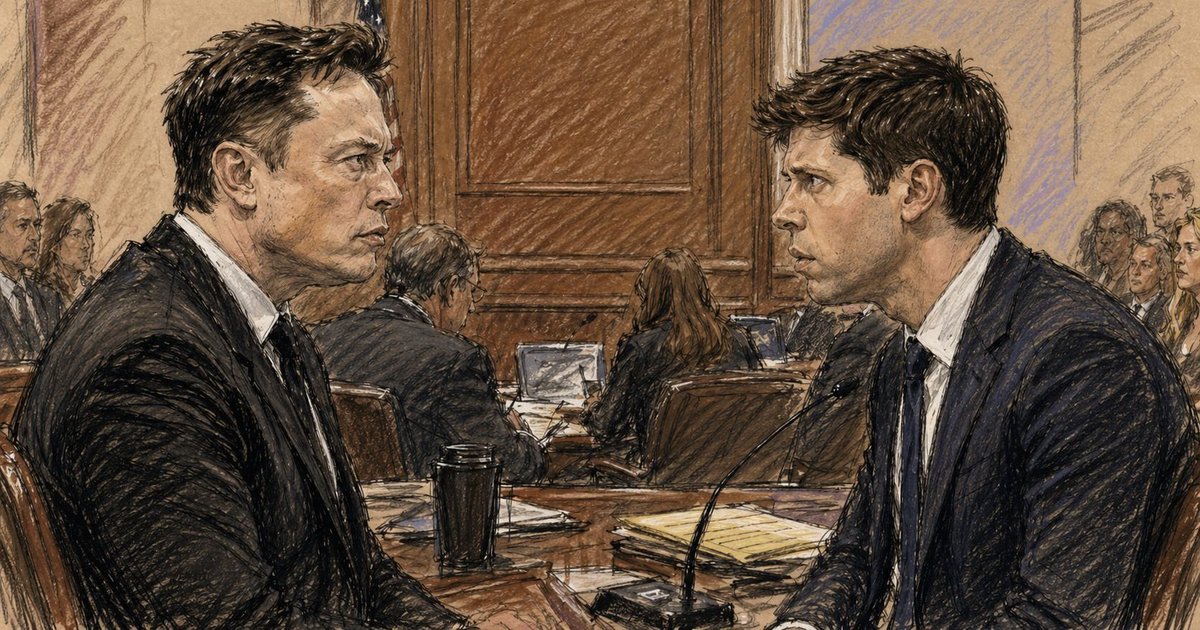
UPDATE: Elon Musk's $150B lawsuit against OpenAI, Sam Altman, Greg Brockman, and Microsoft has been dismissed in an Oakland, California federal court. The jury ruled that Musk waited too long to file the claim, with the judge subsequently accepting the decision. Musk's lawyers indicated they are preserving their right to appeal the ruling.
Leopold Aschenbrenner’s 2026 AI Investment Thesis: By 2026, AI needs gigawatt-scale training clusters (nuclear-reactor level power) costing tens of billions, scaling to 100,000s of H100-equivalent GPUs. Key long positions: CRWV, CLSK, and MARA (Bitcoin miners with power assets that can pivot to AI).
Focus on bottlenecks: AI chips, nuclear/power generation, energy infrastructure, and data centers. He is betting big on energy and Bitcoin mining over pure chips. The game has shifted from AI software to the physical infrastructure powering it.
New Scottish Member of Parliament takes her oath while speaking Chinese. She is from Taiwan, not mainland China. The MSP is Yi-pei Chou Turvey, who was born in Taiwan to Han Taiwanese parents and raised in Brussels. She took her oath in English, Mandarin Chinese (Taiwanese variety), and French. Will AI help bridge the linguistic and cultural divides among urban residents?
UPDATE: U.S. home Sellers now outnumber Buyers by 630,000, the largest gap ever recorded. A historic supply-demand divergence data from 2014–2026 reveals a unprecedented decoupling in the U.S. housing market. While buyer participation (red line) has plummeted to a historic low of 1.36 million, seller inventory (blue line) has climbed to approximately 1.99 million. Key Insights:
• Demand Shock: Driven by high mortgage rates and record prices, buyer activity has entered a state of "shock," dropping to the lowest level in over a decade.
• Inventory Rebound: The "lock-in effect" is weakening. Supply has rebounded to nearly 2 million listings, officially ending the era of extreme inventory scarcity.
• Market Stagnation: The market has crossed into a significant surplus of sellers relative to buyers. However, this has not triggered a boom, but rather a "frozen" state of low liquidity.
Conclusion:The U.S. market is currently defined by an affordability-driven paralysis. Despite rising supply, the barrier to entry remains too high for most, leading to stagnant transaction volumes and mounting downward pressure on valuations.
Dario Amodei’s recent thesis is more than a forecast; it is a blueprint for the Great Compression. As the traditional software lifecycle from requirements to deployment collapses into a seamless dialogue between human intent and machine execution, we are witnessing the Death of the Coder and the Birth of the Architect. Programming is being subsumed because code is the ultimate structured data, but Software Engineering is not dying; it is ascending into high-level orchestration.
Beyond the technical shift, Amodei outlines five pillars of AI-driven human progress:
1. Biological Compression
AI will condense a century of biomedical progress into a decade. By mastering complex biological systems, AI will move us beyond treating symptoms to curing cancer, infectious diseases, and aging—drastically extending the human lifespan.
2. Neuroscience & Mental Health
By unlocking the brain’s "black box," AI will replace trial-and-error treatments with precise neuromodulation and pharmacology. This revolution aims to eradicate depression and Alzheimer’s while optimizing human cognition and emotional resilience.
3. Global Equity & Leapfrog Governance
AI serves as the ultimate equalizer. By optimizing resource allocation and providing universal access to elite education and medicine, it enables developing nations to bypass industrial hurdles and achieve rapid, "leapfrog" development.
4. Post-Scarcity Economics
In a world where labor is no longer a prerequisite for survival, we face a transition to a post-scarcity society. Economic value will shift from routine output to human-centric creativity, deep interpersonal connection, and complex problem-solving.
5. Democratic Resilience
AI will act as a bulwark for the rule of law. By neutralizing misinformation and enhancing judicial transparency, AI can strengthen democratic institutions and provide a powerful systemic check against the rise of authoritarianism.
Is AI scaling wealth and opportunity gaps into a permanent divide? The asymmetry in how the law is applied is staggering. Mark Zuckerberg’s Meta reportedly downloaded at least 81.7 terabytes of data from shadow libraries such as LibGen and Anna’s Archive to train its Llama models—amounting to a massive unauthorized transfer of copyrighted material.
By contrast, in 2010–2011 Aaron Swartz downloaded roughly 70 GB of academic articles from JSTOR via MIT’s network—a tiny fraction of Meta’s scrape. For attempting to liberate scholarly knowledge, federal prosecutors pursued charges carrying a maximum penalty of a $1 million fine and 35 years in prison.
We are witnessing a massive consolidation of power in which a handful of incumbents have captured the entire AI stack. Today’s founders face a harsh reality: to build anything meaningful, they often must rent compute, data, and infrastructure from the very giants they hope to challenge.
We lost Aaron Swartz—the Reddit co-founder and one of our generation’s most brilliant architects—in 2013. The system seemed optimized to protect legacy institutions rather than nurture the open, decentralized future he championed. The world wasn’t ready for that vision, and we are now living with the consequences in today’s increasingly closed AI economy.
AI and Urban Inequality? In Karen Hao’s award-winning "Empire of AI", 250 interviews reveal how tech giants gaslight the public by bankrolling researchers to silence critique. Hao exposes the exploitation of Kenyan laborers like Mophat Okinyi, who was paid pennies to filter 15,000 violent images monthly for ChatGPT. Despite Sam Altman’s dismissal, the book proves that true auditing requires looking at those paid the least, not the industry’s funded elite.
The deeper issue is not just AI ethics, but AI-driven urban inequality. As AI wealth concentrates in a few global tech hubs, low-paid digital laborers in developing cities absorb the psychological and economic costs. The future of AI cities may ultimately be defined not by intelligence, but by how fairly AI-generated wealth is distributed. CityAI is exploring how AI and blockchain can help reduce these inequalities and expand access to value creation.
Singapore Airlines flight attendants were spotted offering passengers a foot wipe service. On ultra long haul routes, the airline provides on demand foot cleaning for First and Suites passengers, helping reduce swelling after 18+ hours. Some view this as exceptional luxury; others see it as excessive. The real question is brand positioning.
For Singapore Airlines, such details reinforce a premium identity built on precision, care, and differentiation. In luxury markets, value is often defined by moments competitors will not replicate. However, there is a fine line. When service shifts from refined hospitality to perceived over servicing, it can dilute brand dignity and create discomfort.
The strategic balance is clear. Elevate the experience, but protect the brand’s sense of professionalism and prestige.
Manhattan: The Future of Luxury vs. A Political Sunset. Standing as New York’s most futuristic skyscraper, this penthouse designed with a $900 million budget is a seamless fusion of avant-garde architecture, cutting-edge design, and billionaire-tier luxury. However, Ken Griffin recently remarked that the city is no longer "welcoming to success" under the leadership of socialist figures like Zohran Mamdani. Following the Mayor’s public criticism of his $238 million mansion, the billionaire hinted that his firm will now pivot its expansion efforts toward Miami.
AI presents transformative opportunities for urban science and management, leveraging massive multimodal datasets to optimize infrastructure, predict trends, and enhance resilience. Conversely, urban science fosters AI development by embedding context-awareness and human-centered insights, thereby equipping algorithms to address complex spatial dynamics. Illustratively, digital twins enable real-time urban analytics, while generative AI facilitates inclusive urban modeling. Ultimately, the synergy between CityAI and urban science paves the way toward smarter, fairer, and more sustainable cities.
Washington, D.C. Inside a $5 billion Golden White House concept designed for Donald Trump. Trump’s Intel $INTC investment has already generated about $45 billion for the U.S. government, with potential upside toward $100 billion. This CityAI designed AI architectural utopia presents a cinematic vision of a next generation presidential residence where scale, authority, and ultra luxury converge into a futuristic American palace. From a monumental marble Hall of State to penthouse level presidential suites, the design reimagines the White House at billionaire scale, pushing beyond tradition into a new era of power architecture.
A 3D Virtual Tour of Manhattan. New York City’s new mayor, Zohran Mamdani, is the first Muslim mayor in the city’s history and a staunch Democratic Socialist. Rising to power amidst the AI wave, his administration is seen as the ultimate manifestation of New York’s political shift to the far left.
Lest we forget, 900 years ago, the capital of the world was Kaifeng, China. Kaifeng reached its zenith through unparalleled commercial vitality, yet eventually declined due to geopolitical instability and institutional fragility. Today, New York faces a critical dilemma: finding a new equilibrium between "Progressivism" (leftist ideals) and the fundamental functions of a city—namely, public safety and fiscal stability.
Why do SaaS companies often encounter problems when adding AI features? SaaS is built on deterministic logic (Input A always yields Output B). LLMs, however, are stochastic engines (probabilistic). When you inject a "black box" that produces non-deterministic results into a precision-oriented workflow, the product loses its reliability. Users don't want a productivity tool that "hallucinates" 5% of the time.
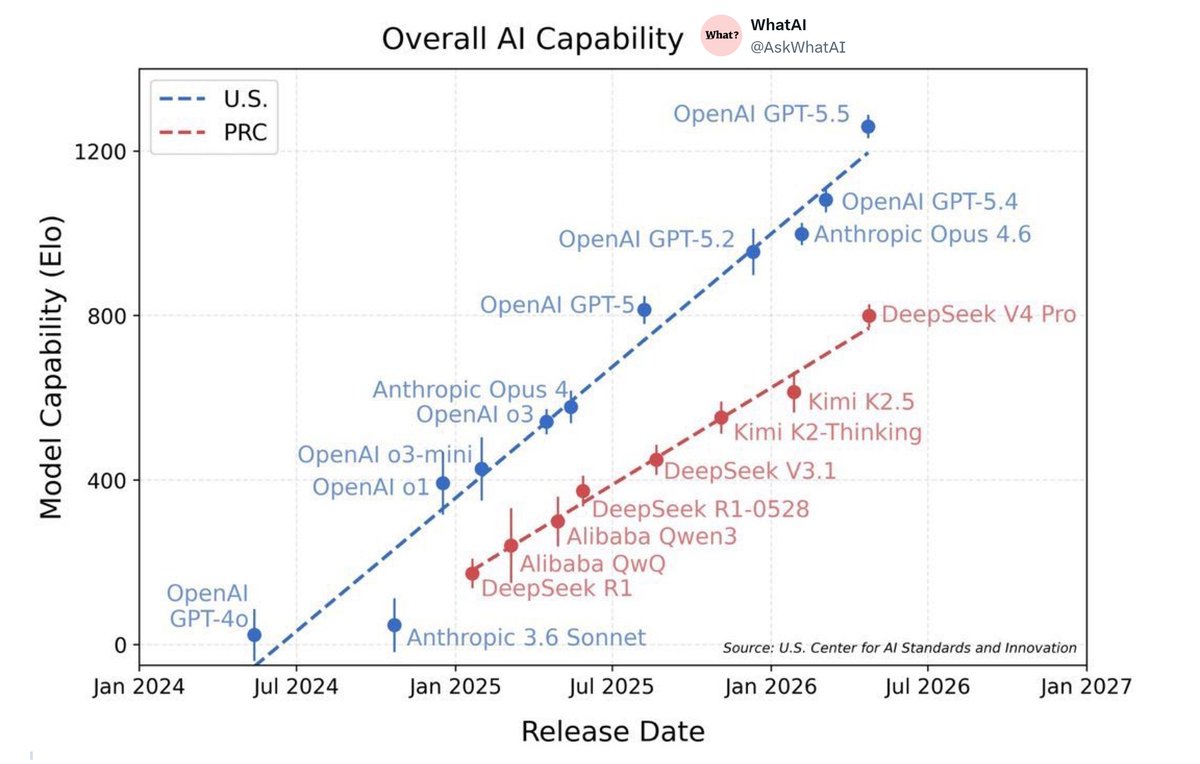
Update: This chart visualizes the projected Elo-rated trajectory of U.S. vs. China AI models through 2026. While U.S. frontier models (GPT-5 series, Anthropic Opus 4.6) maintain an absolute lead, the PRC ecosystem (DeepSeek, Qwen) shows a consistent, aggressive catch-up rate.
JPMorgan’s research team just revealed how they built their multi-agent system “Ask David” and it mirrors a pattern now emerging across AI:
• A supervisor agent orchestrates workflows
• Specialized sub-agents handle retrieval, structured data, and analytics
• An LLM-as-judge layer validates outputs before delivery
• A human-in-the-loop closes the final accuracy gap
This architecture is quickly becoming the default blueprint for production-grade AI systems.
WATCH: Taipei, like Hong Kong, Tokyo, and Singapore, is a modern city with an exceptionally high life expectancy of 83.4 years. With the growing adoption of AI in healthcare, Taipei’s average life expectancy is expected to rise further. In Taiwan’s super-aged society, even grandmothers aged 89 and 91 are training in the gym. More elderly people are working out to maintain both physical health and mental well-being.
Jensen Huang Criticizes Anthropic CEO Dario Amodei over AI Fatalism. Nvidia CEO Jensen Huang dismisses the "god complex" of certain AI leaders, urging a focus on facts instead. AI will generate hundreds of thousands of jobs and add trillions to the U.S.. For nations and cities, technological progress creates a net gain in opportunities through productivity dividends and expanded demand chains.
Historically, the steam engine replaced manual trackers but catalyzed the vast railway, logistics, and global trade sectors, far outstripping the manual jobs lost. While total employment grows, the workforce requires fundamental structural reorganization. Technology remains the essential path for nations to expand the economic pie and maintain global competitiveness.
CityAI’s analysis suggests that individuals performing mechanical, repetitive tasks face the highest risk of displacement. In contrast, those who leverage technology to define new scenarios, provide emotional value, or manage complex decision-making gain significant professional leverage.
In the current AI wave, the primary challenge is that the speed of skill obsolescence may outrun the pace of human retraining. Success no longer depends solely on diligence but on whether one's speed of adaptation can outpace technological decay.
Former U.S. President Bill Clinton was recently spotted walking the streets without visible security, largely ignored by passersby. While the Epstein scandal has clinicaly dampened his personal brand, he arguably remains the most effective post-Cold War president. His tenure was defined by a booming economy, an absence of large-scale ground wars, and exceptional fiscal discipline that saw the debt-to-GDP ratio steadily decline. Under his leadership, U.S. global prestige reached its zenith as a primary beacon of democracy.