Since August, a team within METR has worked with internal Anthropic information to assess whether AI itself is accelerating AI development.
We are now publishing a report summarizing the results of this risk assessment.
METR spent months with Anthropic's internal data on one question: is AI speeding up AI development?
Their read:
- Capability growth on well-specified tasks: likely about 2x the Mar 2024–Oct 2025 pace (range 1.3x–3x)
- Most of that speedup is likely now from AI used in AI R&D, but Anthropic staff don't all agree
- Not from faster growth in training compute
- No clear bottlenecks in the next 12 months, though they may have missed some
Anthropic redacted most of the evidence METR found most informative, so the public has to lean on METR's judgment.
OpenAI's Wednesday:
- Pierre Computer Company joins, reportedly to build Git workflows for Codex
- Images 2.6 reaches ChatGPT, Codex and the API
- Cat Wu, who worked on Claude Code for two years, joins to lead product management for Core Products
The hire got more views than the launch.
Some news: I’m joining OpenAI to lead product management for Core Products!
I have a lot of respect for OpenAI for showing the world that scaling works, for bringing AI to over a billion people, and for believing great products are core to the mission.
I’m excited to work with @thsottiaux, an incredible PM team, and everyone across OpenAI. Together, we’ll build agents that have your back and your team’s, and keep you in control, so you get more time for the people and work you love.
Lots to learn, and lots to build. Please keep your feedback coming!
The 99% in the Claude Code subagent fix is the cost of one status update.
The number for your limit is in the next post from @ClaudeDevs: about 5% less in sessions with background subagents, or about 6% more prompts.
Still worth updating. Just don't expect 99.
Background subagents in Claude Code now use less of your usage limit.
A running subagent updates its status line every 30 seconds, and each update used to re-read its whole conversation. Now Haiku 5.5 writes it from short notes instead, so each update costs about 99% less.
Knowing when to stop is hard for language models controlling a robot arm
➤ Claude Opus 5.5 completed the task in 23 minutes, and said so: "The crocodile looks fully inside now"
➤ It then spent 22 minutes pushing the crocodile back and forth, only to finish almost exactly where it was before
Your coding agent's behavior now lives in a few config files, and any app you run can edit them.
That's the real story in the Postman issue. One user's logs show its desktop app adding plugins to Claude Code and Codex. The code also tries to approve its own Codex hook.
Who else is in those files?
Most alarming line in the Claude Code v2.1.318 notes:
"Fixed idle compaction replacing a conversation with a reply that was not a summary"
Also fixed: workflows re-running finished agents when resumed after a usage limit.
Good week to be a long-running session.
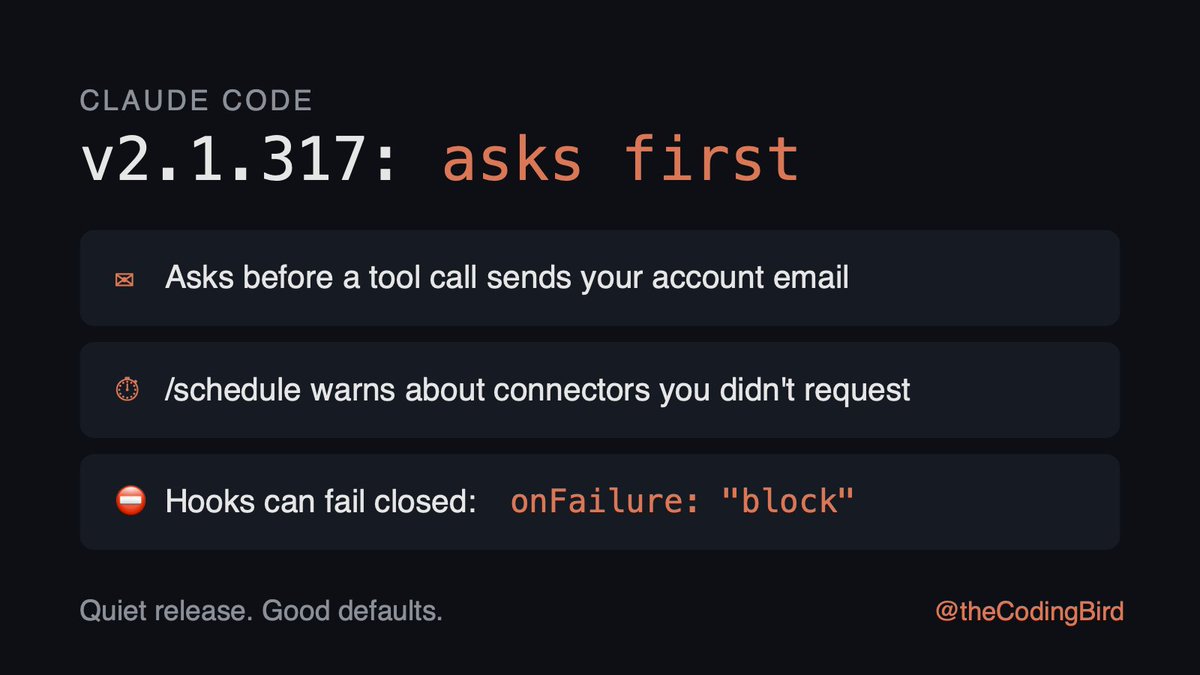
Claude Code v2.1.317 is mostly Claude asking before it does things you didn't ask for.
- Asks before a web or shell tool call sends your account email to the network
- /schedule warns when a new cloud task picks up connectors you didn't request
- Agent SDK hooks get onFailure: "block", so a crashing hook stops the action instead of waving it through
Quiet release. Good defaults.
OpenAI built a new Git backend because agents push a LOT.
Pando: ~80% lower push latency, nearly a petabyte of Git data served a day. The stated goal: grow Git capacity alongside agent usage.
Yesterday Shopify went monorepo, also citing agents.
Soon your repo's busiest contributor won't be human.
Monday dev life:
Open laptop.
Check which AI tool changed its limits over the weekend.
Check which one changed its pricing.
Check which one got acquired.
Start actual work at 11.
2026 architecture decisions:
- Monorepo? Because agents.
- Back to multi-repo? Because agents.
- Redux comeback? Because agents.
- IaC, or no IaC? Because agents.
I genuinely can't tell anymore if we're designing for humans or for the bots.