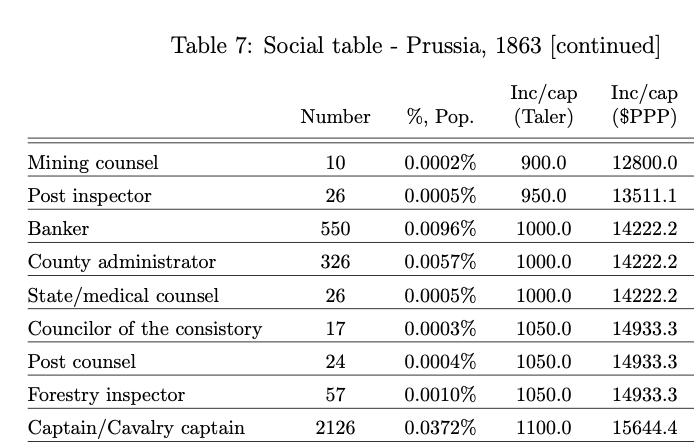
Social tables are a treasure trove of information - easy to fall into a Rabbit Hole. One example: Mean income of a forestry inspector was higher than for a banker in 1863 Prussia. See my new paper featuring German Social Tables: https://t.co/fQ2eZkSkJM
📢 New III working paper:
This paper provides a methodological contribution to the study of historical income inequality by examining the construction and use of social tables for the nineteenth century.
@BrankoMilan@GGabbuti@Maria0zmg@theErforce
https://t.co/8OMxdq4pPf
"Historical social tables: advantages, methodology, and problems",
a new paper by P. Erfurth, M. Gómez León, G. Gabbuti & B. Milanovic
https://t.co/x1k6GkEC8f
Social tables are widely used 🌍but how comparable are they across countries and over time? 📚In a new working paper (with @theErforce@Ggabbuti@BrankoMilan) we explore social tables… methodology, advantages, and problems https://t.co/R3XPoCPFoW
Just out.
New Working paper on the use social tables to study historical inequality; their advantages, problems, methodology;
by @theErforce , Maria Gomez Leon, Giacomo Gabbuti and myself.
https://t.co/3uLnqpDr1a
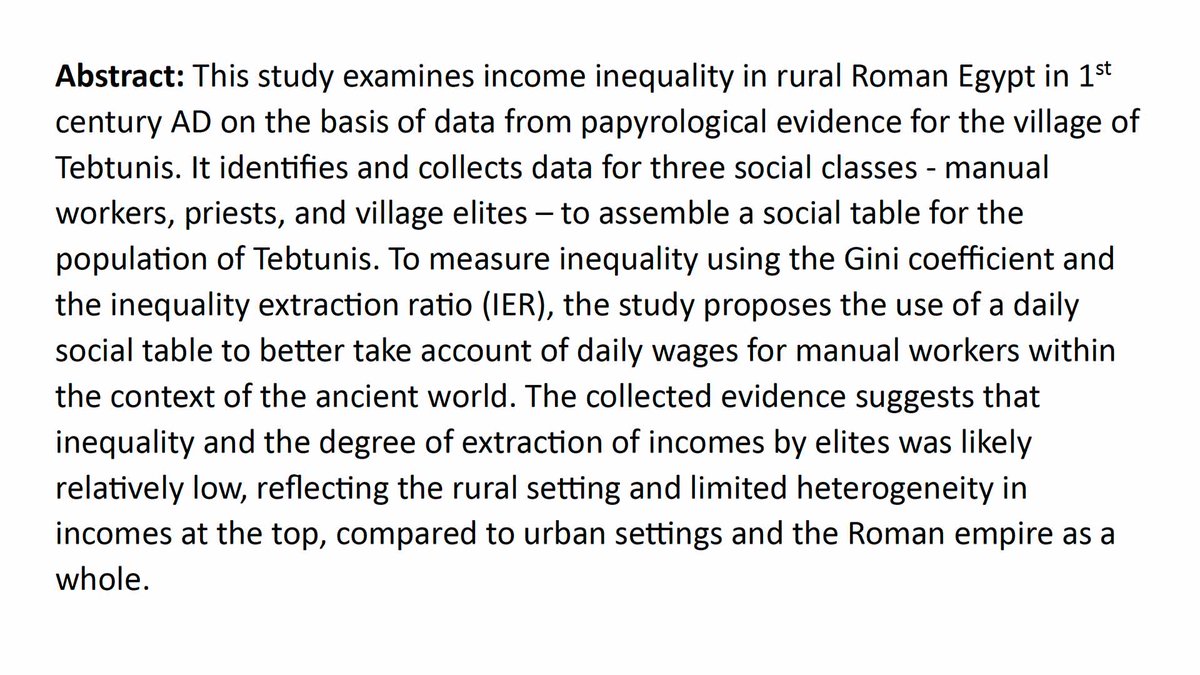
How unequal was a rural society in the Roman Empire? A new WP by Philipp Erfurth @theErforce examines income inequality in rural Roman Egypt in 1st century using daily social tables that build on data from papyri.
https://t.co/CuMm7EJNll
This was previously out as Stone Center Working Paper #46 - so many thanks to
@stone_lis as well as all colleagues providing invaluable comments and suggestions!
Publication alert🚨
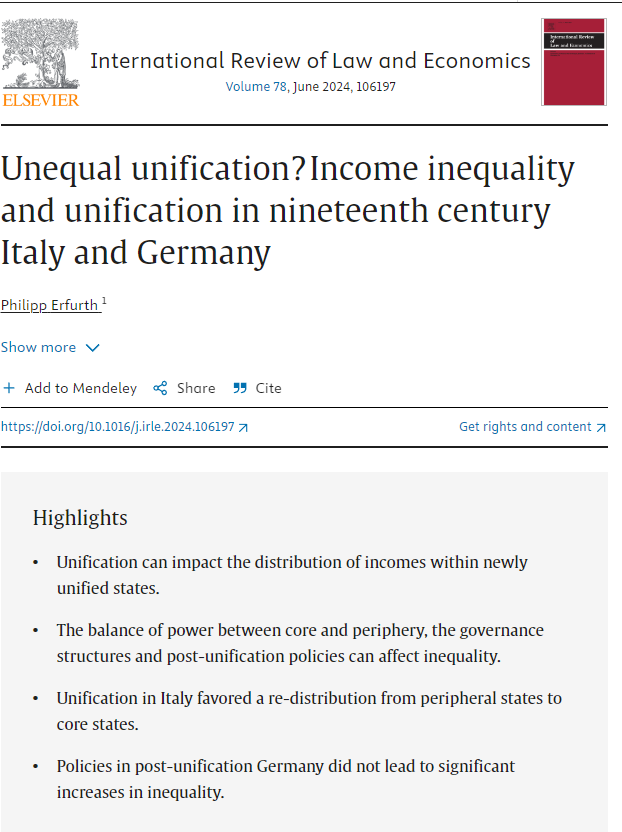
Paper 2/3 of my PhD now out! How did unification in 19th century impact income inequality in DE and IT? Using new social tables for Germany, I study balance of power between core & periphery in newly unified states.
Find out more here: https://t.co/ROx9bC04dT
@BrankoMilan Excellent insights on who benefitted (or did not) from growth in the past 30 years and how trends in global inequality changed since the financial crisis. If you are interested in global inequality, this is a must read!
The 1848 Revolution is possibly one of the most interesting episodes for class/social analysis. It is not surprising that in the Cagé-Piketty book it gets much analyzed, incl. Tocqueville's and Marx's writings on it.
See this:
https://t.co/SoZabNZK7L
@BrankoMilan Social tables are so useful because they allow us to look at inequality within societies with little or almost no data, esp. tax data. To build a social table, you need incomes of classes and their share in society. See cool use of them in @BrankoMilan ‘s new WP studying the 1%.
@BrankoMilan Absolute must-read working paper by @BrankoMilan. Social tables are endlessly insightful when it comes to illuminating historical inequality. Great use of social tables in this WP to study the top 1%.
@BrankoMilan Absolutely true. Curious that Tanizaki refers to money like in the below but without actual amounts:
„Taeko already knew the value of money in the bank(..)and she displayed her postal-savings book. If you ever need a little spending money - she added - just let me know“(P. 15)