The IPC provides #foodsecurity & #nutrition analyses for decision-making in over 30 countries facing food crises. A global partnership of 19 organizations.
🇪🇨 #Ecuador
An estimated 2.6 million people are expected to face high levels of acute food insecurity (IPC Phase 3 or above) through July 2026, a slight deterioration compared with December 2025–March 2026.
The situation is driven by high food prices, unstable incomes, climate shocks, and rising violence and insecurity—compounded by agricultural risks such as Fusarium Race 4, which is undermining production and household incomes in rural and migrant communities.
Read the full Report: https://t.co/0PFqwkM4yx
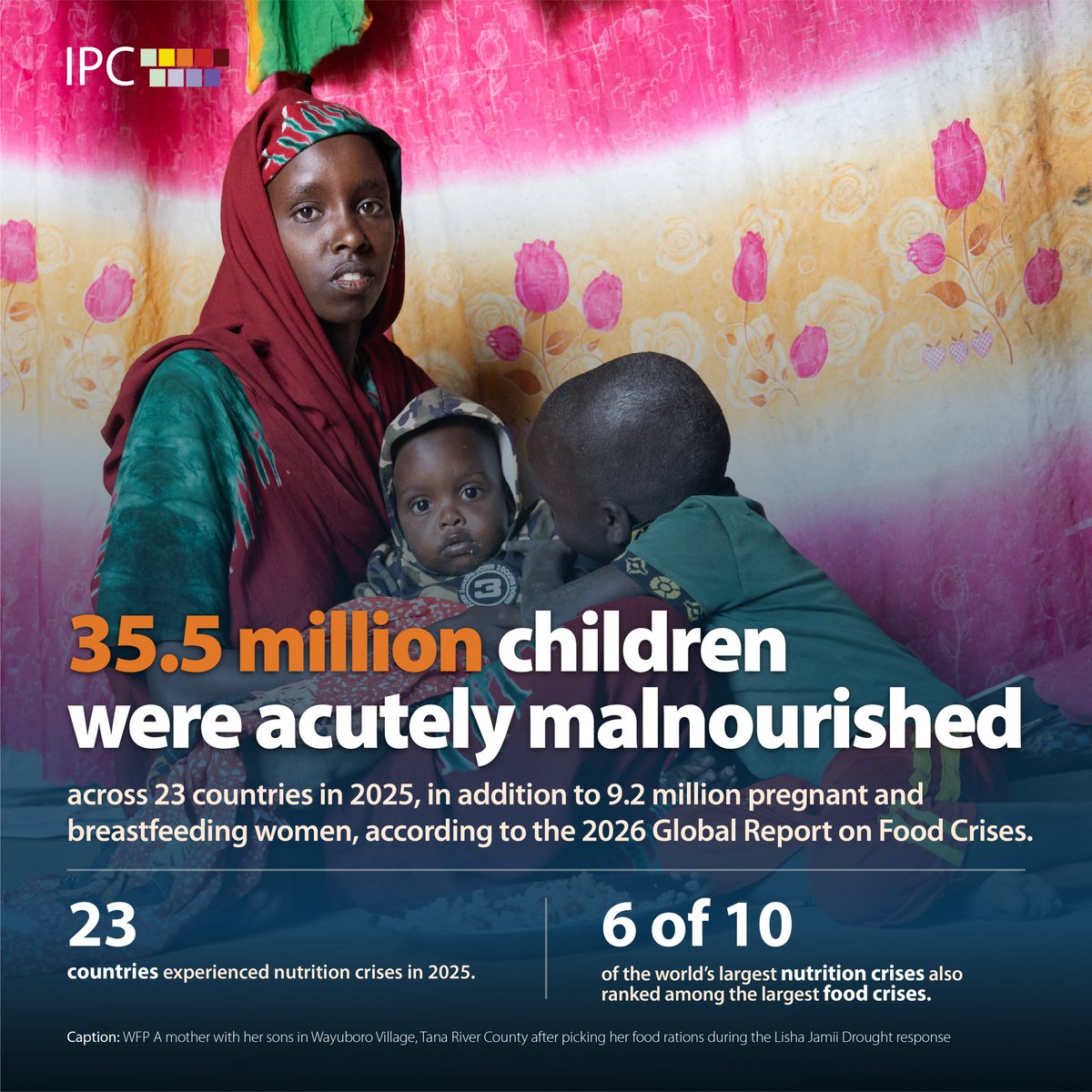
This #WorldNutritionDay, the scale of needs is sobering.
In 2025, the 2026 Global Report on Food Crises identified nutrition crises across 23 countries. An estimated 35.5 million children under 5 and 9.2 million pregnant and breastfeeding women suffered from acute malnutrition. Three further countries were classified as having a concerning nutrition situation, with high nutritional vulnerability but insufficient evidence to confirm nutrition crisis criteria.
In two-thirds of these countries, acute malnutrition was driven by the simultaneous failure of food access, disease prevention, and essential services for women and children. Six of the ten largest food crises also rank among the largest nutrition crises — a reminder that hunger, disease, unsafe water, and weak health systems reinforce one another.
Increased and sustained support for treating acute malnutrition and addressing its key drivers are critical to saving lives.
Photo caption: WFP A mother with her sons in Wayuboro Village, Tana River County after picking her food rations during the Lisha Jamii Drought response
One week. Two countries identified at risk of Famine.
In Sudan, 14 areas across Greater Darfur and Greater Kordofan are at risk of Famine during the June–September 2026 lean season, in a plausible worst-case scenario where conflict intensifies, humanitarian access narrows further, and displacement continues to disrupt livelihoods. This risk continues through January 2026 for 13 of these areas.
In Somalia, Burhakaba District is at risk of Famine through June 2026, in a plausible worst-case scenario in which the Gu season rains fail, food prices continue to rise, and humanitarian food assistance falls below expected levels.
In line with IPC protocols, a risk of Famine indicates that Famine is likely to occur if conditions deteriorate beyond what is currently expected. Risk of Famine is, therefore, a way of highlighting the potential for a situation to deteriorate into Famine, even if it is not the central forecast.
Read more:
🔗 Sudan: https://t.co/M2HfoZeidY
🔗 Somalia: https://t.co/YS5cH0ezx8
🔗 Famine Fact Sheet: https://t.co/JUtSWlFGZ0
#Yemen 🇾🇪 – Government of Yemen (GoY)-controlled areas
Half the population in GoY-controlled areas continue facing high levels of acute food insecurity due to a worsening macroeconomic crisis, localised conflict and instability. Nearly 5 million people are experiencing IPC Phase 3 or above (Crisis or worse) conditions between March–May, including 1.4 million in IPC Phase 4 (Emergency).
The situation is expected to deteriorate during the June–September lean season and the October–December harvest season.
Read more: https://t.co/1MUljPAvi8
@theIPCinfo
🔴 #Sudan 🇸🇩
After more than three years of unrelenting conflict, Sudan remains one of the world’s most intractable and severe humanitarian crises.
Nearly 19.5 million people are facing high levels of acute food insecurity (IPC Phase 3 or above) through May 2026. Of these, around 135,000 people are in IPC Phase 5 (Catastrophe), marked by extreme food gaps, extremely critical levels of acute malnutrition, and a high risk of death.
Read more: https://t.co/M2HfoZeidY
@TheIPCinfo
🔴 #Sudan 🇸🇩
The food insecurity and malnutrition situation remains highly fragile and volatile, with 14 areas at risk of Famine across Greater Darfur and Greater Kordofan.
This risk stems from intensified conflict and further restrictions on humanitarian access and the movement of goods and people.
Read more: https://t.co/M2HfoZeidY
@TheIPCinfo
🔴 #Sudan 🇸🇩
An estimated 825,000 children will face severe acute malnutrition in 2026. In North Darfur, at least two localities are expected to remain at extremely critical levels of acute malnutrition—urgent action is needed.
Read more: https://t.co/ogdtTJbs2A
@TheIPCinfo
🔴 #Sudan 🇸🇩
Sudan is facing a dire food and nutrition crisis. To prevent further catastrophe, the following actions must be taken:
✅ Cease hostilities
✅ Protect civilians & infrastructure
✅ Ensure safe, sustained humanitarian access
✅ Scale up multi-sectoral humanitarian assistance
✅ Facilitate access for data collection to guide response efforts
Read more: https://t.co/M2HfoZeidY
@TheIPCinfo
🔴 #Sudan 🇸🇩
Famine Review Committee Insights
The FRC is extremely concerned about an ongoing shift towards normalisation and acceptance of Famine or near-Famine conditions in parts of Sudan.
The FRC urges all parties to the conflict and their external sponsors to respect International Humanitarian Law and pursue an immediate political settlement and durable peace as the only pathway to ending famine-like conditions in Sudan.
Read more: https://t.co/0mJIk7moag
#Somalia 🇸🇴
The acute malnutrition situation is alarming, with Burhakaba District reaching Extremely Critical levels of acute malnutrition (IPC AMN Phase 5) and facing a risk of Famine in a plausible worst-case scenario
Approximately 1.88 million children expected to require treatment for acute malnutrition in 2026.
Read more: https://t.co/YS5cH0f7mG
2/2
#Somalia 🇸🇴
The food security and nutrition situation is worse than initially projected in the February 2026 analysis, with 6 million people facing high levels of acute food insecurity between April and June 2026 — an increase of more than half a million people than previously expected.
Read more: https://t.co/YS5cH0ezx8
1/2
#DRC 🇨🇩
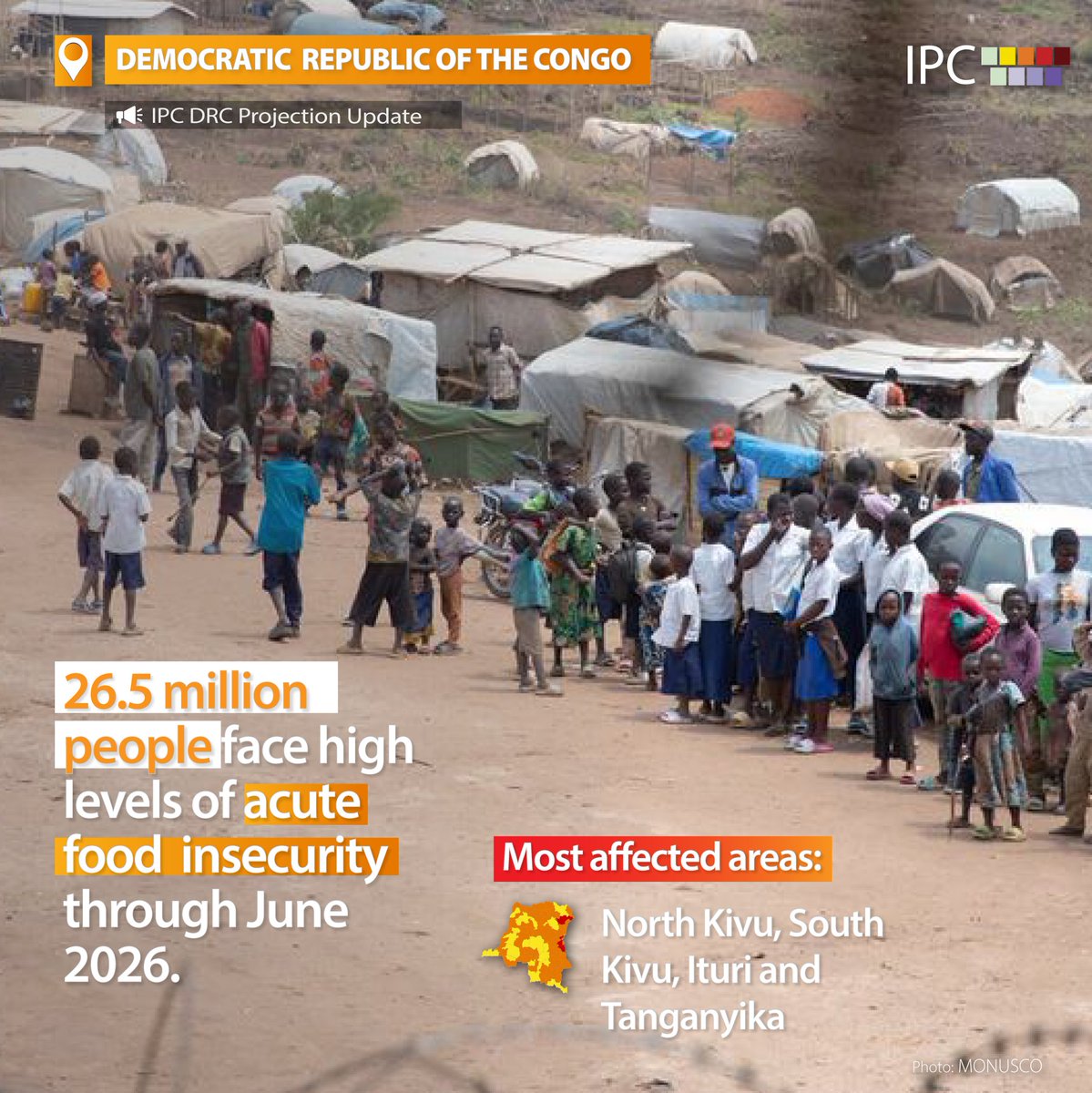
Ongoing conflict, massive population displacement and dire levels of humanitarian need leave 26.5 million people in high levels of acute food insecurity, including over 3.6 million people in IPC Phase 4 (Emergency) and 22.9 million in IPC Phase 3 (Crisis).
The IPC projection update analysis focused on the provinces of North Kivu, South Kivu, Ituri and Tanganyika, found that more than 9.9 million people in these areas will continue to experience high levels of acute food insecurity.
Read more: https://t.co/1anzLZGQQt
@theIPCinfo
Recent IPC analyses show concerning trends across several regions, from the risk of famine in South Sudan, renewed conflict in Lebanon, mass displacement and severe hunger in Haiti, and drought in Kenya.
Read the full reports below:
South Sudan: https://t.co/jKDvkCLjyw
Haiti: https://t.co/eF83DmLTtt
Kenya: https://t.co/QBCfwAtm5I
Lebanon: https://t.co/jvwbhDEdPi
Tanzania: https://t.co/0cUWOK4k7j
SADC: https://t.co/JqDJYSkQAK
@theIPCinfo
#SouthSudan
Worsening food insecurity and malnutrition in South Sudan demand urgent action to protect lives and livelihoods.
More on the latest IPC findings⬇️
@theIPCinfo
#Lebanon 🇱🇧
Food insecurity is sharply deteriorating across all population groups in Lebanon, driven by renewed hostilities and widespread displacement since early March.
Around 1.24 million people are facing high levels of acute food insecurity from April to August 2026, which is worse than previously expected.
Read the full report: https://t.co/jvwbhDEdPi
@theIPCInfo
#SouthSudan
The food security situation in South Sudan is worse than projected in the September 2025 IPC analysis, with 7.8 million people facing high levels of acute food insecurity between April and July 2026 — an increase of 280,000 people in IPC Phase 3 and above.
Read more: https://t.co/jKDvkCLjyw
Post 1/3
#SouthSudan
Approximately 73,000 people are facing IPC Phase 5 (Catastrophe) conditions, characterised by death, starvation, and the collapse of livelihoods. A risk of Famine has been identified in four counties, compared to one in the previous IPC analysis.
Post 2/3
#SouthSudan
Conflict has fueled large-scale displacement, with approximately 280,000 people forced to flee their homes in Jonglei State alone.
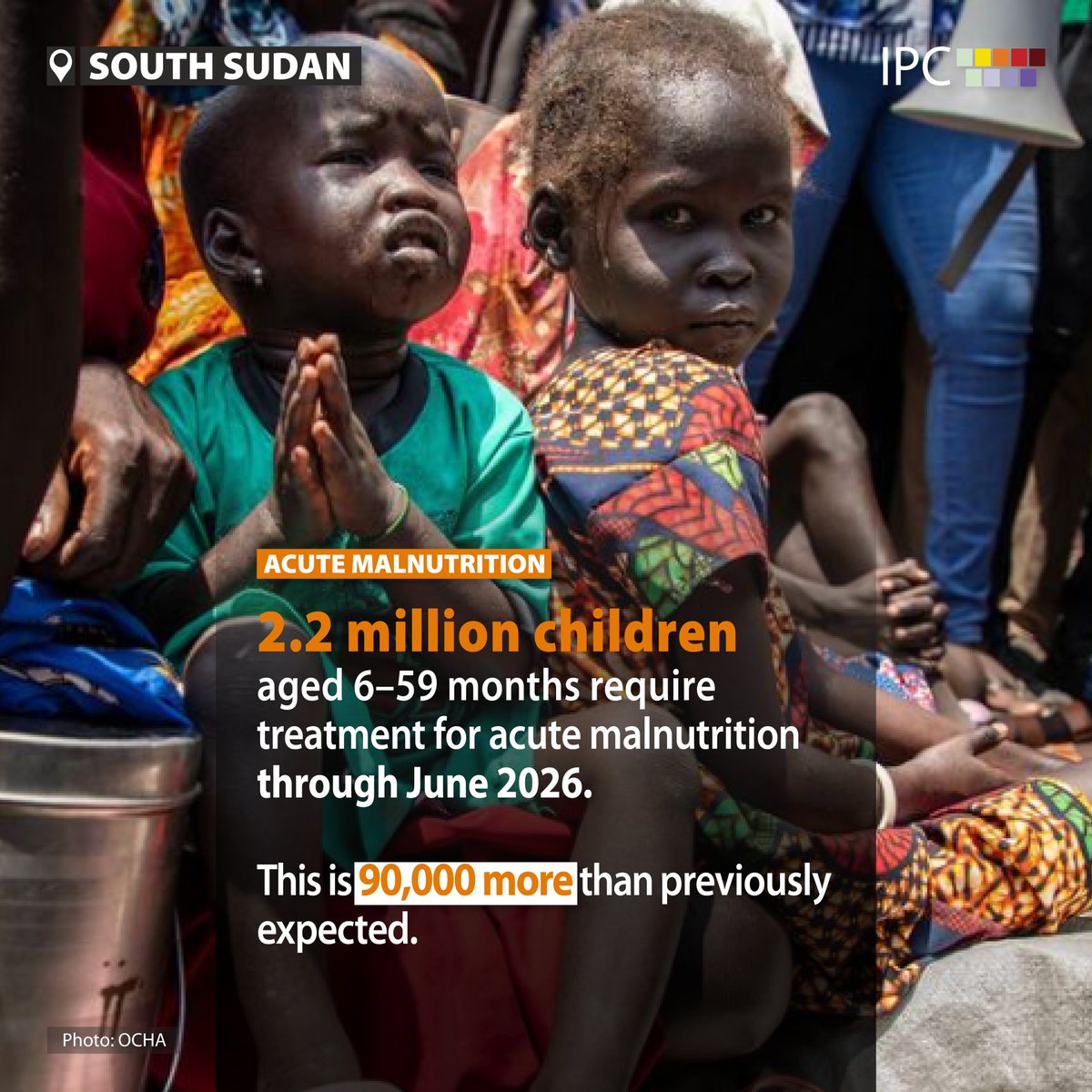
The acute malnutrition situation is alarming, with an estimated 2.2 million children aged 6–59 months requiring treatment — an additional 90,000 cases compared to the previous IPC analysis.
Post 3/3
#Tanzania
In rural districts across mainland Tanzania, climatic shocks, seasonal constraints, and high staple food prices are stretching household food stocks and purchasing power.
Around 1 million people—10 percent of the analysed population—are facing high levels of acute food insecurity from February to May 2026.
Read the full Report: https://t.co/QcKOcuuhjC