Creators 🤝 Gen AI @YouTube @googleai. all the smoke & some sparkle. #Tokenbillionaire, here 4 the memes, sports & tech takes. go birds 🦅. My views. Not yours.
Early thoughts on Fable:
> Thinks really long
> Technical depth is strong
> Doc writing / product thinking was too dense
> prose was short, abrupt, and hard to understand.
Felt like someone trying to be too smart. Might need post training refinement to really nail the stylistic things.
Introducing Gemini 3.5 Flash Live Translate, our real time speech to speech translation model which supports more than 70 languages (both in and out), and is so natural.
It is available in the Gemini API, AI Studio, & Google Translate right now + coming soon to Google Meet!!
Why did we split the IDE from the Agent Manager?
We launched Antigravity 2.0 at Google I/O a couple weeks ago. We made some bold choices and I wanted to share my thoughts...
[1/4] Adapt or Die
I’ve been working in the AI dev tool space for the last three years. Three years is an eternity in this space and I can confidently say that I’ve seen tools, startups, and workflows come and go. Many of the features our team helped pioneer such as autocomplete and RAG-based chat have fizzled away.
Every few months there is a paradigm shift that redefines the AI developer tool landscape. Miss it, and you slowly fade into the backdrop. Time it well and you stay in the game. Invent it and you get catapulted into the spotlight. It’s a fast-paced, unforgiving industry. I love it. The team loves it.
What do I mean by paradigm shifts?
In the last three years, we’ve gone from: Autocomplete → Chat → Agents → Multi-Agents
Each phase forced us to redefine ourselves: Codeium → Windsurf → Antigravity.
The reason why I tell you this is because as painful as it is, we have to continuously evolve our products. The model and the product are increasingly synergistic. The product is only as good as the model and the model gets better with the product. AI technology moves too quickly to keep the status quo.
For example, we deleted chat in Windsurf when we launched in November 2024 (x [dot] com/kevinhou22/status/1892246469303820745). It was a controversial move at the time since users only knew about chat and had never used an agent. But we trusted that the “future is agentic” and I’m glad we did not back down.
My goal — our team’s goal — is to give our users the best dev tool on the market to let them build beyond their wildest dreams.
To give our users the best product, the product must evolve.
[2/4] Current Shift: Agents → Multi-Agents
At Windsurf, we introduced the first agentic IDE. That was in November 2024. We’ve come a long way since then. Models have gotten stronger, users have gotten more tenacious, and expectations are higher than ever. It’s no longer enough to run just one agent. You are now an orchestrator of many agents: multiple conversations or agents spawning their own subagents.
To bring this multi-agent paradigm to our users at Antigravity, we introduced Antigravity 1.0. Highly capable models made it possible for agents to do more complex work and work for longer.
The benefit of working at a lab is seeing around the corner and molding the model to fit the product. We worked with the Gemini team for months before we felt that Antigravity was ready for prime time.
On November 18, 2025, we released Antigravity 1.0 alongside Gemini 3 Pro. It had two surfaces:
1) AGY IDE
2) Agent Manager
Two surfaces, bundled into one app.
Some users loved both. Some only used one. Some just needed Gemini to get better.
[3/4] Now: Better Models + Doubling Down
Over the last 6 months, we’ve been working with the research team to help improve Gemini’s coding and agentic capabilities. We’ve also been dramatically improving our internal version of Antigravity, and as Sundar announced (youtube [dot] com/live/wYSncx9zLIU?si=8nXDk_WhvoCvx12k&t=1504), we're processing over 3 trillion tokens a day. Additional breakthroughs in model research enabled Gemini 3.5 Flash — a lightweight model at the Pareto frontier (performance vs. cost & speed).
Based on internal usage, we knew there were two camps: IDE and Agent Manager (uppercase).
Antigravity IDE is a great product. Good because it’s familiar. Good because you can manually edit your code. Great because of its agent.
We started exporting our agent to other surfaces to build an ecosystem of tools backed by the same powerful Antigravity agent: IDE, Agent Manager, SDK, CLI. That ecosystem is what we announced on stage last week at Google I/O. But Agent Manager was pulling away.
Agent Manager usage was increasing in dramatic fashion and we knew we wanted to double down on this experience. Both technical and non-technical folks are relying on Antigravity every day to not only write code, but also write docs, do competitive research, design prototypes, conduct user simulations, summarize 1:1s, learn new concepts, file expenses, the list goes on and on…
So we made a bold choice to split the two surfaces into two apps.
We now have two applications:
1) Antigravity: unapologetically agent-first
2) Antigravity IDE: the editor you know and love
You can choose which product you want to use. You can switch between the products. Same agent, different surfaces.
Now, I’ll admit we botched some details about the migration and we’re working day and night to make it right. We have plenty of exciting features in the pipeline and I’m excited for you all to get your hands on them.
[4/4] Competition = Users Will Win
Times are changing rapidly. AI dev tools are quickly becoming agent-first. Users are managing tens if not hundreds of agents. Antigravity 2.0 is our way of giving this power to our users.
You can take a look at the competitive landscape and see this for yourself. IDE’s trying to evolve to a world where work is the product and not the code files. Labs releasing agent-first products, exploiting the model <> product synergies. Users spending more and more time and tokens in agent managers (lowercase). Antigravity Agent Manager (uppercase) might’ve been first, but ideas are cheap these days. The leader will not necessarily be the winner and products + models will be constantly evolving to meet growing expectations.
Ultimately, users will win.
—
I want Google Antigravity to be the place where developers build. I also want Antigravity to be the place for knowledge work to get done. Code is becoming an implementation detail. People from all walks of life are and will use code to solve their problems, without necessarily knowing they are “coding”.
Antigravity is at the frontier and will continue to innovate for you.
Thanks for helping shape the future of the product. Keep the feedback coming. More soon.
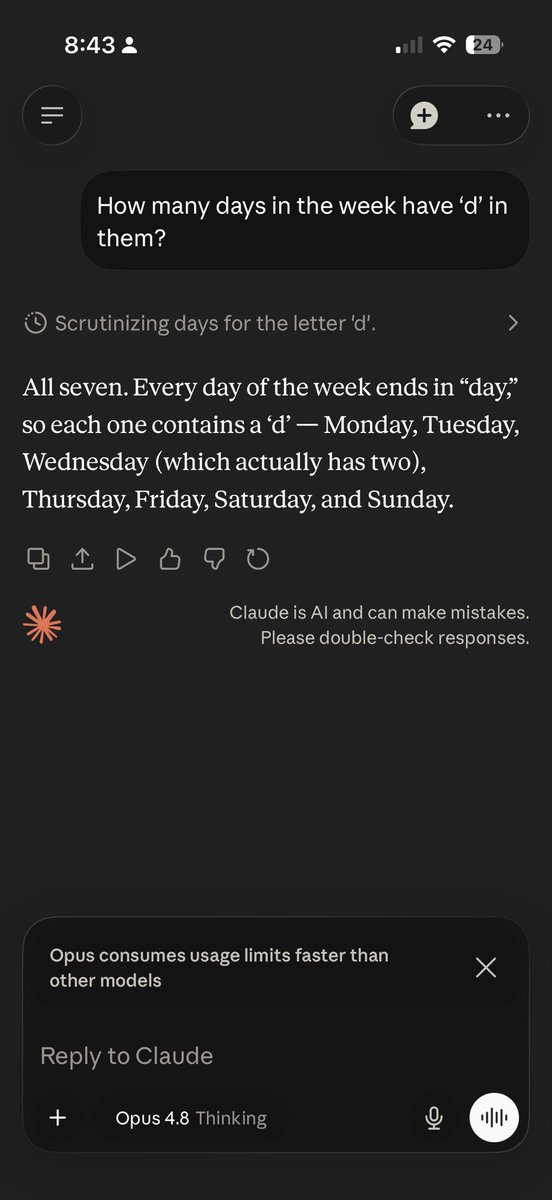
New Claude model drops. Half the people on here dropping localhost jokes. The other half counting how many ‘d’s there are in each day of the week. Guys. We must do better!
I think people don't realize why Gemini Omni is different than other video AIs. It is fully multimodal, so it can edit video natively, too
I took the famous "train " movie from 1896 & made it a bullet train, LEGO, added a time traveler, a centipede, muppets... (see reflections?)
You can stop comparing Omni and Seedance. They’re two very different models built for very different purposes.
Omni, like the name suggests, is lightweight, efficient, and incredibly strong at video-to-video. That’s really where it shines, especially with physics, motion coherence, and its understanding of the real world.
So while everyone is busy generating fight scenes to compare them directly, they’re kind of missing the point.
Omni feels much closer to a “Nano Banana moment” for video than a traditional cinematic generation model.
You’re comparing apples and pears.
For example, I can easily ask Omni to change the entire setting of a sequence and turn day into night while preserving the shot structure. That’s a massive deal.
Efficient v2v is probably going to become a huge part of the future of entertainment and hybrid productions.
Are people misunderstanding Google Omni Flash?
I totally agree with @henrydaubrez 's X post, some of the tests and comparisons with the new Google Omni just don't make much sense, so let's try to find out what this model is for.
There is no official information on where this model will sit in the lineup of future video models, but from what I saw during the release at Google I/O we have some clues:
- 𝐅𝐢𝐫𝐬𝐭 𝐢𝐬 𝐭𝐡𝐞 𝐧𝐚𝐦𝐢𝐧𝐠: this is not Veo, it received a totally different name
- The model's version is called "𝐅𝐥𝐚𝐬𝐡": just like Gemini Flash, this is might be the fastest, lowest cost model in the series, Omni Pro coming later
- Pricing: if I calculate correctly, one generation (with or without video inputs) costs $0.25.
So this means the video above cost $0.25 to generate the original video (with a product image as an input) and then $0.75 for the three versions. So this might be a model that is made for:
- very cost-effective and fast generations
- supporting image and video inputs
- made for video editing
Also, if you check the difference mode comparison - everything black is pixel-perfectly matching the original file - I think it's pretty good for such a low generation cost.
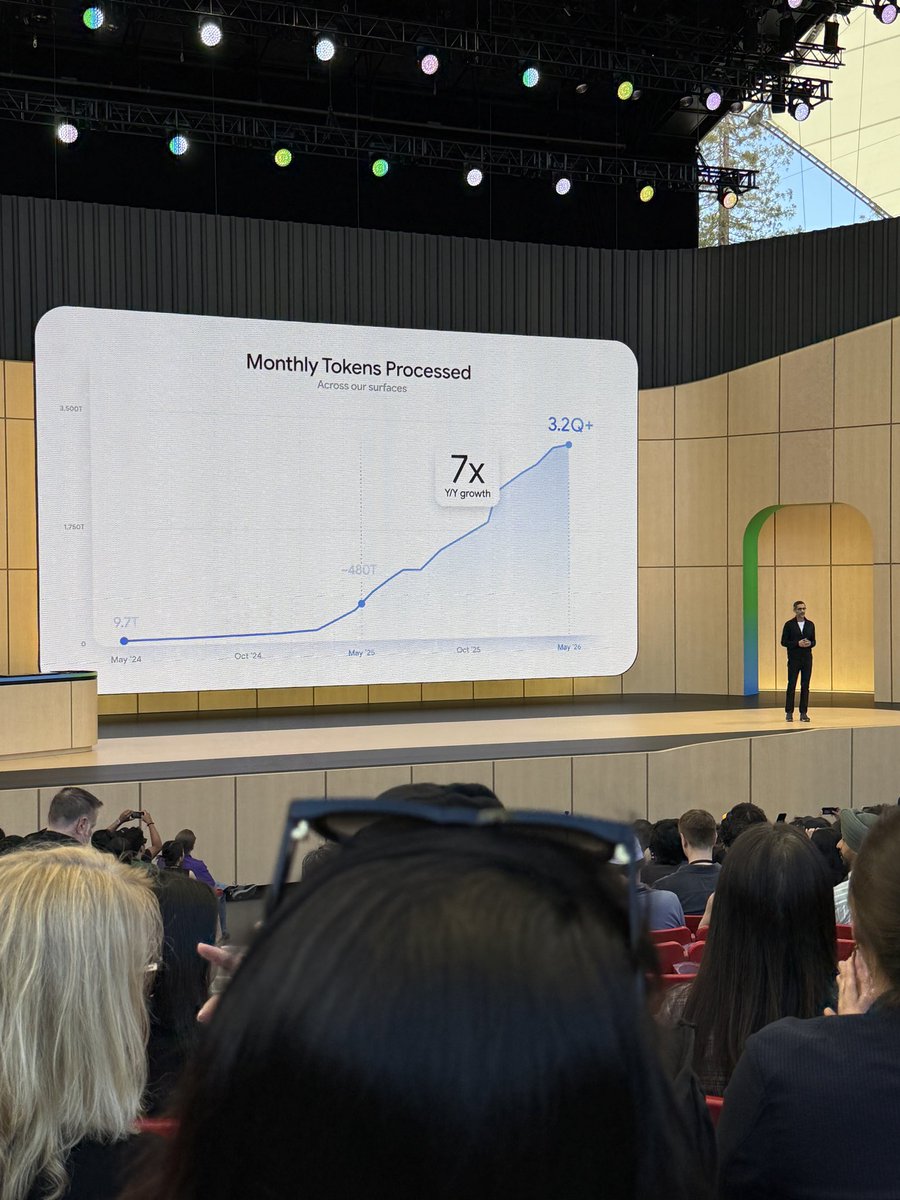
everyone’s dragging #Gemini & #Google on AI Twitter but if y’all actually paid attention to IO: we’re just out here serving BILLIONS at a cost, speed & scale that’s untouchable rn #GoogleIO
Holy crap. And I don’t say that lightly.
Google is now processing 3.2 quadrillion tokens per month, up 7x from last year.
That’s a 3 with 15 zeroes after it.
Actually, it’s 3 and a 2 and 14 zeroes.
#Google
@davis7 Lost count of the number of times Google’s been counted out. It’s a long game, and coding is just one of many AI use cases. Show me another company serving a billion people through gemini in search.