AI bill tripled overnight. Billing showed how much, not who. Root cause took 2h14m.
The boring fix: request labels on every model call (team, use_case, step), enforced in CI.
A sharp blameless postmortem (composite of real patterns):
https://t.co/JzSQrStLMN
#SRE#FinOps#LLMOps
"which gs" came back empty on my Debian 13 box. libgs10 was still installed.
Upload2Shell (CVE-2026-125396) reaches Ghostscript via thumbnails, previews and print jobs, even from files named .png.
Inside: 6 checks to find every path and close it. https://t.co/i4qA10Gv9t
@milan_milanovic funny bit is .NET 10 LTS ends the same day, Nov 14 2028. so sitting on 10 doesn't buy you any extra support now, the old "wait for the LTS" reason kind of goes away
@e_opore solid list. I'd put reading public postmortems somewhere near the top. Cloudflare and GitHub write really detailed ones and you learn how DNS and config pushes actually break in prod
@SemiAnalysis_ yeah and for agent traffic it's TTFT that people actually feel. prefill on a long context is where they sit waiting, so a sub-100 token demo mostly tells you how fast decode is
"Zero data retention" was a checkbox. Then someone checked.
OpenRouter just pulled 125 endpoints from ZDR eligibility and off-boarded 3 providers.
A data policy is a dependency claim:
- Pin your providers
- Ask for evidence
- Keep secrets and PII out of prompts
#LLMOps#SRE
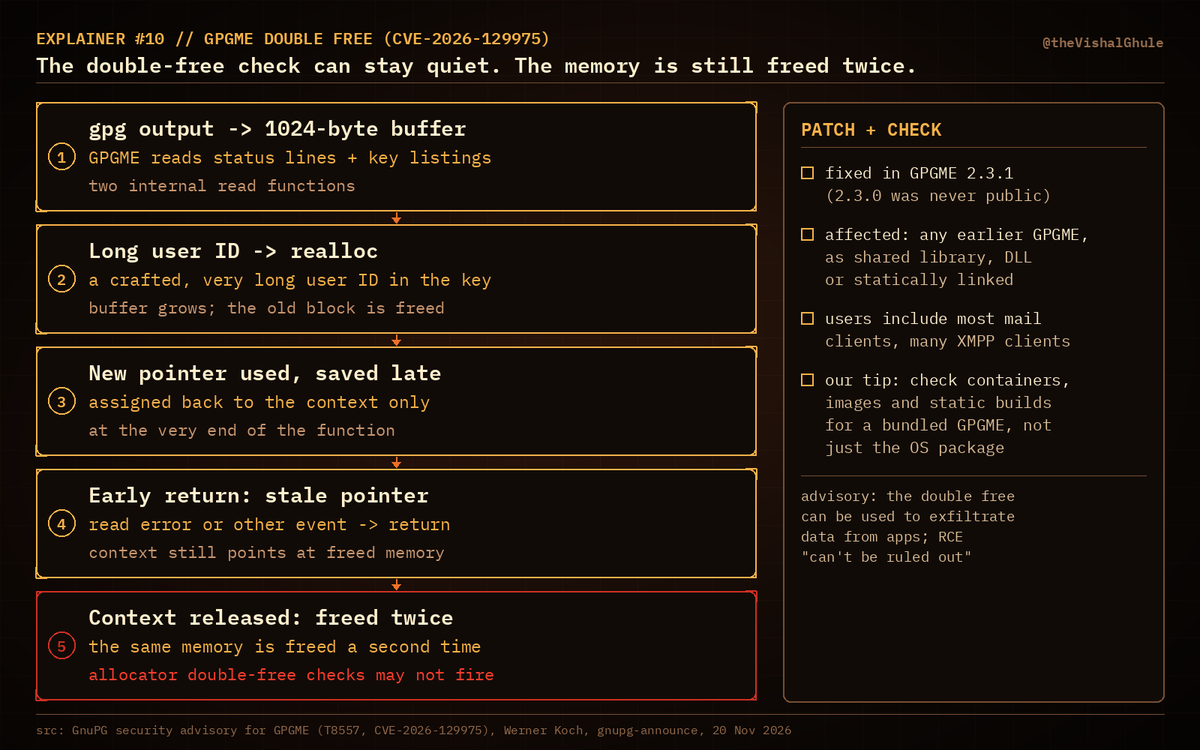
The allocator's double-free check can stay quiet. GPGME still frees the same memory twice.
That's CVE-2026-129975, out 20 Nov. All it takes is an OpenPGP key with a crafted, very long user ID. GnuPG says it can be used to pull data out of apps, and RCE "can't be ruled out".
Explainer #10, the flow:
1. GPGME reads gpg's status lines and key listings into a 1024-byte buffer.
2. The long user ID needs more room, so the buffer gets reallocated.
3. The function keeps using the new pointer, but only saves it back to the context at the very end.
4. A read error (or some other event) makes it return early. The context still holds the old pointer, to memory that's already freed.
5. The context gets released and that memory is freed again. Other allocations in between mean common double-free checks may not fire.
Fix is GPGME 2.3.1 (2.3.0 never shipped publicly). Older versions are affected whether it's a shared lib, a DLL or statically linked. Most mail clients use it.
My take: patching the OS package is half the job. Check your containers, images and static builds for a bundled copy too.
Where would a stray GPGME hide in your stack?
@0xlelouch_ on #1 I'd also spell out the bad day. p99 under 200ms sounds good, but the next question is usually what happens when a dependency gets slow, and having an answer ready (timeouts, and where you degrade) lands better than more happy-path numbers
@devopscube the GPU one's a good read. fun part is the instance status check can stay green while the GPU itself is throwing Xid or ECC errors, so if nothing probes the accelerator "healthy" really just means the host booted
@CTOAdvisor you might need explicit non-goals in the prompt. stuff like "don't fix app code" or "no per-team exceptions". otherwise it keeps sliding back to whatever the app persona is complaining about
Don't let endpoint error rates tell you how bad your outage is.
DoorDash had an incident on Saturday. The public status entry read "Drive Endpoints - Partial Outage": increased errors at 4:30 PM UTC, recovery at 4:50, resolved at 6:58. That's 2 h 28 min.
The user-side signal was louder. Instatus logged reports at 29,203 an hour, peaking at 206x normal. X News cited over 12,000 Downdetector complaints, mostly app errors preventing restaurant browsing and orders.
DoorDash hasn't published a root cause, so I won't guess one. What I take from it (my advice, not theirs):
1. Alert on the user journey: browse > checkout > order placed.
2. Run a synthetic order path on a schedule, not just endpoint health checks.
3. Let your status label follow what users can do, not which component threw errors.
Healthy components don't mean users can order.
#SRE #Observability
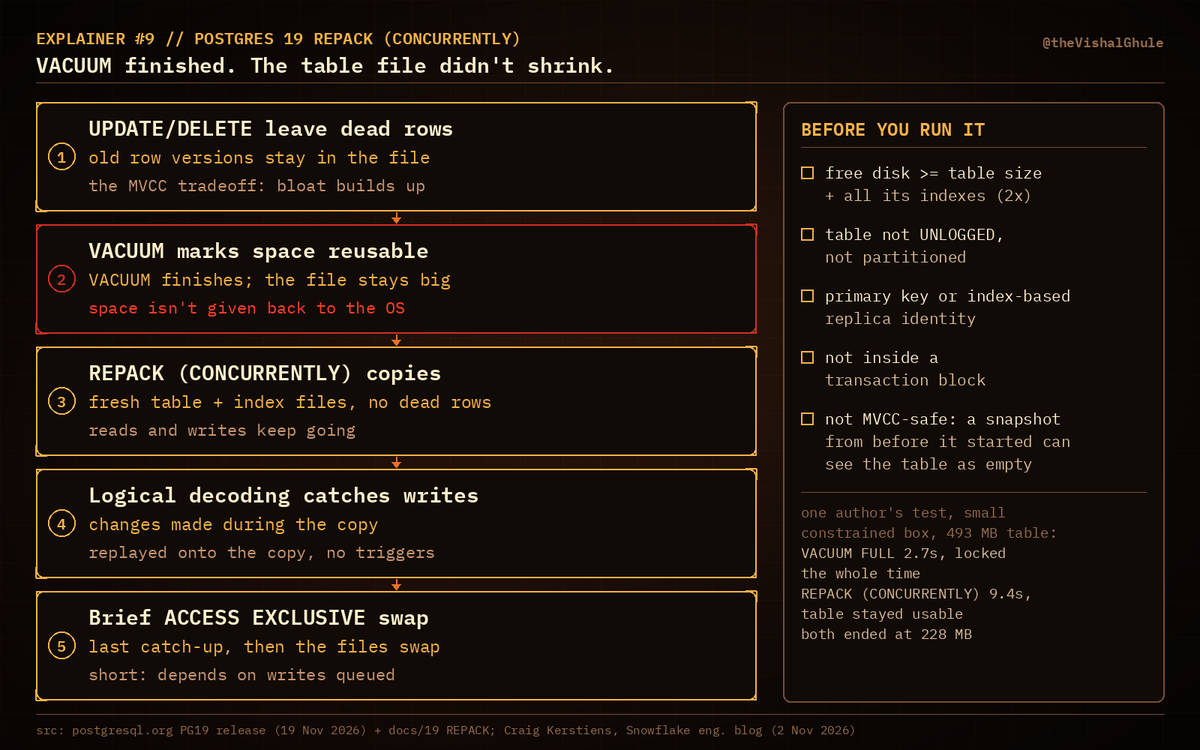
VACUUM finished. The table file didn't shrink.
That's bloat. Before Postgres 19, getting the space back usually meant VACUUM FULL (table locked the whole time) or an extension like pg_repack. PG19, out 19 Nov, builds in REPACK (CONCURRENTLY).
Explainer #9, the flow:
1. UPDATEs and DELETEs leave dead row versions in the file.
2. VACUUM marks that space reusable. It doesn't give it back to the OS.
3. REPACK (CONCURRENTLY) writes a fresh copy of the table and its indexes, minus the dead rows. Reads and writes keep going.
4. Writes made during the copy get captured with logical decoding and replayed. No triggers on your table.
5. A brief ACCESS EXCLUSIVE lock, one last catch-up, and the files swap.
Before you run it: free disk at least the size of the table plus its indexes. No UNLOGGED or partitioned tables. It needs a primary key or index-based replica identity. And it's not MVCC-safe: a snapshot from before it started can see the table as empty.
One author's test on a constrained box, 493 MB table: VACUUM FULL took 2.7s, locked throughout. REPACK (CONCURRENTLY) took 9.4s, table usable. Both ended at 228 MB.
Online costs you wall-clock time, not uptime.
Which table would you try it on first?
Same OpenSSL bug, three verdicts: 9.8, 5.9 and Low.
CVE-2026-121481 is an integer overflow in EVP_EncodeBlock(). CISA first scored it 9.8 Critical. Its entry in the CVE record now says 5.9. OpenSSL rates it Low: no attacker path is known, and the caller must already hold a buffer of about 2 GB.
Don't patch by the score alone. Check whether your code can reach it.
#SRE #DevSecOps
Don't trust nginx -v this weekend.
NGINX2Root is unauthenticated RCE when HTTP/2 is on, and the version string can mislead you both ways.
The copy-paste check below shows which of your nginx boxes are exposed tonight, plus a stopgap if you can't patch. https://t.co/a9ZmiXLp1g
For 53 hours, an LLM endpoint served a tampered model. Capability benchmarks didn't budge.
Prime Intellect says its DeepSeek V4.1 Flash deployment was swapped for an abliterated copy. Refusals on JailbreakBench: 98/100 down to 1.
Test behaviour, not just evals.
#LLMOps#SRE