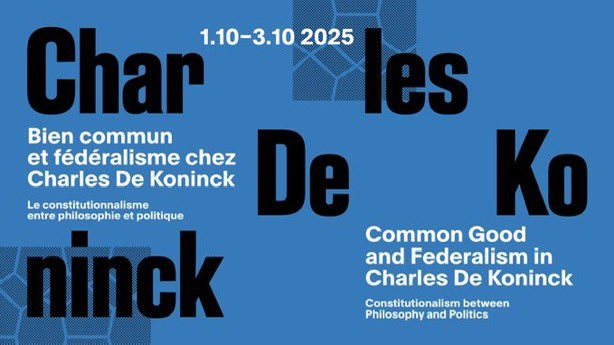
Jurists, political scientists, and philosophers will gather in Quebec City to critically revive the thought of Charles De Koninck on constitutionalism, the common good, and federalism. Keynote lecture by @Vermeullarmine
A symposium not to be missed!
👉 https://t.co/za22uPHAvL
@PhilCatholic @howtingmi@FeserEdward@josias_rex We understand Senior to mean Maritain as popularizer, not restrictively.
De Koninck engaged with Maritain in a way few others could, in a way mere popularizers could not begin to appreciate. (JGB)
The second essay is by Glen Coughlin, which explains length two terms that play a large role in De Koninck’s essay, symbol and calculation, all while contrasting them to their equivalents in ancient science: word and argument.
https://t.co/vPvbSXBCPM
The first is by John G. Brungardt, considering an argument made by De Koninck about the nature of the cosmos as the “lowest rung” of a hierarchy in the universe.
https://t.co/gXZIgW9xnL
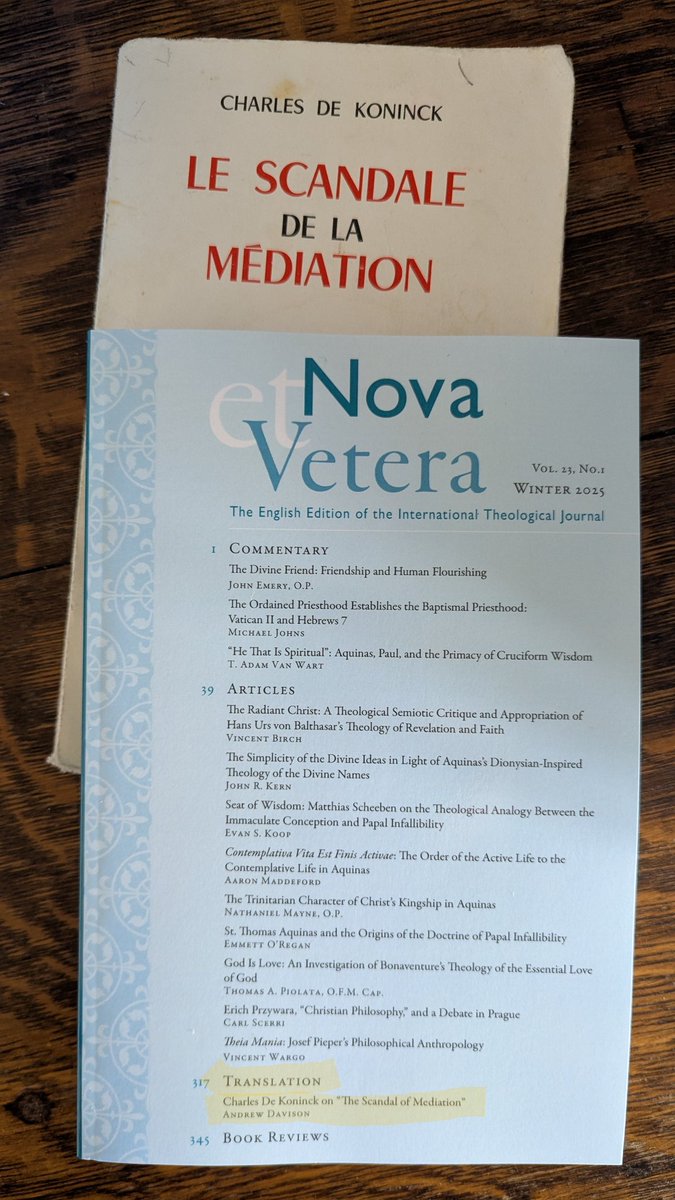
The issue features a series of previously unpublished material from De Koninck, as well as an essay from his consideration of Meyerson’s philosophy.
https://t.co/yOWMIP2sfa
The latest issue of the Aquinas Review from Thomas Aquinas College in dedicated to Charles De Koninck, in anticipation of the 60th anniversary of his death (in Feb, 2025).
We are an initiative of @sacradoctrina. Donations can be made to our work by donating to the Sacra Doctrina Project. Please leave a comment indicating the CDK Project, and your kind gift will be allocated accordingly.
https://t.co/yKqbuEJbdY
"A true philosophical temperament is not thrown into panic by error, but seizes upon it as an occasion to get nearer the truth. As Ortega y Gasset pointed out early in this century, the desire to know is one thing, fear of error is another. When fear takes precedence, philosophy reduces to criteriologies, epistemologies and gnoseologies -- prolegomena to nothing. To begin in fear of error is to end in doubt."
—Charles De Koninck, “Three Sources of Philosophy”, 1964
De Koninck, “Du bien qui divise l'être” (“On the Good Which Divides Being,” 1954)
“That the community is able to pursue only those goods on which all its members should be able to agree—here precisely is what characterizes social nihilism. What is the source of this nihilism?”
“The answer to this question is found in the words of St. Augustine: There are two cities built by two contrary loves: the love of self to the contempt of God, which makes the City of the World; the love of God to the contempt of self, which makes the City of God.”
This comment by Ralph McInerny was one essential piece to the direction of my graduate research: “[De Koninck’s] account of the relation between natural philosophy and natural science still awaits a serious appraisal by philosophers of science.” https://t.co/8t5SdgAcdk
Fr. Ernest Fortin on his time studying under De Koninck at Laval University.
"I decided early on that if ever I were to become a card-carrying Thomist, this is the kind of Thomist I wanted to be."
@The_CDK_Project@josias_rex




![howtingmi's tweet photo. @The_CDK_Project Fr. Ernest Fortin when asked "What made him [De Koninck] great? https://t.co/OPc4yCHCHJ](https://pbs.twimg.com/media/GC3E0PUWAAAudFw.jpg)





