🎁 GIVING AWAY A BMW M340i (+ €5000 x5 WINNERS) 🎁
To enter :
- Follow @LuxDropCom + @LobanjicaCS
- retweet + like
- Tag 2 friends 👥
- CLICK HERE TO GET ALL ENTRIES : https://t.co/YuLD5BoQRi 🚨
That is it, very easy to join and possibly win your dream car. Make sure you join the Gleam link above to get the full entries as the giveaway will be drawn from there.
Winner will be picked 8th October, good luck! 🥳
Intersting that long time vegan with low serum LDL Simon Hill has more heart disease at age 38 than do the folks in the Keto CTA study at average age 55 and super high LDL cholesterol 🙀🙀🙀
Chronic diseases are on the rise — and yet the most radical healing protocol is still not widely. It's a high fat carnivore diet, called the Paleolithic Ketogenic Diet (PKD). A thread 🧵
Interviewed a guy who had developed severe GI issues to include hospitalization and multiple transfusions for bleeding-went vegan and no improvement-later goes Carnivore and see full resolution of problem! Also wife whole vegan has severe migraine headaches, also goes carnivore and headaches disappear!
🇭🇺🇭🇺🇭🇺
If you are based in Hungary and have Hungarian citizenship, please SIGN this.
🇭🇺🇭🇺🇭🇺
Thousands of animals are being killed instead of applying approaches that have been used 50 years ago, during the last outbreak, and proved to be effective. Foot-and-mouth disease is potentially curable, most of the time not lethal, and does not pose a risk to humans. Testing is based on PCR, which is unreliable and may result in false positive results.
https://t.co/Bwspp5PVIB
The reality behind CURCUMIN. Long article!
"..No double-blinded, placebo controlled clinical trial of curcumin has been successful...This manuscript reviews the essential medicinal chemistry of curcumin and provides evidence that curcumin is an unstable, reactive, nonbioavailable compound and, therefore, a highly improbable lead."
https://t.co/Jis3YLWbUE
All too often, there is a lack of nuance in discussions surrounding obesity and weigh loss. In this series of tweets, I address the core issues, while also touching on several important, yet overlooked topics. I suspect much of this content will be new to most conventionally trained doctors.
Understanding Obesity: The Role of Hormones and Nutrients
The Calories In/Out (Energy Balance) model of obesity is wrong
Imagine if you went to a doctor, and after assessing you, they said - ‘Of course you feel terrible, you have a fever of 40°C (104°F). All you need to do is bring down your fever and you’ll feel better’. Would you be happy? While this information is accurate enough, it is completely unhelpful, in that it doesn’t provide any advice at all on how to actually bring the fever down.
Patients attending doctors for assistance with weight loss often receive equally useless commentary. In line with the "calories in/calories out" model of obesity, they are simply told they need to expend more calories than they take in. The problem is, they are often not given any advice on exactly HOW to do this. And when they are given advice, it is often completely wrong. Many doctors advise patients to restrict fat intake, primarily on the basis that it is more energy dense than either protein or carbohydrate.
The problem is, the Calories in/Calories out energy balance model of obesity completely ignores the sciences of biochemistry and endocrinology, overlooking differing effects of fat, protein and carbohydrates on hormones. By oversimplifying the cause of obesity to a simple case of caloric balance, incorrectly presumed to be entirely under volitional control, obesity is thought to represent a failure of will power. In essence, the implication is that most obese individuals are lazy and overindulgent, something that is both manifestly false and an egregious form of medical gas-lighting. The truth is, low fat foods, which typically contain large amounts of carbohydrates, have been scientifically proven to cause weight gain.
It's not however, that doctors give poor advice maliciously. Many doctors after all, follow their own advice, which may explain why in 2015, nearly 60% of Australia’s doctors were overweight or obese.
Hormonal Influences on Weight Gain
Most people are aware that thyroid hormone helps to regulated our metabolism, and that deficiencies can result in weight gain. The fact is, there are at least a dozen hormones whose dysregulation has been associated with weight gain. For example, high cortisol levels as seen in Cushing’s syndrome may lead to distinctive fat deposits known as "moon face" and "buffalo hump." By far the most significant obesogenic hormone, however, is insulin.
Insulin and obesity
A 1996 study conducted in Bogalusa, Louisiana, highlighted the crucial role of insulin in obesity . Over an 8-year period, the study measured insulin levels in children and young adults. It found that those with the highest insulin levels (in the top 25% at both the beginning and end of the study) were 36 times more likely to become obese compared to those with the lowest insulin levels (in the bottom 25%). Specifically, the risk of becoming obese was just 2% for those with the lowest insulin levels, while it soared to 72% for those with the highest insulin levels.
Type 1 diabetics well know that fattening effect of insulin. Before they are diagnosed, and commence insulin therapy, many type 1 diabetics are dangerously underweight. The reality is that, without insulin, the body cannot store fat. The commencement of insulin therapy can rapidly reverse this emaciation, research showing that type 1 diabetics gain an average of 5.1kg (11.2lbs) during their first year of insulin therapy . Despite its life saving potential in type 1 diabetics, up to 60% of type 1 diabetics may deliberately reduce or skip insulin doses due to its fattening effect – a condition referred to as diabulimia .
Further evidence of insulin's fat-storing effects is the development of localised fat masses at sites of injection. Known as lipohypertrophy, this can occur in anyone who injects insulin, one study reporting that 49% of all insulin injecting type 2 diabetics developed lipohypertrophy . *
*Importantly, many adults diagnosed with type 2 diabetes may actually have an autoimmune form that impairs insulin production. This condition, known as Latent Autoimmune Diabetes in Adults (LADA), is present in about 10% of diagnosed type 2 diabetes cases. Individuals with LADA are often more slender than typical type 2 diabetics and may even be underweight. While a strict low-carb diet is generally beneficial for these individuals, insulin therapy is often necessary.
Finally, they prove that all the Harvard dietary observational studies should go into the garbage.
Predictive equation derived from 6,497 doubly labelled water measurements enables the detection of erroneous self-reported energy intake | Nature Food https://t.co/3mAusAFmC4
What people think fiber does:
- Makes digestion easier
- Creates a microbiome wonderland
- Gets rid of constipation
- Stops diabetes
- Stops colon cancer
What fiber actually does:
- Adds indigestible junk
- Clogs the gut
- Increases your carbon emissions
- Makes your bad gut bugs proliferate
- Adds a legion of inflammatory plant toxins
- Lowers nutrient absorption
8 years old child with absence epilepsy 🧠on the 11th day of the PKD (paleolithic ketogenic diet)
No epileptic seizures until now. The first few days were "rough" due to the too-quick jump into ketosis. Now, the child says, "I feel good. It's hard to explain why it's good."
We keep going on.
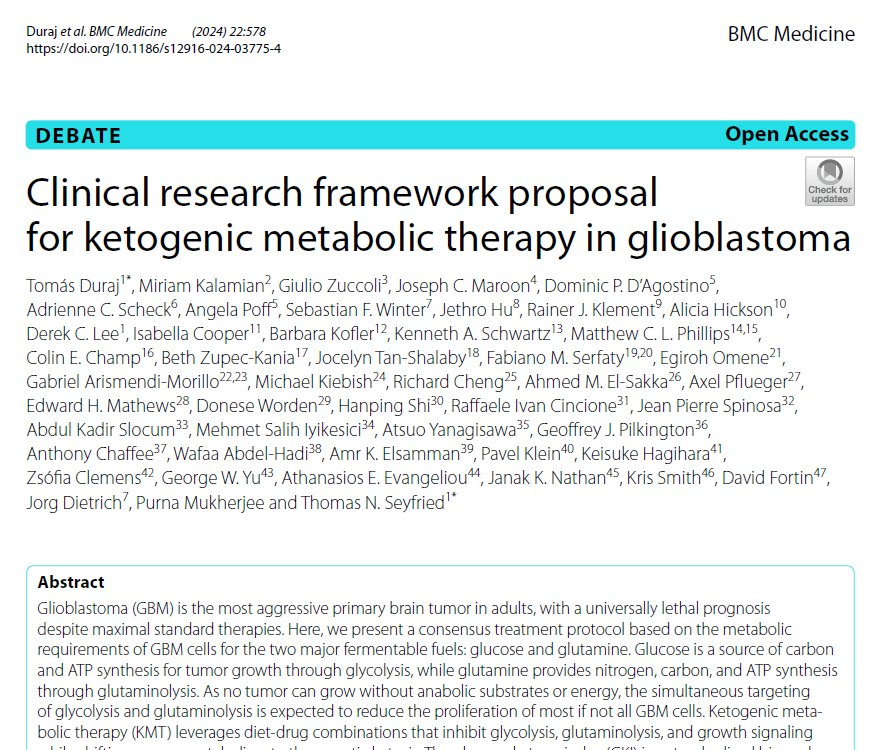
The most comprehensive glioblastoma (GBM)—ketogenic diet paper is now out and available as open access. I hope this paper will change the landscape. If real science prevailed over something else, there would be more such papers by now. I hope this will be a go-to paper on how glioblastoma should be properly viewed and treated. This issue is urgent as despite loads of money and human resources poured into it, the outcome of GBM is poor and has not been getting better over the last decades. Professor Seyfried and his colleagues put together a masterpiece, and I am honored to be associated with this paper.
https://t.co/qc2egaFicP