Meta Media Buyer | Creative Specialist
Built an ad that generated $875K+ in sales
Managed over $10M on Meta Ads
Follow & Learn How to Create Winning Ads
Reddit is Where Your Next 7-Figure Ad Angle is Hiding
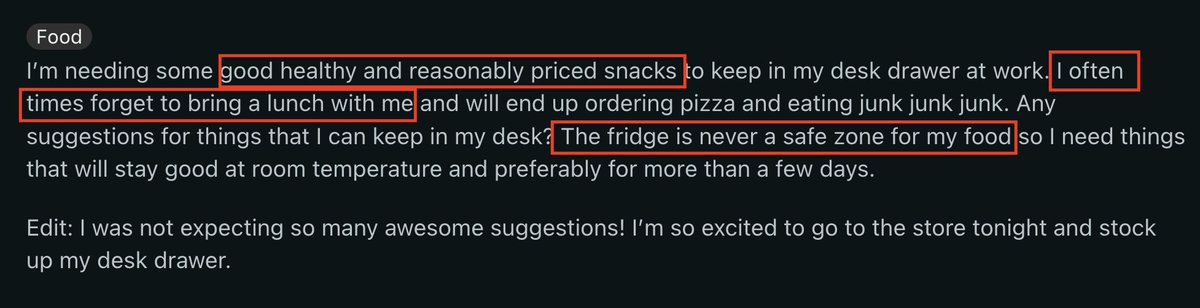
While researching for a client, I came across a Reddit post where someone casually shared their experience with snacks. Most marketers would have scrolled past. I saw three angles immediately:
1. They Wanted Affordable Snacks → Bundle Offer
They specifically mentioned they were looking for reasonably priced snacks. That tells me two things:
- Price is a key decision factor.
- They’d likely buy more if they felt they were getting a deal.
Instead of pushing individual products, we now have a strong reason to position a bundle. A simple “Stock Up & Save” message could make the difference between a casual browser and a repeat buyer.
2. They Kept Forgetting Their Lunch → Position the Bundle as an "Emergency Stash"
They admitted that they often forgot to bring lunch. That’s not just a one-time issue—it’s a recurring pain point.
So instead of just saying “great snacks,” we can now reframe the offer:
- “Always hungry at work? Stash these in your drawer. Problem solved.”
- “Your boss won’t care if you skipped breakfast, but your stomach will.”
-“The perfect emergency stash for those ‘oh crap, I forgot my lunch’ days.”
It turns the product into a solution for a real-life struggle, not just a snack.
3. They Didn’t Trust the Shared Office Fridge → Perfect for Non-Perishable Snacks
One sentence in the comment said it all: “The office fridge is NOT safe.”
Food goes missing.
People don’t clean up after themselves.
It’s a breeding ground for questionable smells.
And guess what? My client’s snacks don’t need refrigeration.
This becomes another easy angle:
- “No fridge? No problem. Stays fresh for weeks in your desk drawer.”
- “Your snacks should be yours. Keep them safe (and out of the fridge).”
- “Shared fridge drama? Skip it. These snacks are made to last.”
Now Imagine Doing This with 100s of Comments…
This is one comment. On one thread. Now imagine scraping hundreds of Reddit, Twitter, or forum posts related to your product niche.
You’d uncover:
- The exact words people use when talking about their struggles.
- The real-life situations where they need your product the most.
The subtle objections stopping them from buying.
And yet, most marketers are too busy scrolling the ad library.
Ad inspiration isn’t found in what’s already running. It’s found where your customers are venting their frustrations in real time.
Start there. The winning angles will write themselves.
The UGC creator you choose matters more than the script you give them.
One of my recent clients was stuck. Two months of failed ads, despite testing hundreds of videos every week.
Here's what we discovered:
Their best customers? Women over 50. Their video spokespeople? Women in their 30s and 40s.
The disconnect was killing their results.
We saw it in the comments: "She's too young to have those problems" and "Of course it works for her, she's not our age."
The fix was simple. We hired women in their 50s and had them read the exact same scripts.
Performance exploded overnight.
Then we tested something interesting. We gave those same 50+ creators completely different, broader scripts. Still worked great.
Why?
Meta knows who buys from you. When you show them content with someone who looks like their actual customers, the platform does the heavy lifting to find more of those people.
Your script can be average. But if your spokesperson doesn't match your real buyers, even brilliant copy won't save you.
Before you rewrite another script, check this: Does the person in your ad look like the person buying your product?
That mismatch might be the only thing standing between you and profitable ads.
Reddit is Where Your Next 7-Figure Ad Angle is Hiding
While researching for a client, I came across a Reddit post where someone casually shared their experience with snacks. Most marketers would have scrolled past. I saw three angles immediately:
1. They Wanted Affordable Snacks → Bundle Offer
They specifically mentioned they were looking for reasonably priced snacks. That tells me two things:
- Price is a key decision factor.
- They’d likely buy more if they felt they were getting a deal.
Instead of pushing individual products, we now have a strong reason to position a bundle. A simple “Stock Up & Save” message could make the difference between a casual browser and a repeat buyer.
2. They Kept Forgetting Their Lunch → Position the Bundle as an "Emergency Stash"
They admitted that they often forgot to bring lunch. That’s not just a one-time issue—it’s a recurring pain point.
So instead of just saying “great snacks,” we can now reframe the offer:
- “Always hungry at work? Stash these in your drawer. Problem solved.”
- “Your boss won’t care if you skipped breakfast, but your stomach will.”
-“The perfect emergency stash for those ‘oh crap, I forgot my lunch’ days.”
It turns the product into a solution for a real-life struggle, not just a snack.
3. They Didn’t Trust the Shared Office Fridge → Perfect for Non-Perishable Snacks
One sentence in the comment said it all: “The office fridge is NOT safe.”
Food goes missing.
People don’t clean up after themselves.
It’s a breeding ground for questionable smells.
And guess what? My client’s snacks don’t need refrigeration.
This becomes another easy angle:
- “No fridge? No problem. Stays fresh for weeks in your desk drawer.”
- “Your snacks should be yours. Keep them safe (and out of the fridge).”
- “Shared fridge drama? Skip it. These snacks are made to last.”
Now Imagine Doing This with 100s of Comments…
This is one comment. On one thread. Now imagine scraping hundreds of Reddit, Twitter, or forum posts related to your product niche.
You’d uncover:
- The exact words people use when talking about their struggles.
- The real-life situations where they need your product the most.
The subtle objections stopping them from buying.
And yet, most marketers are too busy scrolling the ad library.
Ad inspiration isn’t found in what’s already running. It’s found where your customers are venting their frustrations in real time.
Start there. The winning angles will write themselves.
Why Every Ecom Brand Needs a Killer Slogan
Studies show that brands with strong slogans have a higher recall rate among customers.
Why? Because a slogan is:
- Memorable
- Emotionally engaging
- A shortcut to what your brand stands for
Here’s a simple formula to create one FAST:
[Your Core Promise] + [Emotional Hook] = Your Slogan
Yet, when I ask ecom owners about theirs, they’re like:
"Uh… we don’t really have one."
If billion-dollar brands like Nike (Just Do It) and McDonald's (I'm Lovin’ It) swear by them… maybe it’s time you create yours too.
I dropped 100 evergreen slogans in the comments, go check them out and get inspired! 🚀🔥
Secret from running $2M+ Meta accounts during BFCM:
Your best-performing ads from this year will beat any new "creative" concept you make for Black Friday.
Here's exactly what to do:
1. Pull your top 10-15 ads from the past year. The ones that actually drove sales.
2. Add your Black Friday offer as banners - one at the top, one at the bottom. Done.
3. Make sure you have both:
→ Square version (1080x1080) for feed
→ Vertical version (1080x1920) for stories
Now here's what actually matters:
1. During the sale, check your account every 2 hours. Not daily. Every 2 hours.
2. Track which ads are spending without converting. Cut them. Track which ones are printing. Scale them.
I watched brands burn $50K testing fancy BFCM campaigns while their old ads with simple offer banners drove 3x more sales.
People buy because of the discount, not because your ad looks different.
Your time should be in the ad account moving budgets, not in Figma making new creative.
Client went from spending $25k/day to barely managing $10k.
Here's the one metric that turned it around:
I started tracking how many people who clicked "checkout" actually bought something.
Simple ratio. Huge insight.
Some ads brought window shoppers. Others brought buyers.
The pattern was clear once I looked at 60 days of data:
Certain ad angles had 2x better checkout-to-purchase rates
Same products, same prices, different results
The difference? How we presented the product
So we killed the weak ads and doubled down on what worked.
No fancy tactics. No Black Friday gimmicks.
Just made more ads like the ones that brought real buyers.
35 days later → Back to $25k daily spend.
The lesson?
Your ads might get clicks and add-to-carts.
But are they bringing buyers or browsers?
Track this one ratio. It'll change how you think about "good" ads.
Most people obsess over click rates. Smart marketers obsess over buyer quality.


![theadman__'s tweet photo. Why Every Ecom Brand Needs a Killer Slogan
Studies show that brands with strong slogans have a higher recall rate among customers.
Why? Because a slogan is:
- Memorable
- Emotionally engaging
- A shortcut to what your brand stands for
Here’s a simple formula to create one FAST:
[Your Core Promise] + [Emotional Hook] = Your Slogan
Yet, when I ask ecom owners about theirs, they’re like:
"Uh… we don’t really have one."
If billion-dollar brands like Nike (Just Do It) and McDonald's (I'm Lovin’ It) swear by them… maybe it’s time you create yours too.
I dropped 100 evergreen slogans in the comments, go check them out and get inspired! 🚀🔥](https://pbs.twimg.com/media/Gkvt8IRXsAA5Vno.jpg)


