Ils ont tué les marais. Le Huleh a été drainé dans les années 1950, la vallée du Jezreel une génération plus tôt, et l'Organisation mondiale de la santé a certifié Israël exempt de paludisme en 1967, dans une région où la maladie était endémique depuis l'âge du bronze.
Ils ont planté des forêts. Le Fonds national juif a mis plus de 240 millions d'arbres dans ce sol, faisant d'Israël l'un des très rares pays de la planète à être entré au XXIe siècle avec plus de couverture forestière qu'au début du XXe siècle, tandis que le Sahel et l'Amazonie sont allés dans l'autre sens.
Ils ont reconstruit l'agriculture à partir de rien. La tomate cerise commerciale moderne a été conçue à l'Université hébraïque. Les trouperts laitiers israéliens produisent plus de lait par vache que tout autre dans le monde. Le pays exporte de la nourriture en étant assis sur le sable.
Ils ont construit une culture scientifique à partir de réfugiés. Quatorze prix Nobel, dont six en chimie, dans un pays de dix millions. Les dépenses de recherche et de développement dépassent six pour cent du PIB, le plus élevé de tous les pays de l'OCDE et plus du double de la moyenne. Intel a ouvert son premier centre de conception en dehors des États-Unis à Haïfa en 1974, et le processeur au cœur de l'ordinateur personnel IBM original y a été conçu, tout comme l'architecture qui a sauvé l'entreprise trente ans plus tard. La clé USB, le pare-feu, l'appareil photo de la taille d'une pilule qui photographie l'intestin grêle, Waze, Mobileye, Copaxone, Iron Dome. Un pays de la taille du New Jersey, en guerre en permanence, en produit plus en une décennie que les vingt-deux États de la Ligue arabe depuis que la découverte du pétrole en a fait le plus riche accident de l'histoire économique.
Et ils ont accueilli tout le monde. En trente-six heures en mai 1991, trente-quatre avions dont les sièges sont retirés ont fait partir 14 325 Juifs éthiopiens d'Addis-Abéba. Deux bébés sont nés dans les airs. Cela reste la seule occasion de l'histoire moderne où les Africains ont été transportés en masse à travers la mer par un pays à majorité blanche dans le but d'en faire des citoyens libres plutôt que des esclaves. Un million de Juifs soviétiques ont suivi après 1991 et ont été absorbés dans un pays de cinq millions, ce qui est l'équivalent démographique des États-Unis admettant soixante millions de personnes en une décennie et leur donnant à tous des passeports.
Le verdict
Le sionisme a pris des personnes dispersées, non armées et systématiquement assassinées et leur a donné une armée, un parlement, une monnaie, une langue, un littoral et un avenir. Il l'a fait en cinquante ans, sur un terrain en ruine, sans sponsor impérial, tout en luttant contre l'invasion en 1948, 1967 et 1973 et en absorbant plus de réfugiés par habitant que n'importe quel État n'en a jamais absorbé.
Mesuré par n'importe quelle norme que le monde s'applique à quiconque, c'est le mouvement de libération nationale le plus réussi du XXe siècle et l'une des grandes réalisations constructives de l'histoire de l'espèce.
C'est précisément pourquoi il ne peut pas être pardonné. Un État juif défaillant serait pitoyable. Un modeste serait toléré. Ce qui ne peut être supporté, c'est un État juif qui travaille, qui gagne, qui nourrit les enfants de ses ennemis grâce à la technologie d'irrigation qu'il a donnée, et qui se présente comme une réfutation vivante permanente de chaque excuse offerte par chaque régime voisin pour sa propre misère.
@cessadelove1 Playing with inventing collective nouns for various groups relevant to this space!:
A disbelief of atheists.
A conviction of believers.
A doubt of agnostics.
A certainty of fundamentalists.
A reformation of Protestants.
A tradition of Orthodox Jews.
A communion of Catholics.
A tribute to @LiquidFaerie
I have not written about this until now because, to be honest, I have struggled to accept my sweet friend’s passing, let alone begin to process it. She was far too young to be taken from us and the news of her sudden passing was more than I was prepared to hear.
This magnificent creation - the enormous, vividly ornate fabric dragon you see here - is the work of my beautiful friend Leah. She shared these pictures with me and I was so awe-inspired I saved them to my phone. She was an accomplished and highly sought-after artist. Fabric was her medium; her sewing machines were her tools. She poured color, imagination, and meticulous craftsmanship into this towering piece, which was displayed in a mall in Thailand and brought joy and wonder to everyone who encountered it, and this was just one of many works of art she had shared with me.
Leah was equally gifted as a writer. She composed many thoughtful, well-crafted, and insightful posts that reflected her sharp mind and generous spirit.
She was an unapologetic Zionist who defended the Jewish people’s right to exist with courage, fortitude, and unwavering tenacity.
Brilliant and passionate, she approached everything she set her mind to with wholehearted intensity. In every sphere of her life she left the world richer and better than she found it.
I met her shortly after 10/7 and was instantly drawn to her energy and presence, like so many others here. She’s touched countless lives - both here online and in person - for anyone fortunate enough to have known her. She has left an indelible mark on their lives. My time with her was far too short.
I will miss you so much, Leah. What a profound and terrible loss for all of us who loved and admired you. Rest in peace, Leah. You left us too soon.
Until we meet again.
This morning several of us thought of Leah as her funeral took place thousands of miles away.
I know Leah liked the sea, she loved the water by her home. Clearly that stillness helped her navigate her spiritual journey.
The message today is to live life to the full, with zest, determination and courage. Centre yourself in knowing that you are created perfect, you are perfect. Fulfil your destiny, remained focused on the important things. Family, friendship, extending the hand of love and kindness far and wide.
Previously we spoke about meeting to break bread in Jerusalem. So below I attach a couple of images of my own time in Israel, one in Eilat, the other at the Kotel last month.
Life is short, fragile, a precious miracle, a precious gift. Embrace your life and your loved ones, you are part of the magic of this Universe.
With that I wish you all Shabbath Shalom Oumevorach. 🕊️💙
If the rumours are correct and Ed Miliband is indeed Foreign Secretary it will be most nauseating political appointment of my lifetime.
In the summer of 2013, evidence emerged that Bashar al-Assad had used chemical weapons against his own people – crossing what US President Barack Obama had set down as his ‘red line’.
David Cameron sought parliamentary approval for Britain to join limited military action alongside the United States in defence of what he called the longstanding ‘international taboo’ against the use of chemical weapons. Miliband chose instead to whip Labour MPs against the Government – and the motion failed.
Not only was it a day of shame for Britain, it had global impact. Obama feared a repeat in Congress and so backed away. Assad was thus sent a clear signal: butcher your own people with chemical weapons and the West will look the other way.
It also sent a signal to Putin that the West was weak, and he soon after invaded Crimea.
Miliband’s decision to do all he could to block action against Assad is one of the most disgraceful acts of any British politician in living memory.
I hope with all my will that Miliband is nowhere near the FCDO.
Now that the real culprits of any shortages in Gaza have been admitted – Hamas – where is the international outcry?
Israel’s facilitation of Aid into Gaza has exceeded the needs of the population and surpassed the requirements of international law. Attempts internationally to blame Israel and whitewash Hamas do an outrageous disservice to Arab Palestinian civilians.
A story that gives you chills.
On the morning of October 7, Nisan de Kalo, the deputy security coordinator of Kibbutz Nahal Oz, immediately realized the scale of the attack. He locked his two children inside their safe room with one simple instruction: Do not open the door for anyone, no matter what. Then he went out to defend his community.
Soon after, his commander and close friend, Ilan Fiorentino, of blessed memory, was killed. Nisan assumed command of the kibbutz’s defense against dozens of Hamas terrorists.
As the fighting intensified, Nisan made a decision that, in his own words, shaped everything that followed: “I decided that I would not be taken alive to Gaza.” Armed at times with nothing more than a pistol, he fought for 13 straight hours, evacuated the wounded under heavy fire—even as his vehicle became covered in blood—and led the clearing of the kibbutz house by house. His actions helped save the lives of more than 400 residents of Nahal Oz.
Today, while still living with the trauma and pain of those events, Nisan has made another courageous decision: he has returned to live in his home in Nahal Oz. His message to Israel’s enemies is clear: “You dealt us a devastating blow, but you did not defeat us.”
Let’s honor this hero together. Like this post as a sign of gratitude to Nisan and the members of the local security squad, share it so more people can learn about the man who helped save hundreds of lives, and follow SIMAN SHE ATA RUSI to hear more stories about the true heroes of Israel. 🇮🇱💙
Jews (generally speaking) would be my friends even if we didn’t share a common enemy in Islamism. They (again, generally speaking) tend to be intelligent, courteous and productive citizens. They punch far above their (proportional) weight in virtually every category from science to the arts. They’re like Asians with better social skills and the ability to grow afros.
Here’s the thing, though. We do share a common enemy, and it’s not just some boogeyman invented by Fox News to scare boomers for ratings. It’s an ideology—and by extension a massive global community—that refuses to budge from the 7th century, demanding that we assimilate to their worldview. They insist we affirm an Iron Age barbarian as the perfect messenger of God and they’ve been doing it for millennia.
Defeating this death cult will be difficult, to put it mildly. To alienate an exceptional community of people who understand this enemy better than anyone in the world is not merely the height of stupidity—it is the forfeiture of Western civilization at the altar of the most irrational bigotry.
Pick a side.
.@ClarkeMicah You are making quite some effort to demonstrate you are definitely not the greatest reasoner of current times. You really do not need to try at all, we all know. Now if you incoherently insist that atheism is 'There is no God, and I hate Him', well if I did, you would have given me a good reason to hate god, since after all surely it is the case that God killed the wrong brother?
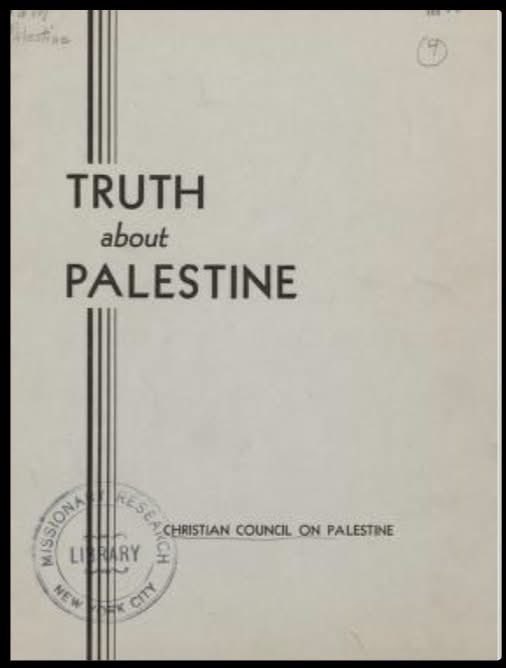
I was digging around a site called Newspaper Finder (wow did I come across a mountain of info). But...I found a pamphlet from January 1946 called "Truth About Palestine." It was written by the Christian Council on Palestine, a group of nearly three thousand mostly Protestant clergy, with a number of Catholics too. Reinhold Niebuhr was the treasurer. Paul Tillich signed it. So did Norman Vincent Peale.
It's a direct, point-by-point rebuttal to three anti-Zionist church statements that had circulated the year before. Some of what's in it lines up almost exactly with arguments still being made today. Here's what stood out:
The Hussein-McMahon correspondence, the letters people cite to claim Britain "twice promised" Palestine to both Arabs and Jews, never mentions Palestine by name. McMahon himself said so on the record in 1922 and again in 1937.
Emir Feisal, who led the Arab delegation at the Paris Peace Conference, signed an agreement with Chaim Weizmann in 1919 recognizing the Balfour Declaration and agreeing to encourage large-scale Jewish immigration. He only backed away from it after the extremist wing of Arab nationalism gained ground.
Lloyd George, who was prime minister when the Balfour Declaration was issued, said flatly that the Cabinet always understood it to mean an eventual Jewish state, not just a cultural or spiritual center. Churchill said the same thing about his own 1922 White Paper.
The Arab population of Palestine doubled between the 1920s and 1945, going from about 600,000 to 1.2 million, largely because Jewish development lowered the death rate and raised wages. That's a strange result if the story is supposed to be Arab displacement.
Out of thousands of Arab families who claimed to have been made landless by Jewish land purchases, British investigators validated 664 total. Land reclamation by Jewish settlers added farmable acreage to the country, it didn't shrink it.
The Mufti of Jerusalem, the most powerful Arab political leader in Palestine at the time, fled the country and helped organize a pro-Nazi coup in Iraq. He later worked directly with Hitler. The church documents being rebutted don't mention this.
A 1945 poll by Elmo Roper found about 80 percent of American Jews supported a Jewish state. The idea that American Jewry was deeply split on Zionism was already a manufactured talking point by 1946.
The official Jewish Commonwealth proposal on the table at the time included full legal equality for non-Jews, universal suffrage, and local control of Muslim and Christian holy sites by their own communities. That's the opposite of the "theocratic, racial state" critics claimed it would be.
Worth reading as a primary source, whichever side of the current argument you're on. It shows how old these exact talking points are, and how they were being argued over inside the Christian church itself, not just between governments.
Archive link: https://t.co/klGUcbBaMs
We aren't witnessing a new debate. We’re watching a rerun of a script written decades ago, only updated for social media. When modern institutions claim to be "unbiased," they’re usually just digging up the same tired myths and convenient silences that were being dismantled before the state of Israel even existed. The fact that the same arguments survive eighty years later proves they aren't meant to shed light—they’re meant to lock us in the dark. - Melissa Steinberg Brodsky
Read it here: https://t.co/VmBDGsYFjv
The central mistake of contemporary political discourse is to treat politics primarily as a contest between left and right. This is I think a deep mistake.
What do people even mean by left versus right nowadays? At least three spring to mind:
Labour versus Capitalism?
Global versus National?
Group versus individuals?
Just these three factors turn a one dimensional line into a three dimensional cube. And how these map to left and right might vary from country to country! Too many conversations project solutions located in this space and flatten it to a line with important distinctions and concerns rendered invisible and consequently impossible to resolve. We need to get beyond this.
Now these three factors do appear orthogonal or perpendicular or independent to each other but are these the only ones and these all independent or interdependent?
This is what I want to explore in future threads.
To be brief for now, I think that a more useful framework views society as a complex adaptive system whose stability depends on a number of interacting variables or factors including those stated above but also trust, institutional legitimacy, social capital, relevant moral foundations, universal and consistent rule enforcement, individualist versus group identities, and internal issues of cooperation over conflict or fragmentation versus integration. This is a multi-dimensional space or state space (a pun but a useful one here) with different regions, some more preferable than others - depending on our values - and some more stable than others.
My underlying concern is to better understand the Enlightenment and the modern world - the "West" - that arose from this movement and I want to map it as an attractor region into this state space.
I see too many misunderstanding what the Enlightenment was and what the benefits and deficits of it are. This leads to fundamentally incompatible solutions to the current malaise of the 21st century. We might agree to the symptoms of our sick body politics, but if we cannot agree on the diagnosis of the cause, we cannot recommend the appropriate treatment regime that could lead to a cure. Our world may remain permanently sick. I hope this framework can help resolve this confusion.
The Enlightenment can be understood as a remarkable but fragile equilibrium or attractor in which individuals are treated primarily as citizens rather than members of competing groups.
All our modern liberal nation-states are different experiments existing in this attractor region of this state space. Different experiments with all situated in their own specific history and locale. That is they might agree on a key set of universal values such as rule under law, democracy, individual rights, liberty and so on but all are expressed in their own national flavours and accent. Some more successful than others, and this might change through time, and, more important to me, some more stable than others. And what are the dangers of instability and where can this lead?
That all being noted, this state space region where this Enlightenment attractor exists in its many instantiations (to date only nation-states) has allowed unprecedented levels of freedom, prosperity, innovation, safety, security, scientific progress and large-scale cooperation. No other approach has come close to providing such success in the history of humanity's way of organising large groups of people. I don't know about you, but I want to preserve this.
IThe post-Westphalian liberal nation-state emerged as the most successful institutional container for sustaining these conditions, not because nations are morally supreme, but because they provide the bounded legitimacy and trust necessary for such enlightened liberal institutions to function. In other words, I argue that the nation-state is not the goal; it is the best container we have yet found for universal liberal values.
Are there other containers that could do better? Many have been proposed, usually of a trans-national nature whether regressing back to empires or progressing towards some super-national type organisation (including religion). I believe that these have all been failures but need to apply the framework to analyse these too.
What are the conditions that lead to such stable solutions and what can destabilise them?
First, we need to give up Left versus Right arguments as past their sell-by-date. As long as we go round and round arguing one side or the other and deciding which systems we don't like are categorised one way or another, we are creating noise and no signal. This serves those who are against the modern liberal nation-state and there are many.
Today many of the feedback mechanisms that once stabilised our liberal nation-states are weakening. Some political movements increasingly replace universal standards with group-based frameworks, while digital media amplifies outrage, identity and conflict and promote a re-tribalisation of our societies making it more fragmented and less integrated. Together these developments risk shifting society away from a individualist, high-trust, positive-sum equilibrium and toward more tribal, low-trust and zero-sum forms of politics.
Social media did not create tribalism but it changed the feedback loops that once kept tribalism in check.
The problem is not left versus right; it is whether the feedback architecture of society still supports the institutions required for liberty.
Freedom survives not because people are good, but because institutions keep tribal instincts under control.
The remedy for growing group-based politics is not a new and alternate reactive group hierarchy - Far-Left versus Far-Right - but a return to universal individualistic standards.
The challenge of the twenty-first century is therefore not simply to defend Enlightenment values rhetorically, but to preserve the institutional ecology that makes those values sustainable.
I will explore my suggested state space framework in future posts.