@denizrudin@LstSaar \footnote{I use the cardinality function as shorthand for a property of first-order plural variables returning their number of atomic members, or something, forgive me.}
∃x & news(x) & |x| = 2:
(1) Next Friday, Dec 1, I'm defending my dissertation (!)
(2) In Jan, I will be moving to Germany (!) to join Vera Demberg's lab at @LstSaar as a post-doc, studying (& modeling) individual differences in pragmatic processing
Couldn't be more excited!
@LstSaar If you'd be interested in attending the public portion of the defense to hear more, do reach out, there will be a remote option! In the meantime: many thanks to my committee, and everyone that's helped me along the way. (Yes, I am frantically writing my acknowledgments.)
@LstSaar I (begin to) argue for a picture where comprehenders select a single candidate interpretation on varying timelines, depending on the utility/risk of a rapid decision, given the type of ambiguity and their task/goals. Thankfully, lots more work to do to develop this further!
@denizrudin I've been absolutely craving the day I get to use this to introduce undergraduates to the mutual identifiability requirements of definite descriptions.
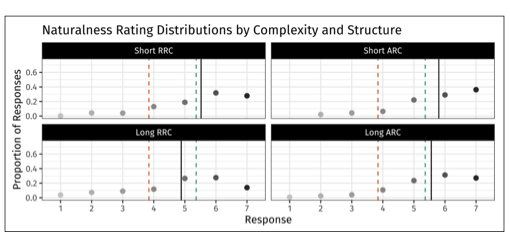
@jkdempc eg "the lady that bought ham"? This is in fact the critical comparison! If you lengthen that (restrictive) relative clause ("the lady that bought ham which was cured in Spain"), you see standard naturalness penalties, but the same length in an appositive has a weaker effect.
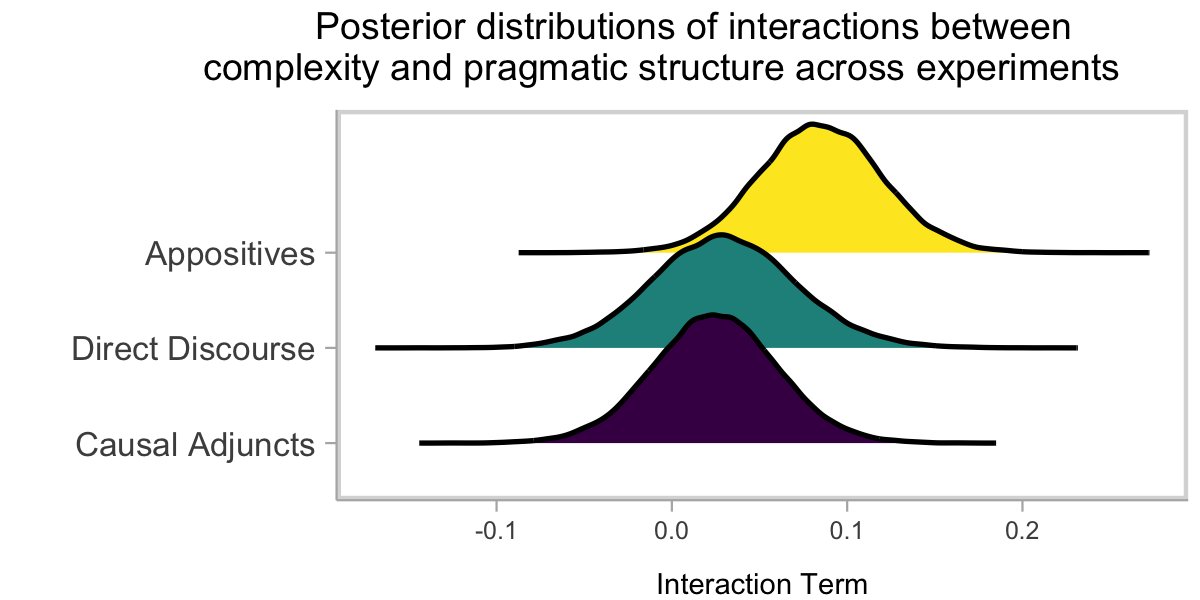
Article out in @glossapsycholx today! https://t.co/Z4DDSrA2vO We present five studies on a curious finding due to @linguistbrian & colleagues: comprehension/judgment processes care less than normal about appositive structures (like the latter part of "the lady, who bought ham").
With this new evidence, we're somewhat skeptical of tying discounting to pragmatic packaging. At the end of the article we review a promising alternative approach using *prosodic* packaging. There's many open questions there, but we hope future work might head in that direction!
We replicated this 'discounting' for appositives, but were surprised to find evidence against it in both other cases. It seems like if the pragmatic packaging approach is correct, the relevant pragmatic unit must one that appositives comprise, but these other structures do not.
Interested in making a similar game yourself? You can access a template for the game, and follow a step-by-step guide to making your own version, on Github, here: https://t.co/LnttyUVkRJ 🎶
@nidodelenguas recently made an online version of our "Game of Tones", a simple sorting game to introduce players to lexical tone in the indigenous languages of Oaxaca. Play here! https://t.co/t1uxxkQaZL + Stop by our organized session tomorrow @ #ssila2023 to learn more.
In the session tomorrow (11:30 MST), language experts and linguists at UCSB and UCSC will talk about our experiences putting community-based approaches into the "field methods" curriculum, including demos about specific projects like the Game of Tones. https://t.co/aRyyKAMfsp
@LinguistDan If you haven't already consulted it, there's lots of good guidance in the draft Nicenboim et al. book on bayes_factor()! Here's the relevant chapter: https://t.co/gDIIpDqvHB 15.5.1 might be particularly helpful.
@ctdicanio Neat! You might be interested in work on reported speech as iconic "demonstration", to some extent separate from assertion/interrogation etc. Clark & Gerrig (1990) lay out the idea, and then Davidson (2015) expands on it in a great paper in Ling & Phil.
And do check out the other excellent papers in the volume! @VArvindam and Hedding on exceptions to partially-overlapping reference constraints, @DanBrodkin on the arg structure of perception verbs in Mandar, and Meadows with new data on agrmnt attraction from reduced relatives.
Volume 5 of Syntax & Semantics at Santa Cruz is out, and with it, this working paper on demonstratives and redundancy constraints on restrictive modification in Santiago Laxopa Zapotec (dille' xhunh Laxup). (https://t.co/MyCDyV9N1y)
There are also nominal appositive modifiers in the language, and they're free from that constraint, as you'd predict. But we also notice that they can still perform pseudo-restrictive functions, just like English 'one'-appositives. A puzzle for the future!