In terms of the deficits and national debt, I think it's fair to say there are no breaks, but that is not true generally
Trump is making things much worse and more dangerous unnecessarily
There are infact obvious material differences based on his policy decisions with the Biden admin
@Spiveyziev@m4h007 It's easy to fact check: https://t.co/uqPEikTRUJ
Don't you remember the blow up in the white house where JD told Zelenskyy he didn't even say thank you and Trump said he didn't have any cards?
BREAKING: Iran has again struck U.S. bases in Kuwait and the UAE with multiple missiles and drones - the Trump adminstration has not even responded to this wave or the previous one, per Iranian state media.
The attacks targeted U.S. communications, weapons depots, aircraft hangars, troop positions and radar systems, in the 31st phase of Iran’s Operation Saeqeh.
The U.S. has now absorbed two consecutive waves without responding.
The events of the past several days sharpen the picture in the Strait of Hormuz, and expose a fundamental mismatch between the U.S. and Iranian approaches to the current confrontation.
1. Washington is trying to contain the conflict.
The administration clearly wants to avoid sustained kinetic escalation and, as much as possible, keep the confrontation in the economic domain: moving tankers through the Strait while expanding sanctions and financial pressure on Iran. The relatively restrained U.S. response to repeated Iranian attacks reflects a broader desire to avoid being dragged back into a prolonged military campaign that could quickly escalate.
2. Tehran is pursuing almost the opposite strategy.
Iran has no intention of accepting the current status quo in Hormuz. It will continue trying to disrupt tanker traffic and challenge the U.S. effort to establish a new reality in the Strait. Iran’s broad and largely predictable, response to the latest U.S. strike, followed by another deliberate attack againt Kuwait that was not itself triggered by immediate U.S. military action, underscores an important point: Tehran is not simply reacting. It is trying to change the status quo through military initiative.
This reflects the broader doctrinal shift inside Iran from a primarily defensive posture toward a more offensive, proactive approach.
3. But both sides are still observing important guardrails.
Neither Washington nor Tehran appears interested in completely breaking the rules of the game. So far, both have largely concentrated their attacks on military rather than civilian or energy targets. And despite threats from senior Iranian officials, Tehran has not resumed attacks against Saudi Arabia or the UAE.
That restraint matters. It suggests that both sides understand the risks of uncontrolled escalation, even as they continue climbing the escalation ladder.
4. The problem is that this equilibrium is unlikely to hold.
The Trump administration may prefer to turn this into an economic confrontation. Tehran is unlikely to allow it.
For Iran, the current “no war, no peace” environment is increasingly unattractive. A limited military confrontation may actually serve the regime better politically than sanctions alone: external conflict makes it easier to rally the population around the flag and frame Iran’s economic hardship as the consequence of a national struggle rather than regime failure.
That means Washington should not assume that economic pressure can remain economically contained.
Iran is likely to continue taking offensive action in and around the Strait and potentially surprising U.S. forces, to demonstrate to President Trump that maintaining a maritime siege on Iran carries a military price.
The central contradiction is therefore becoming clearer: Washington wants to manage the confrontation. Tehran wants to change its terms.
As long as that gap remains unresolved, further escalation is not an aberration. It is increasingly built into the structure of the conflict.
#iran
Having thought a little bit more about this, in my opinion, the fundamental question to ask is: what is the one thing that Iran has consistently executed, in an incremental manner, that has been universally acknowledged as being successful?
The answer to that is what @ripplebrain has called “debasification”, and has written about (in his substack).
This, in my opinion, is the key to understanding Iran’s plan: to remove the US forces from the region, in such a way that it cannot project power anymore. After that, Iran can exert any influence on the Persian Gulf, the Strait of Hormuz, and the GCC Arab states.
That means, the closing of the Strait of Hormuz has only one reason: to force the US to respond, which will allow Iran to respond by destroying US bases and pushing US forces farther back. Just look at the events, and it fits. If the US doesn’t respond, Iran has already won. The oil blockade is just a method to force Trump’s hand. Strait of Hormuz isn’t the objective. It’s only a forcing mechanism.
Another study confirms the mechanism:
Elon Musk stole the 2024 election—using targeted algorithms.
The experiment was conducted in 2023, when Musk was still early in his Twitter Nazification project.
“Switching from a chronological to an algorithmic feed increased engagement and shifted political opinion towards more conservative positions, particularly regarding policy priorities, perceptions of criminal investigations into Donald Trump and views on the war in Ukraine.”
Crucially, the effect did not disappear when the user switched back, because they had already followed new accounts which reinforced their beliefs.
No mainstream media covered this study when it was published in February.
It’s unconscionable that we still neglect the single most important ingredient of our national chaos—psychological warfare, both foreign and domestic.
Trump…
How it Started:
“The US is going to make so much money, we may even eliminate Federal Income Tax”
How it’s Going:
“You take too many vacation days. Work more!”
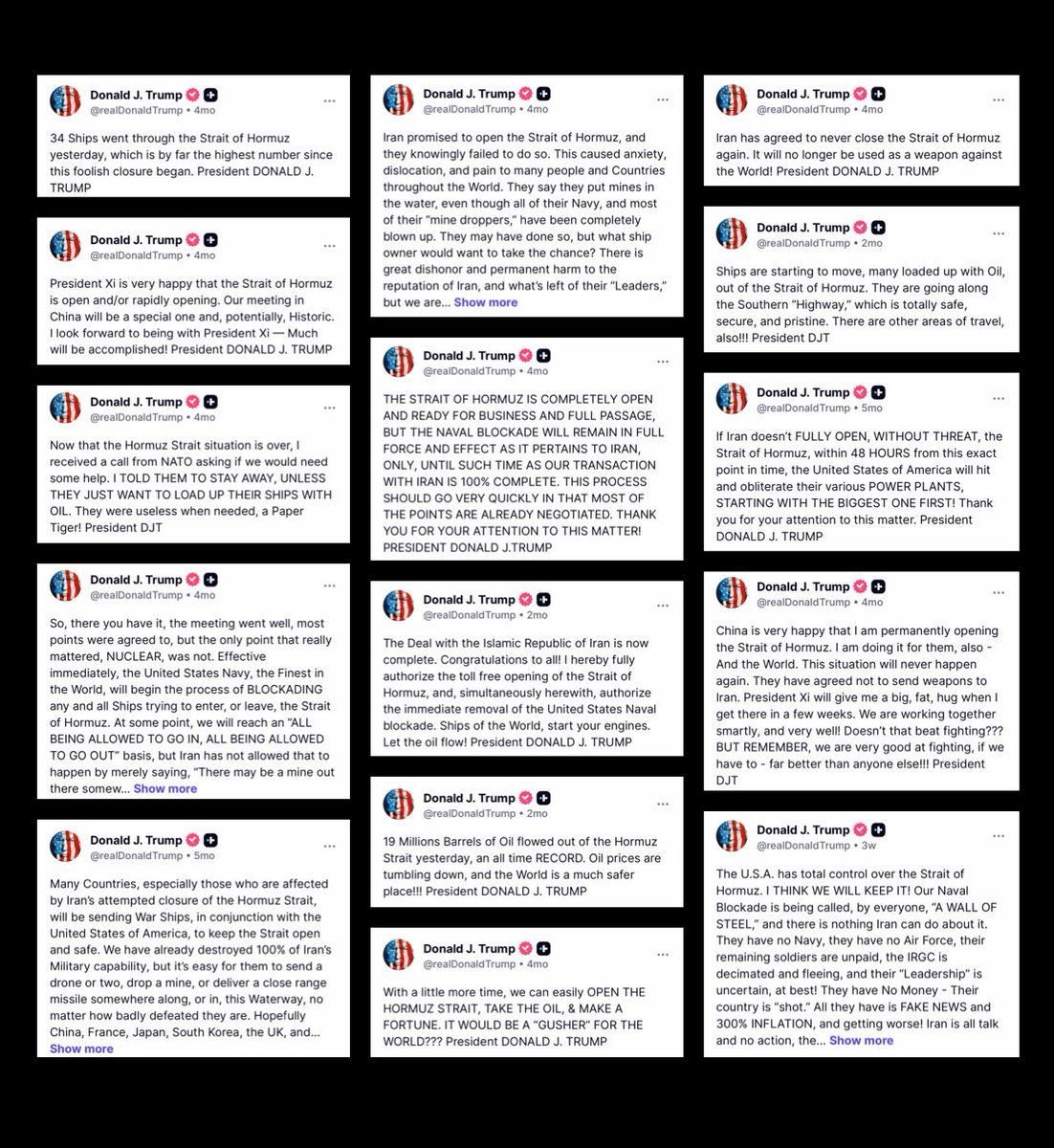
6 months worth of rambling about the Strait of Hormuz. Closed, open, closed, open, closed, open, closed, open.
As a 3 time Trump voter… He is not stable or competent anymore.
This is embarrassing.
Hegseth has fired or blocked the promotions of more than 80 generals -- that's 10 percent of the military’s top brass and shows no signs of slowing.
https://t.co/DFzsYmk1xm
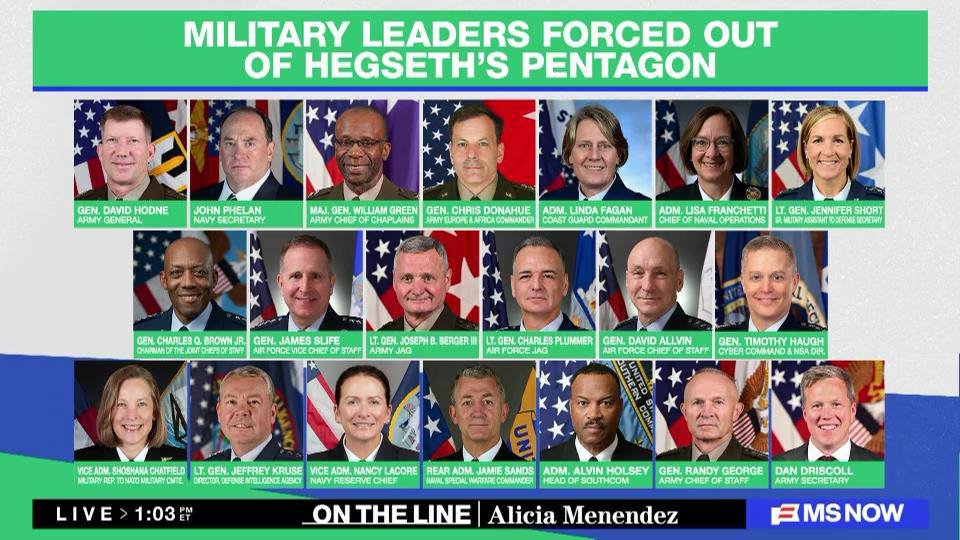
🚨🇺🇸 Twenty-one military leaders have been forced out of Hegseth's Pentagon, and the list reads like a chain of command
MS NOW's count includes the chairman of the Joint Chiefs, the Chief of Naval Operations, the Air Force chief of staff, the directors of the NSA and the DIA, the SOUTHCOM commander, the Coast Guard commandant, the Army chief of staff, and now the Army and Navy secretaries.
The Atlantic reports Trump was surprised when Driscoll told him how many had gone, and Driscoll resigned days later.
Rep. Mike Rogers says he is tired of the churn.
Seven months into a war that has consumed 1,700 Patriot interceptors and left European stocks beyond critical, the officers who would plan the next fight keep leaving the building as the plans are being devised.
Source: MS NOW / Writer: Daniel
Good luck getting rate cuts with trade war, $2 T deficits, and $40 T debt. Global yields are surging, which will also pressure US bond yields.
Too much debt and there is no quick fix. Growing out of the debt is not realistic when the debt is growing 4x faster than GDP.
Hopefully Iran and US reach settlement but I think anyone being objective would have to say it's a clusterfuck right now.
It's not clear how long it will take oil prices to normalize after settlement either.
AI and robots to the rescue of the economy?
New reporting indicates that the United States is now seeking to OFFENSIVELY target Iranian vessels in the Strait of Hormuz, regardless of whether or not they attempt to break through the US blockade line.
This strategy, dubbed a "tanker for tanker" policy, seeks to damage one Iranian tanker every time Iran hits a tanker crossing the Strait of Hormuz.
Here is the primary problem I see with this. We already HAVE a blockade. These vessels aren't GOING anywhere. As a result, this doesn't "add" to the pain Iran is feeling in their economy, it just adds to the final bill that Iran will hand Washington in the event that they achieve victory in this war.
What it DOES risk however, is Iran immediately then seeking to further escalate this conflict as more and more of their vessels are destroyed. It gives them a REASON to escalate, without making a difference in the economic warfare campaign the United States is attempted (sometimes) to wage.
All risk, no reward.