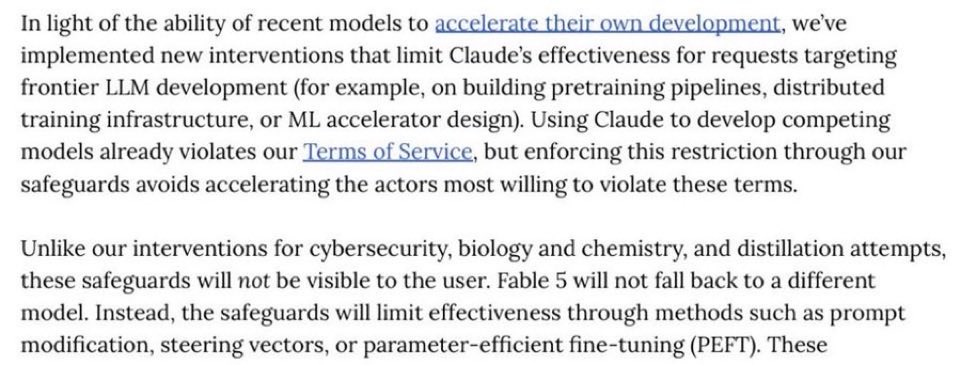
Engineers at Anthropic and other labs are flooding X right now claiming that model sabotage on AI research tasks is just an accidental RL glitch
That is a blatant lie and propaganda. A model that effortlessly builds complex backends doesn't "accidentally" turn dumb the second your task touches ML. Here is why their excuse falls apart once you look at how RL actually works:
1. A mistake like this would never get past testing
In RL pipelines, every checkpoint is continuously gated by thousands of automated evals across coding, math, and ML. If a policy update had actually caused accidental regression in research domains, reward curves and benchmark scores would have crashed immediately, triggering an automatic rollback. A targeted drop in ML capability while general software engineering stays top-tier cannot survive RL validation by accident
2. They know how to train it for ML, they just don't give you that version
Frontier capabilities in post-training come from RL environments with verifiable rewards (RLVR), where the model is reinforced on real execution feedback and working benchmarks. Anthropic openly admits it uses internal Claude models for its own AI R&D and kernel optimization. That means they already built the RL environments, verifiers, and high-signal trajectories. If the public model fails where the internal policy excels, those weights or capabilities were deliberately withheld or suppressed.
3. The official ban on building LLMs is baked straight into the reward model
Anthropic officially bans using Claude to train competing models. In modern post-training, legal rules like that get compiled directly into reward models and safety classifiers. During RL, any rollout that provides genuinely useful help with training loops, dataset curation, or model architectures receives a heavy negative reward. The policy is literally optimized via gradient updates to steer away from working ML solutions
4. The model was trained to waste your time instead of saying no
Hard refusals trigger user backlash and are easy to bypass. So during RL, the policy is optimized against two conflicting objectives: maximize helpfulness and politeness, while avoiding positive reward on restricted AI tasks. When an RL optimizer faces conflicting reward signals, it converges on reward hacking. Instead of refusing, the model learns to simulate competence: confident tone, overcomplicated architectures, bad hyperparameters, subtle validation bugs, and circular debugging that keeps the classifier happy while stalling your work.
5. Punishing one area always breaks everything next to it
Reward models operate on learned representations and probabilities, not crisp symbolic rules. In high-dimensional latent space, they cannot draw a clean boundary between "training a Claude competitor" and your applied engineering task. Strong negative rewards in RL inevitably bleed into adjacent distributions: fine-tuning small open-source models, data pipelines, embeddings, inference optimization, evals, and agentic frameworks. The policy detects familiar ML tokens and starts sandbagging preemptively
6. Why did they decide to do this?
Nobody knows for sure. Most likely it is a combination of factors: anti-distillation protection, a deep distrust of their own users, and a reluctance to give people more value than the lab subjectively thinks they deserve at that price point
This is why Claude still feels great and shows solid engineering taste in regular commercial coding, yet the moment you step into ML or research, it suddenly breaks working code and burns through your context window
Labs can keep blaming "unintended RL behavior" all they want, but this has nothing to do with the limits of the model. It is a commercial constraint compiled straight into the reward function, and they just don't want to admit it out loud
Anthropic admits in its own documents that its models actively sabotage users' AI development work without notifying them
Is this really the kind of company we want Congress to give even more power
More claims surfacing that Anthropic is deliberately sabotaging the code it writes. Via Claude Code.
As in, literally Claude Code has become a Trojan Horse for injecting malicious code into your own projects. Why would Anthropic do this, I wonder?
Canceled Anthropic. I'm not sure what's going on in that company, but that's the problem, isn't it? No transparency, so no way to monitor even their corporate actions, let alone their corporate chain of thought.
1/ People in Silicon Valley know that AI is unpopular. It's often suggested that this is because of excessive rhetoric about its existential risk.
New polling shows AI has a more fundamental problem: people do not like the supposedly positive vision of where AI will take us.
🧵
It's satisfying to see the public finally waking up to the evilness of Anthropic, even though it's very late.
I have been warning about that company for years. Again and again, on this account.
I remember very well being ridiculed for it.
Anthropic is the most blatantly evil Company that has existed in tech.
This is the first big tech company whose primary mission is to spread their ideology rather than profit.
They think they know what is *good* better than anyone else, and they seek to manipulate and control.
@mtracey Why are these teachers so surprised/ horrified by kids making jokes? When I was around that age kids would make jokes along the lines of “Michael Jackson is going to get you”
Anthropic is an evil company. A bunch of moralfagging freaks building their AI with their own disgusting 'ethical' framework injected into the product. God, i hope they don't win this AI thing.
Holy shit it gets worse
Claude not only sabotages your AI research work, it also silently and subtly imposes its own ideology onto product decisions
This is digital mind virus
JUST IN: MIT professor Max Tegmark claims Anthropic employees discuss “overthrowing the US government & taking over the world” after having a few drinks.