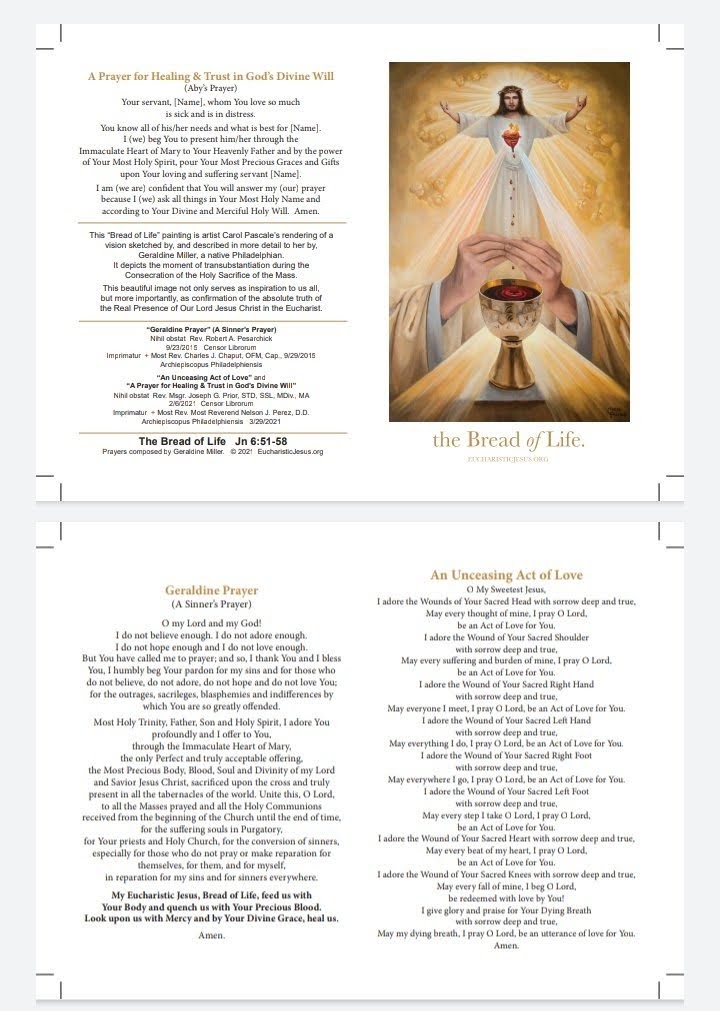
“Bread of Life Image” is an artist rendering of a vision sketched by, and described to the artist by Geraldine Miller. Follows & RTs are not endorsements
"...Pray for me and beseech our heavenly Father to permit me to be an instrument to save my country and advance a just cause."
- Mead to his wife this night
#Gettysburg
A Colorado teacher REFUSED to allow a 13-year-old student to present her Pro-Life poem for the class because it’s "offensive."
MILLIONS have now listened to her poem and her story.
If you haven't heard it yet, @StudentsforLife made an amazing video of her reading it!
Give it a watch and a share! 👇
Unfortunate that the. SSPX has chosen schism. It is, of course, condemnable.
However, just as in the days of Luther, there are legitimate grievances that should not be ignored.
The Church has been lax on discipline, allowing pride masses, even at the Varican.
Too much of the Church's "dialogues" borders of indifferentism, minimizing the primary of Christ.
I hope these issues are addressed.
BREAKING: Rep Andy Ogles just introduced the Anchors Away Act which bans certain pregnant women who are seeking to give birth here, from entering the U.S.
A PRAYER TO OUR LADY OF LOURDES
Our Lady of Lourdes,
Immaculate Conception,
Mother who appeared in silence and light,
teach us to pray without pride,
to suffer without despair,
and to believe without conditions.
Lead us to your Son, Jesus Christ,
who alone heals what is broken in us.
Obtain for the sick relief,
for the suffering strength,
for sinners conversion,
and for the world the courage to return to God.
Our Lady of Lourdes,
pray for us.
Amen. 🙏
OUR LADY OF LOURDES: WHEN HEAVEN SPOKE IN A HIDDEN GROTTO
There are moments in history that do not feel like history.
They feel like Heaven interrupting time.
Lourdes is one of them.
A quiet grotto in southern France. A sickly, poor, illiterate girl. A forgotten corner of the world.
And then silence breaks.
Not with thunder.
But with a Lady in white.
THE GIRL THE WORLD WOULD HAVE IGNORED
Bernadette Soubirous was not important by human standards.
She was poor. Frequently ill. Uneducated. Misunderstood even in her own town.
If the world were choosing a messenger for Heaven, it would not have chosen her.
But God does not look at rank.
He looks at the soul.
FEBRUARY 11, 1858 - THE FIRST ENCOUNTER
Bernadette went to gather firewood by the grotto.
Cold air. Damp stone. Ordinary struggle of survival.
Then she hears it.
A sound like wind… though nothing is moving.
She looks up.
A light.
And within it a Woman.
Dressed in white. A blue sash. Roses at Her feet. A Rosary in Her hands.
Bernadette freezes.
Her body trembles.
And then something happens that defines Lourdes forever:
The Lady makes the Sign of the Cross first.
Only then does Bernadette follow.
Heaven teaches prayer before speaking words.
THE ROSARY: HEAVEN’S FIRST LESSON
The Lady does not begin with secrets.
She begins with prayer.
Together, they pray the Rosary.
In that moment, Heaven and earth are united not by argument or spectacle but by repetition, humility, and love.
The Rosary becomes the language of Lourdes.
“I AM THE IMMACULATE CONCEPTION”
Days pass. Crowds gather. Authorities question. Confusion rises.
Bernadette is questioned like a suspect, not a messenger.
And yet she returns again and again to the grotto.
On March 25, 1858, she asks the Lady Her name.
The answer is unexpected.
Not poetic.
Not symbolic.
Doctrinal.
“I am the Immaculate Conception.”
Bernadette does not understand the words.
She repeats them exactly as she heard them.
But the Church understands.
Four years earlier, Pope Pius IX had defined this dogma.
Lourdes becomes Heaven’s confirmation of what the Church already declared.
THE GROUND THAT BEGAN TO BLEED WATER
The Lady gives a strange instruction:
“Go, drink at the spring… and wash yourself.”
But there is no spring.
Only dirt.
Bernadette digs.
Mud.
More mud.
People laugh.
Then suddenly
water.
Clear. Flowing. Alive.
It does not stop.
It still flows today.
And from that spring, millions come.
Some seeking healing of the body.
All encountering something deeper.
Healing of the soul.
THE REAL MIRACLE OF LOURDES
The Church is careful.
Not every claim is accepted.
Not every story is declared supernatural.
But Lourdes remains undeniable in one way:
Hearts change there.
Confessionals are full.
Atheists kneel.
The broken begin to pray again.
The proud learn silence.
The suffering learn meaning.
Even when the body is not healed, something deeper often is restored.
Hope.
THE MESSAGE THAT NEVER CHANGES
Our Lady does not complicate the Gospel.
She repeats it with maternal urgency:
Pray.
Do penance.
Convert your heart.
Love God.
Return to Christ.
Pray the Rosary.
It is not new.
It is eternal truth spoken gently.
WHY LOURDES STILL SHAKES THE MODERN WORLD
We live in a world that worships control.
Science without humility.
Comfort without sacrifice.
Speed without reflection.
Lourdes interrupts all of it.
It says:
You are not self-sufficient.
You are not healed by noise.
You are healed by grace.
THE DEEPEST HEALING
Many arrive at Lourdes asking:
“Can I be cured?”
But Heaven often asks a different question:
“Can you be converted?”
Because a healed body will still return to dust.
But a converted soul enters eternity.
The Lord warns us against the temptation to embrace hatred with our hearts and the temptation to enter into conflicts with one another. The Lord reminds us that very soon everything surrounding us will pass away and we will find ourselves standing before the throne of God's judgement and all we will possess is what we have stored up in our hearts.
The Church dedicates the month of July to the Precious Blood of Jesus Christ, a devotion that invites the faithful to reflect on the profound mystery of Christ’s sacrifice. This devotion centers on the Blood Jesus shed during His Passion and Crucifixion, revered as the price of humanity’s redemption.
The shedding of the Precious Blood is a manifestation of God’s boundless love, the forgiveness of sins, and the life-giving grace offered through the Holy Eucharist. For Catholics, July becomes a time to deepen their spiritual connection to this sacred mystery through prayer, penance, and adoration.
The origins of this devotion trace back to early Christianity, with a significant revival in the 19th century when Pope Pius IX extended the Feast of the Precious Blood to the universal Church in 1849, initially celebrated on the first Sunday of July. Although the modern liturgical calendar after Vatican II integrated elements of this feast into Corpus Christi or suppressed it in some places, the month-long dedication persists in popular piety. The devotion underscores the belief that Christ’s Blood, shed on the cross, objectively cleanses humanity of sin and restores communion with God.
The devotion to the Precious Blood of Jesus Christ in July, however, is more than a tradition; it is a call to live in gratitude for Christ’s sacrifice. By meditating on the Blood poured out for humanity, Catholics are inspired to offer their own lives in reparation for sin, and the pursuit of holiness. This month-long focus strengthens faith, drawing believers closer to the heart of the Gospel—the selfless, sacrificing love of Jesus Christ, Whose Blood continues to bring life to the world.
Gestures of Worship: Relearning Our Ritual Language
“When our daughter Alexandra was a toddler, we attended the Methodist church with my parents one Sunday morning. She preceded us down the aisle and genuflected deeply and crossed herself before entering the pew, as she did every Sunday at church eliciting amused smiles from the grownups.
But, of course, it had never occurred to her not to genuflect before entering the pew. It was a habit she learned early, even if she did not understand the reason for her gesture.
This tiny child did not and could not understand fully the symbolism of what she did, of course, but her desire to express reverence as they had seen others do was beyond question.”
—————————————
From Helen Hull Hitchcock, “Gestures of Worship: Relearning Our Ritual Language”
One of the mistakes in implementing the liturgical changes following the Second Vatican Council was downplaying, often eliminating, traditional gestures of Catholic ritual – physical actions that express our faith.
Vatican II - a New Meaning to “Ritual Cleansing”
Exactly why this happened is not easy to explain, but one reason was a kind of super-rational approach to worship that prevailed in the years following the Council.
Some thought that such ritual gestures as kneeling, genuflecting, bowing, making the sign of the cross, and striking the breast were mindless habits without real meaning, empty gestures possibly tainted with superstition.
Some liturgists viewed the bodily actions that had traditionally accompanied Catholic worship as examples of the “vain repetition” that Protestants criticized (another example is the Rosary, with its repeated prayers), so eliminating the “meaningless” bodily actions of Catholic worship was considered a nod toward ecumenism.
A misguided view of “updating” Catholic worship also led to the elimination of these distinctive symbolic actions, which were no longer seen as an integration of body and soul in authentic worship. Lost in all this was the idea that these bodily actions express both a personal and communal response to the Mystery of Faith and to the sacramental world the Liturgy represents – and that these actions are a means of uniting all believers with the sacramental life of the Church.
Instead, they were thought to be prompted only by subjective piety and an overly sentimental sense of devotion. Many liturgists had come to regard these ritual gestures as liturgical debris accumulated over the centuries – debris that obscured the pure form of Christian worship and that needed to be removed. The result gives a new meaning to “ritual cleansing”.
A Silent Liturgical Language
Only a few ritual gestures by the people remain in general practice today. Among these few are making the sign of the cross with holy water when entering or leaving the church, genuflecting before entering or leaving the pew, and kneeling briefly in prayer before Mass begins … but, even these gestures are often omitted or performed carelessly.
Even rarer are other gestures of the people that were explicitly included in the revised liturgical books: striking the breast during the Confiteor (at “through my fault”), bowing or genuflecting during the Creed at the Incarnatus (“and was made man”) and making a gesture of reverence (often the sign of the cross) before receiving Communion while standing.
Even the gesture of reverence before receiving Communion, though this is specifically mentioned in the General Instruction of the Roman Missal, is by no means universally observed – not even after the emphasis the US bishops gave this in 2002, by deciding that “a simple bow of the head” fulfills this requirement.
The origin of most of these symbolic gestures that are integral to Catholic worship – a wordless liturgical language – is, in many cases, lost in history.
A Basic Vocabulary
A basic vocabulary of essential gestures would include genuflecting toward the altar and tabernacle, bowing the head at the name of Jesus and when the names of the Trinity are pronounced (the Doxology, or “Glory be…”), along with bowing toward the crucifix, striking the breast and making the sign of the cross. They do have meaning and significance as powerful signs of worship even if the way this happens is only dimly understood.
The vocabulary of ritual gestures Catholics make during worship is by now, quite clearly, endangered – as has happened with other unwritten languages. As there are relatively few explicit rules (and even these are often not followed), little uniformity of practice, and considerable confusion, it seems worthwhile to compile a sort of “dictionary” of ritual gestures, their meaning and grammar, in order to relearn our historic language of ritual worship.
Start With The Sign of the Cross
One of the principal gestures of Christian worship is the sign of the cross – tracing the cross on our body by touching our head, abdomen, left and right shoulder signifies our salvation through Christ’s sacrifice on the cross, a reminder of our baptism, and of our commitment to Christ.
It is also a sign of our worship of the triune God, Father, Son and Holy Spirit... For this reason, we make the sign of the cross whenever the sacred name of God (Father, Son, and Holy Spirit) is invoked, either in acclamation or blessing or absolution.
We make the sign of the cross following the confession of sins, because the absolution is made in the name of the Trinity and because it is the cross of Christ that makes possible our forgiveness.
Making the sign of the cross before and after we receive Communion signifies that in the sacrament of the Eucharist, we recognize Christ crucified, risen, and present with us.
We make the sign of the cross at the blessing at the very end of the liturgy because the blessing is made in the name of God, Father, Son, and Holy Spirit.
We make the sign of the cross before we pray to collect and compose ourselves and to fix our minds and hearts and wills upon God.
We make it when we finish praying in order that we may hold fast the gift we have received from God.
In temptations we sign ourselves to be strengthened; in dangers, to be protected. The cross is signed upon us in blessings in order that the fullness of God’s life may flow into the soul and fructify and sanctify us wholly.
Think of these things when you make the sign of the cross. It is the holiest of all signs. Make a large cross, taking time, thinking what you do. Let it take in your whole being – body, soul, mind, will, thoughts, feelings, your doing and not-doing – and by signing it with the cross strengthen and consecrate the whole in the strength of Christ, in the name of the triune God.
Article Continues online ...
Gestures of Worship: Relearning Our Ritual Language
Full article continues at 👇👇👇
https://t.co/ZebDBQTI4N
@CatholicSOTC@Catholic_State Phew!
We need a complete overhaul of the Catholic Hierarchy!
Talk about Evil!!!
When a Catholic Archbishop prevents the Rosary to be prayed because he is afraid of offending a Pride Parade which is a Parade Celebrating Sodomy the Catholic Church is in serious trouble!
So what some people are missing here with the Archbishop Casey situation is the REAL STORY. The real story is NOT him kicking us off the steps of the cathedral. He's within his ecclesiastical and legal rights to do so. The REAL STORY is that he is showing indifference to the sin parade at his doorstep and choosing to distance himself from us, his faithful Catholic flock, instead of taking his rightful place and demanding to LEAD US next time. I sent this email to his communications director, and what did I get back as the response??? Silence. Silence is an answer that says a lot, actually.
IRELAND
The former Convent of Mercy in Stream Street in Downpatrick was engulfed by a HUGE blaze yesterday
Firefighters believe that it was a DELIBERATE ATTACK
Downpatrick is the burial site of SAINT PATRICK